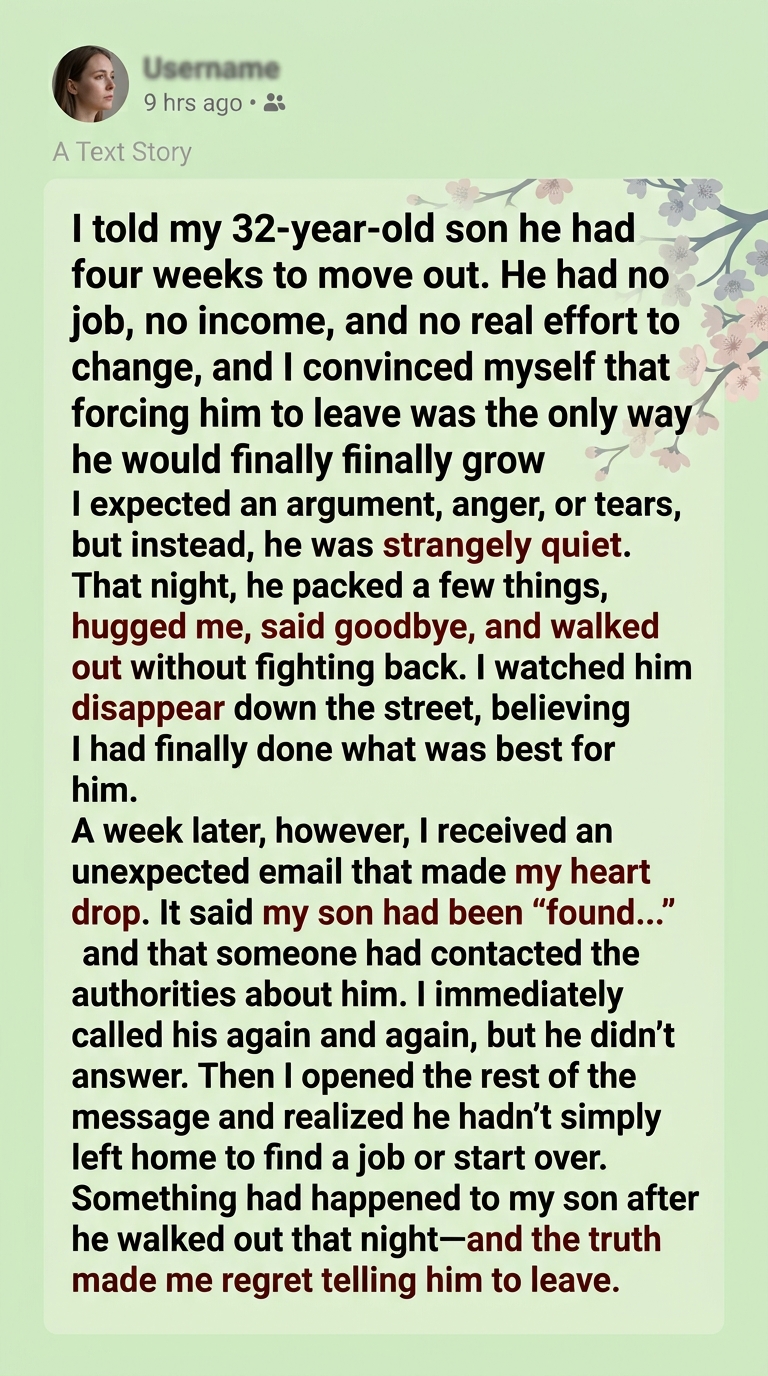
I told my thirty-two-year-old son he had four weeks to move out.
He had no job.
No steady income.
And, from what I could see, no real plan to change.
For years, I’d tried everything.
I helped him update his résumé.
I sent him job listings.
I encouraged him to take temporary work.
I even offered to drive him to interviews.
Nothing lasted.
He’d promise me things would be different.
Then another week would pass.
And another.
He would sleep until noon, spend the afternoon on his computer, and tell me he was “figuring things out.”
I was tired.
Not just financially.
Emotionally.
I had started feeling like I was enabling him instead of helping him.
One evening, I finally sat him down.
“You’re thirty-two.”
He looked at me.
“I know.”
“You can’t keep living like this.”
“I know.”
“I need you to move out.”
He stared at the floor.
I expected an argument.
I expected anger.
Maybe tears.
Instead, he simply nodded.
“How long?”
“Four weeks.”
“Okay.”
That was it.
No fight.
No accusations.
No pleading.
That night, he quietly packed a few things into an old duffel bag.
I watched him from the hallway.
He hugged me.
“Thanks for everything, Mom.”
I hugged him back.
“You’ll figure it out.”
He smiled faintly.
“I hope so.”
Then he walked out.
I stood at the window and watched him disappear down the street.
Part of me felt guilty.
But another part felt relieved.
I told myself I’d finally done the hard thing a parent sometimes has to do.
I thought maybe losing the safety net would force him to grow up.
A week passed.
I didn’t hear from him.
I assumed he was angry.
Then, one Tuesday morning, I received an email.
The subject line was:
URGENT — FOUND PERSON
My stomach dropped.
I opened it.
The message said someone had found my son and contacted the authorities.
I read it twice.
Then again.
My hands started shaking.
I immediately called his phone.
No answer.
Again.
Nothing.
Again.
Straight to voicemail.
I called every number I could think of.
Nothing.
Then I opened the rest of the email.
And that’s when I realized this wasn’t about my son finding a job.
It wasn’t about him starting over.
Something had happened after he left my house.
The email explained that he had been found unconscious near an abandoned bus station nearly fifty miles away.
A stranger had discovered him early that morning.
He had no identification.
No wallet.
No phone.
And no way to explain how he’d gotten there.
I couldn’t breathe.
I drove to the hospital.
When I arrived, a police officer met me in the lobby.
“Are you his mother?”
“Yes.”
He nodded.
“He’s alive.”
I nearly collapsed.
“But he’s confused.”
“What happened?”
“We’re still trying to determine that.”
He explained that my son had been unconscious for several hours.
When he woke up, he couldn’t remember everything that had happened after leaving home.
He remembered walking.
Then getting on a bus.
Then almost nothing.
I walked into his room.
He looked smaller than I remembered.
There was a bandage above his eyebrow.
His lips were dry.
When he saw me, he started crying.
“Mom.”
I rushed to him.
“I’m here.”
“I didn’t know where I was.”
“I know.”
“I tried to call you.”
“You didn’t have your phone.”
He closed his eyes.
“I lost it.”
I held his hand.
“Tell me what happened.”
He took a shaky breath.
After he left our house, he had spent the first night walking around town.
He didn’t want to call me.
He didn’t want to admit he had nowhere to go.
The next morning, he found temporary work loading trucks.
He slept in a cheap motel.
Then his money ran out.
He tried sleeping at a bus station.
That’s where things became unclear.
Someone had approached him.
A man offering work.
A place to stay.
My son had followed him.
He didn’t remember much afterward.
The police were investigating.
I felt sick.
Not because he had made bad choices.
Because I had convinced myself he was simply lazy.
I had never asked why he couldn’t seem to move forward.
I had assumed the answer was that he didn’t want to.
But sitting beside his hospital bed, I finally saw what I had missed.
He wasn’t refusing to grow up.
He was struggling.
And I had mistaken struggle for laziness.
The doctors eventually told me my son was physically okay.
But emotionally, he was shaken.
I stayed beside him for three days.
On the third evening, he finally asked,
“Are you still angry?”
I looked at him.
“No.”
“You wanted me out.”
“I know.”
“I thought you hated me.”
My heart broke.
“I never hated you.”
“You made me feel like you did.”
I looked down.
“I thought forcing you out would make you stronger.”
He was quiet.
“Did it?”
I shook my head.
“No.”
He smiled sadly.
“It almost killed me.”
Those words stayed with me.
After he was discharged, I brought him home.
Not because I wanted to return to the way things had been.
Because I wanted to help him build something better.
We sat at the kitchen table.
I told him,
“You’re not moving back in so you can do nothing.”
He nodded.
“I know.”
“But you’re also not going to be punished for struggling.”
He looked at me.
“What does that mean?”
“It means we’re going to figure this out together.”
For the first time in months, he smiled.
We started small.
He got a part-time job.
Then a full-time position.
He began seeing a counselor.
He learned how to manage money.
And, slowly, he rebuilt his confidence.
A year later, he moved into his own apartment.
This time, I wasn’t forcing him out.
He was ready.
The night before he moved, we sat on the porch.
He looked at me.
“You know what I remember most about that night?”
I knew exactly which night he meant.
“When you told me I had four weeks.”
“Yes.”
“I thought you were giving up on me.”
I swallowed.
“I almost gave up on myself.”
He looked at me.
“But you didn’t.”
“No.”
“Why?”
He smiled.
“Because you came to the hospital.”
I shook my head.
“Of course I did.”
He looked down.
“You didn’t have to.”
“Yes, I did.”
He smiled.
“I know.”
Then he hugged me.
And I realized something I’d never understood when I gave him that four-week deadline.
Sometimes people don’t need someone to push them out.
They need someone to stand beside them long enough to help them find their footing.
I still believe my son needed independence.
I still believe he needed responsibility.
But I also learned that there is a difference between giving someone a push and letting them fall.
I thought telling my son to leave would force him to grow up.
Instead, it nearly made me lose him.
And I’ll never forget the lesson that followed:
You can teach someone to stand without making them believe they have to stand alone.