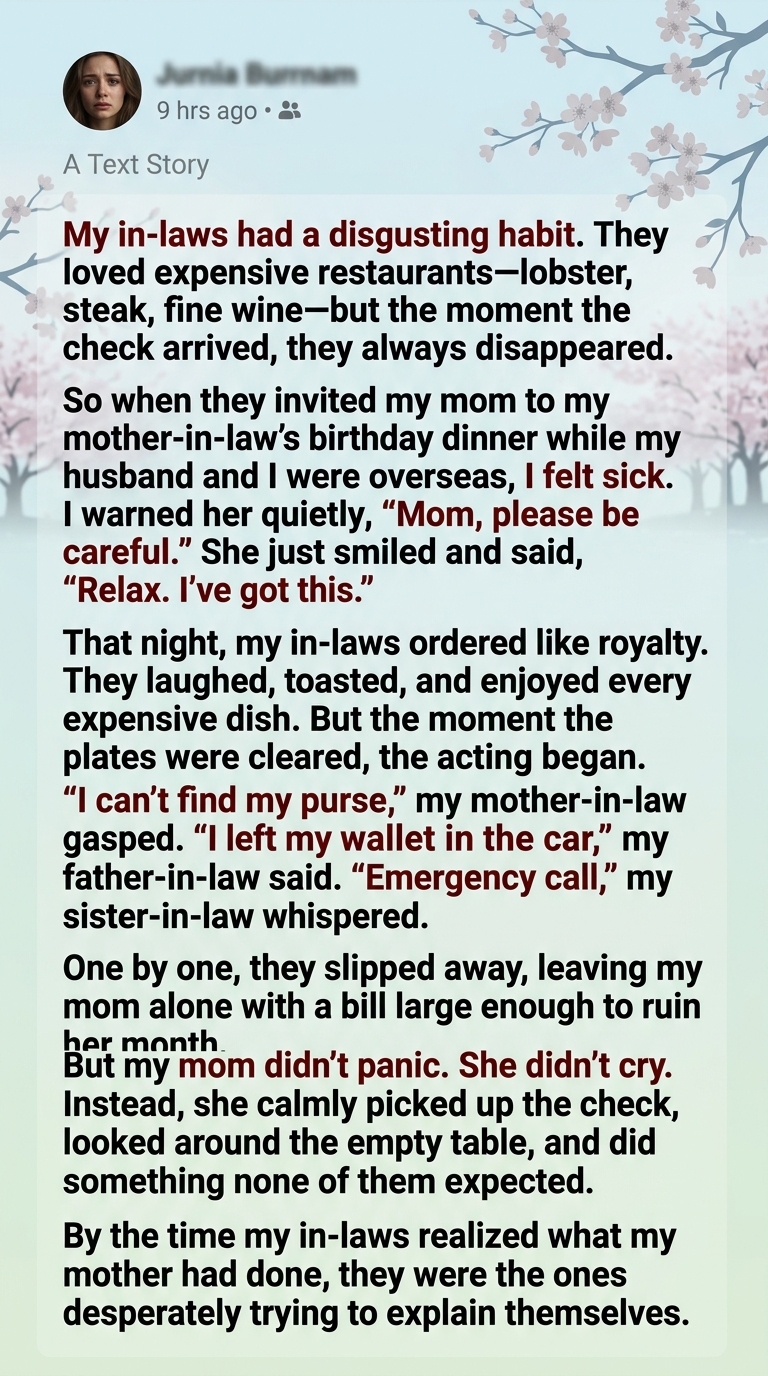
My in-laws had a disgusting habit.
They loved expensive restaurants.
Not nice restaurants.
Expensive ones.
The kind with white tablecloths, crystal glasses, and menus where you had to ask how much something cost because the prices weren’t printed.
They ordered lobster.
Prime steak.
Fine wine.
Desserts nobody actually finished.
And then, somehow, when the check arrived, they always disappeared.
My mother-in-law would suddenly need to make a phone call.
My father-in-law would remember something he’d left in the car.
My sister-in-law would claim she had an emergency.
It was always something.
And somehow, someone else always ended up paying.
Usually my husband and me.
I’d complained about it more times than I could count.
My husband hated confrontation.
“They’re family,” he’d say.
“They’re taking advantage of us.”
“I know.”
“Then say something.”
“I will.”
He never did.
So when we planned a two-week trip overseas, I was relieved to be getting away from all of it.
Then, three days before we left, my mother-in-law called my mom.
She invited her to dinner.
It was supposedly a birthday celebration.
“My whole family will be there,” she told her.
“My son and daughter-in-law won’t be, but we’d love for you to join us.”
When Mom told me, I immediately felt uneasy.
“Mom, please be careful.”
She laughed.
“Careful of what?”
“They have a habit.”
“What habit?”
I explained everything.
She listened quietly.
Then she smiled.
“Relax.”
“Mom.”
“I’ve got this.”
I wasn’t convinced.
But my mother was sixty-eight years old and had spent her entire life dealing with difficult people.
So I let it go.
The night of the dinner, I was thousands of miles away.
I checked my phone repeatedly.
Around eight o’clock, Mom sent me a message.
Dinner is going wonderfully. Don’t worry.
I replied:
Are you sure?
A few minutes later:
Enjoy your vacation.
I put my phone down.
Meanwhile, at the restaurant, my in-laws were having the time of their lives.
According to Mom later, they ordered everything.
Lobster.
Ribeye steaks.
A bottle of wine that cost more than my first car.
Then another.
My mother-in-law raised her glass.
“To family!”
Everyone toasted.
Mom smiled.
She ate her dinner.
She listened.
She watched.
And she waited.
Then the plates were cleared.
The waiter brought the check.
It was enormous.
My mother-in-law looked at it.
Then suddenly gasped.
“Oh my goodness.”
Everyone looked at her.
“I can’t find my purse.”
My mother knew immediately.
She smiled.
“I can help you look.”
“No, no.”
Her mother-in-law stood quickly.
“I must have left it in the car.”
She rushed toward the door.
My father-in-law looked at the check.
“Oh.”
He patted his pockets.
“I left my wallet in the car too.”
Mom nodded.
“Of course.”
Then my sister-in-law’s phone rang.
She glanced at the screen.
“Emergency call.”
She stood.
“I have to take this.”
And walked away.
One by one, they disappeared.
Within five minutes, my mother was sitting alone at a table surrounded by empty wine glasses and expensive plates.
The waiter approached.
“Ma’am, will you be taking care of the check?”
Mom smiled.
“Yes.”
The bill was $1,846.
She didn’t flinch.
She reached into her purse.
But instead of pulling out her wallet, she pulled out her phone.
She took a photograph of the bill.
Then another photograph of the empty table.
Then she asked the waiter for a copy of the itemized receipt.
He looked confused.
“Of course.”
Mom paid.
Every penny.
Then she stood.
Before leaving, she handed the waiter a small envelope.
“Could you please give this to the restaurant manager?”
“What is it?”
“Just something for the record.”
Then she left.
The next morning, my mother-in-law called her.
“Thank you so much for dinner!”
Mom smiled.
“You’re welcome.”
“We had such a wonderful time.”
“I did too.”
There was an awkward pause.
Then my mother-in-law said,
“I felt terrible about my purse.”
“Oh, don’t worry.”
“You know how these things happen.”
“Absolutely.”
Then Mom said,
“I just wanted to let you know that I paid the entire $1,846.”
“Oh, thank you.”
“And I also left the restaurant manager a copy of the receipt.”
Silence.
“What?”
Mom continued calmly.
“I explained that I had been invited to dinner and that everyone else had apparently forgotten their wallets.”
Another silence.
Then my mother-in-law’s voice changed.
“What exactly did you tell them?”
“The truth.”
My mother-in-law hung up.
My mom didn’t think much more about it.
Until that afternoon.
She received a call from the restaurant manager.
He thanked her for bringing the situation to his attention.
Apparently, this wasn’t the first time my in-laws had done it.
Not even close.
The restaurant had records of several similar incidents.
Different guests.
Different excuses.
Same family.
The manager explained that they’d been discussing whether to ban them.
Mom had given them exactly what they needed.
The receipts.
The photographs.
And most importantly, the names of everyone who had been at the table.
But Mom wasn’t finished.
She had one more thing.
The following week, my husband and I returned from our trip.
The first thing I noticed was that my husband looked nervous.
“What’s wrong?”
He sighed.
“My mom is furious.”
“Why?”
“She says your mother humiliated the family.”
I stared at him.
“What did she do?”
He showed me his phone.
There were dozens of messages.
My mother-in-law accused Mom of being disrespectful.
Of embarrassing them.
Of making a private family issue public.
Then my husband showed me another message.
It was from his sister.
Mom got banned from the restaurant.
I started laughing.
My husband looked at me.
“Don’t laugh.”
“I can’t help it.”
Then he told me what had happened.
After the restaurant manager contacted the family, my in-laws had been asked to explain themselves.
They couldn’t.
Because the restaurant had security footage.
The footage showed them leaving one by one.
The manager also had records of previous dinners where similar things had happened.
My mother-in-law finally admitted they had done it before.
But she insisted it was “just a family tradition.”
My husband looked horrified.
“A tradition?”
I shook my head.
“That wasn’t a tradition.”
“No.”
“It was theft.”
He nodded.
“I know.”
Then he did something I never expected.
He called his parents.
And for the first time in our marriage, he confronted them.
“You’re not doing this anymore.”
His mother became furious.
“You’re taking her side?”
“I’m taking the truth’s side.”
His father tried to interrupt.
But my husband continued.
“You’ve embarrassed me for years.”
Silence.
“You’ve made my wife pay for your meals.”
More silence.
“And now you did it to her mother.”
His voice became firm.
“It’s over.”
My mother-in-law started crying.
“You’re my son.”
“And that’s exactly why I should have said this years ago.”
He hung up.
Then he looked at me.
“I should have defended you sooner.”
I took his hand.
“Yes.”
He nodded.
“I was afraid of upsetting them.”
“I know.”
“But I was wrong.”
That evening, Mom came over for dinner.
I hugged her.
“You knew exactly what they were going to do, didn’t you?”
She laughed.
“I suspected.”
“So why did you agree to go?”
She smiled.
“Because sometimes the best way to stop a bad habit is to let someone demonstrate it clearly.”
I laughed.
“You paid $1,846 just to prove a point?”
She shook her head.
“No.”
She opened her purse and pulled out an envelope.
Inside was the receipt.
“I paid $1,846 to make sure they couldn’t tell anyone I was lying.”
She handed it to me.
Then she smiled.
“And besides…”
“What?”
“They won’t be getting another free dinner from me.”
A few weeks later, my in-laws finally repaid every dollar.
Not because they suddenly became generous.
Because my husband refused to speak to them until they did.
They also apologized.
The apology wasn’t perfect.
There were excuses mixed into it.
But it was a start.
The restaurant never let them return.
And eventually, the story became something the family joked about.
Except my mother-in-law never laughed.
Whenever someone mentioned the dinner, she’d suddenly find a reason to leave the room.
My mother, however, still tells the story.
She always ends it the same way.
“I didn’t embarrass them.”
She smiles.
“They embarrassed themselves.”
And she’s right.
My mother didn’t yell.
She didn’t threaten anyone.
She didn’t cause a scene.
She simply paid the bill, documented what happened, and made sure the people who had been quietly taking advantage of others could no longer pretend it was an accident.
Sometimes the strongest response isn’t revenge.
It’s evidence.
Because once the truth is written down, photographed, and placed in the right hands, there isn’t much room left for excuses.
And after years of making other people pay for their expensive dinners, my in-laws finally received a bill they couldn’t walk away from.
It wasn’t $1,846.
It was the cost of losing everyone’s trust.