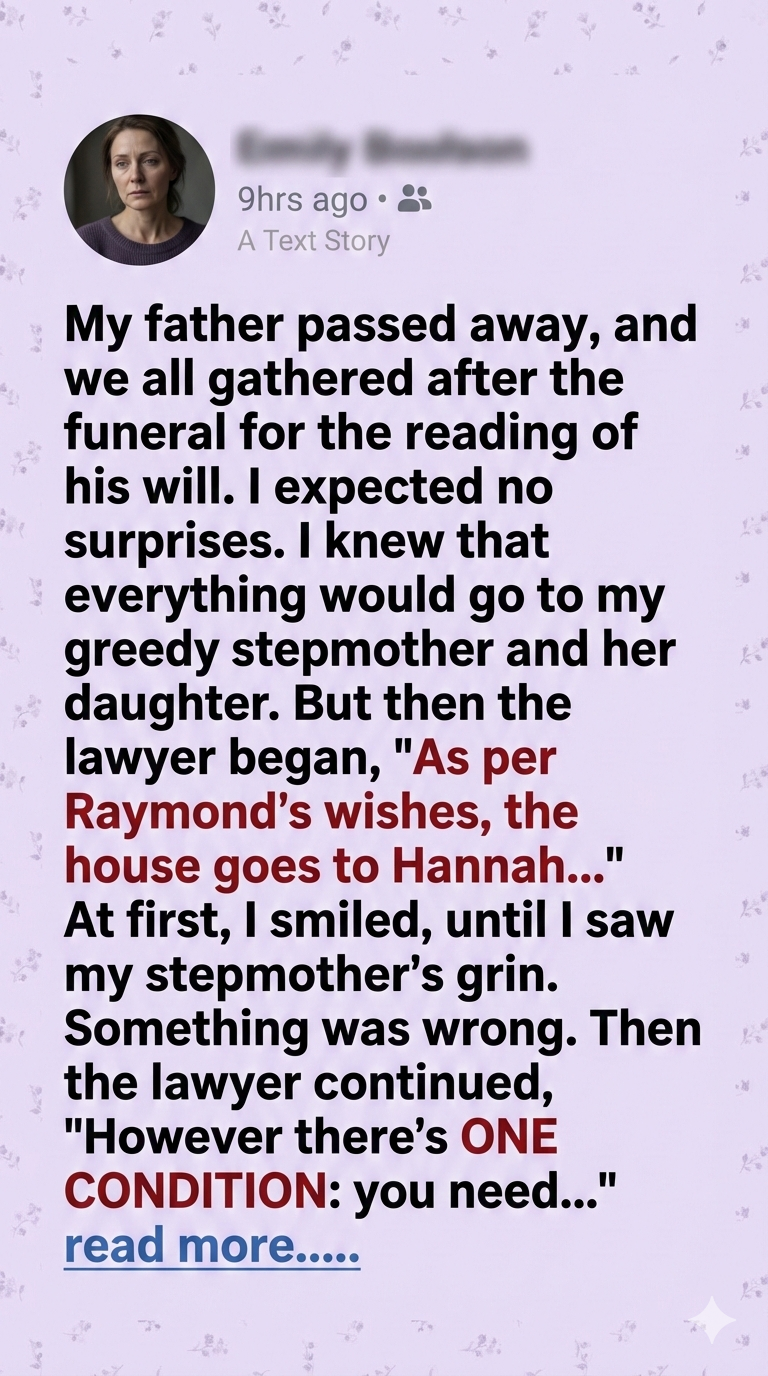
“…you need to let Margaret and Lila live in the house for one full year. If you attempt to evict them or sell the property before that, ownership transfers to them permanently.”
The room went silent.
My stepmother’s grin widened, slow and satisfied. She folded her hands in her lap like she had just won the lottery. Lila smirked at me from across the table.
Of course. There it was.
Dad hadn’t been blind to the tension in the house. He knew how they treated me after Mom died. But he also believed in “keeping the peace.” A year under the same roof as them felt less like a gift and more like a punishment.
I forced a smile. “That’s fine,” I said calmly. “A year goes by quickly.”
Margaret’s eyes narrowed. I think she expected me to argue. To storm out. To give up.
But I didn’t.
That night, when we returned to the house, the rules began almost immediately.
“You’ll stay in your old room,” Margaret announced. “Lila needs the master bedroom for her online business. And since you own the house, you can handle the property taxes and maintenance.”
I nodded again. “Of course.”
If they thought I was naïve, they were wrong.
The next morning, I called the lawyer privately. “Is there anything else in the will?” I asked.
He hesitated. “There is one more clause. Your father set aside a separate investment account in your name. It’s accessible immediately. He instructed me to mention it only if you asked directly.”
My heart pounded.
The account wasn’t just savings — it was enough for renovations, legal fees, and more.
Over the next few months, I began making quiet changes.
I renovated the guest wing into a small rental suite and listed it legally under my name. The extra income covered the taxes Margaret had smugly pushed onto me. I documented everything — every expense, every utility bill, every instance of them trying to sabotage the property.
Margaret grew irritated when she realized I wasn’t struggling.
Lila’s “business” fizzled out when she discovered she couldn’t use the house’s address for questionable shipments without my permission.
And then the final blow came.
Six months in, I discovered that Margaret had secretly tried to refinance the house using old paperwork. Fraudulently.
I didn’t yell.
I didn’t argue.
I handed everything to my lawyer.
By the tenth month, Margaret and Lila were the ones on edge. They knew I had evidence. They knew the year was almost up.
On the exact anniversary of Dad’s death, I invited them into the living room.
“I’ve honored the condition,” I said calmly. “You’ve had one full year here.”
Margaret’s face had lost all its color.
“I’ve decided not to evict you immediately,” I continued. “You have thirty days to find somewhere else. After that, I will proceed legally.”
She opened her mouth to protest, but this time there was no smug grin. No hidden advantage.
Just reality.
As they packed their things weeks later, I stood on the porch and watched them leave.
The house felt lighter.
For the first time since Mom died… it felt like home again.
Dad hadn’t given me a trap.
He’d given me a test.
And I passed.