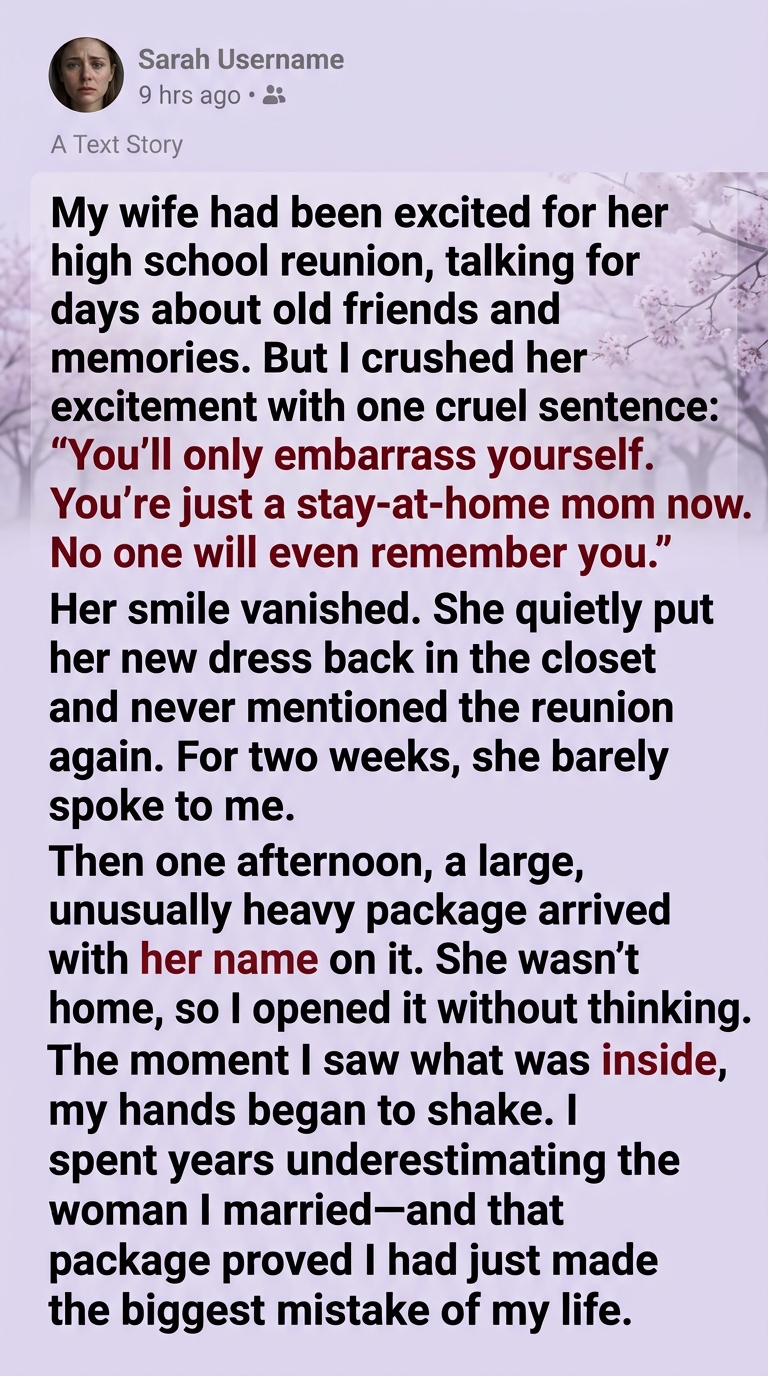
My wife had been excited about her high school reunion for weeks.
She talked about old friends.
Funny memories.
Teachers she still remembered.
She even bought a new dress.
One evening, she stood in front of the mirror wearing it, smiling at herself.
“What do you think?” she asked.
I barely looked up from my phone.
“You’ll only embarrass yourself.”
Her smile disappeared.
I continued, without thinking.
“You’re just a stay-at-home mom now. No one will even remember you.”
The room went silent.
She looked at me for several seconds.
Then she nodded.
“Okay.”
She took the dress off.
Hung it back in the closet.
And never mentioned the reunion again.
For the next two weeks, something changed.
She still made breakfast.
Still took care of the kids.
Still smiled when necessary.
But she barely spoke to me.
I told myself she was being dramatic.
After all, I was the one working.
I paid the mortgage.
I paid the bills.
She stayed home.
I thought I was the important one.
Then, one afternoon, a delivery truck stopped outside our house.
The driver carried a large package to our front door.
It was unusually heavy.
The label had my wife’s name on it.
She wasn’t home.
I should have left it alone.
Instead, I opened it.
The moment I saw what was inside, my hands began to shake.
There were three trophies.
Several framed certificates.
A thick leather portfolio.
And a large envelope stamped with the logo of a major publishing company.
I opened the envelope.
Inside was a contract.
My wife’s name was printed across the top.
I read the first paragraph.
Then the second.
Then I sat down.
The publishing company was offering her a $750,000 advance for a book she had written.
A book about raising children while rebuilding a life after loss.
I stared at the pages.
My wife had written a book?
Apparently, she’d been writing it for years.
Late at night.
After the kids went to sleep.
During nap times.
On weekends.
Whenever she could find a quiet moment.
And the book had already attracted a major publisher.
I kept reading.
Then I saw another document.
A royalty projection.
The book had already been sold to publishers in eight countries.
My mouth went dry.
But that wasn’t even the biggest surprise.
At the bottom of the box was a thick folder labeled:
“High School Reunion — Class of 2001.”
I opened it.
Inside were photographs.
Newspaper clippings.
Letters.
And a printed invitation.
My wife’s name appeared repeatedly.
She had been invited to give the keynote speech at the reunion.
Not because she was simply attending.
Because she had become the class’s most successful alumna.
I couldn’t believe it.
Then I found the reason.
Years ago, my wife had started a nonprofit helping single mothers return to school and find stable employment.
She had kept it almost completely private.
She never talked about it because she didn’t want praise.
She simply did the work.
Over the years, the organization had helped thousands of women.
And that work had recently been recognized nationally.
The reunion committee wanted her to speak about it.
The package contained the award they were going to present her.
I sat there staring at everything.
My wife wasn’t “just a stay-at-home mom.”
She had been raising our children while quietly building something that mattered.
And I had reduced her entire life to a job title.
Then I heard the front door open.
She walked in.
She stopped when she saw the box.
Then she looked at me.
“You opened it.”
I stood.
“I didn’t know.”
She stared at me.
“No.”
“I mean—I had no idea.”
“You never asked.”
That sentence hurt.
Because it was true.
For years, I’d asked:
“What’s for dinner?”
“Did the kids do their homework?”
“Can you take care of this?”
But I’d never asked:
“What are you working on?”
She walked over and picked up the contract.
“You weren’t supposed to see this yet.”
“When were you going to tell me?”
“I wasn’t sure I was going to.”
“Why?”
She looked at me.
“Because of what you said.”
I swallowed.
“You mean the reunion?”
She nodded.
“I realized that if my own husband couldn’t see any value in what I did, maybe I shouldn’t keep trying to prove it to anyone.”
I looked at the trophies.
“How long have you been doing all this?”
“Eleven years.”
Eleven years.
While I thought she was sitting at home doing nothing.
She had been writing.
Building.
Organizing.
Helping people.
Raising our children.
And somehow, she’d done all of it without making me feel like I wasn’t doing enough.
I felt ashamed.
But then she said something that changed the entire conversation.
“The reunion isn’t really about the award.”
“What is it about?”
She smiled sadly.
“My best friend.”
I looked confused.
“She died shortly after graduation.”
My wife opened the folder.
There was a photograph of two teenage girls.
Her and another young woman.
“She wanted to become a teacher,” my wife said.
“But she couldn’t afford college.”
My wife had spent years helping women like her friend.
“I promised her I’d find a way to help women who didn’t have the opportunities she deserved.”
I looked at the nonprofit documents.
Everything suddenly made sense.
The book.
The organization.
The reunion.
The award.
It wasn’t about fame.
It was about a promise she’d made when she was eighteen.
I sat down.
“I was cruel to you.”
She didn’t answer.
“I thought staying home meant you weren’t doing anything.”
Still nothing.
“I was wrong.”
She finally looked at me.
“You were.”
I nodded.
“I don’t deserve an apology from you.”
“No.”
“I deserve to apologize.”
She looked away.
“I don’t want flowers.”
“I know.”
“I don’t want some expensive gift.”
“I know.”
“What do you want?”
She thought for a moment.
“Respect.”
That one word hit harder than anything.
“I can give you that.”
She looked at me.
“Not just when other people are watching.”
I nodded.
“Every day.”
The night of the reunion arrived.
My wife stood in front of the mirror wearing the same dress she’d put away two weeks earlier.
She looked beautiful.
She looked nervous.
I walked up behind her.
“You look amazing.”
She smiled faintly.
“Thank you.”
I handed her a small envelope.
She opened it.
Inside was a note.
I had written only one sentence:
“I was wrong about who you were because I never took the time to see who you had become.”
She read it twice.
Then looked at me.
“Are you coming?”
“If you’ll have me.”
She smiled.
“Yes.”
At the reunion, I watched people surround her.
Former classmates hugged her.
Teachers thanked her.
Women she’d helped told stories about how she’d changed their lives.
Then she walked onto the stage.
The room became silent.
She talked about her friend.
About motherhood.
About sacrifice.
About how easily people mistake quietness for weakness.
Then she said:
“Sometimes the most important work a person does is work nobody applauds.”
I looked down.
She wasn’t talking about herself anymore.
She was talking about millions of people who quietly hold families together.
When she finished, the room stood.
Everyone applauded.
I stood too.
And I clapped harder than anyone.
Not because she had become successful.
Not because a publisher offered her $750,000.
Not because other people finally recognized her.
I clapped because I finally understood something I’d been too arrogant to see.
My wife hadn’t lost herself when she became a stay-at-home mother.
She had built a life around the things she valued.
She had raised our children.
She had kept our home together.
And in the spaces nobody noticed, she had built an entire legacy.
I had spent years thinking I was the one carrying our family.
The truth?
She had been carrying all of us.
That night, on the drive home, she looked out the window.
“Do you still think no one will remember me?”
I felt my throat tighten.
“No.”
She smiled.
“Good.”
Then she reached for my hand.
I held it.
And I knew I’d been given something far more valuable than forgiveness.
I’d been given the chance to finally see my wife for who she really was.
Not “just a stay-at-home mom.”
Not someone beneath me.
Not someone whose worth could be measured by a paycheck.
But the woman who had quietly built a life worth remembering.
And I realized the biggest mistake of my life wasn’t insulting her.
It was spending years beside an extraordinary woman—
and being too blind to notice.