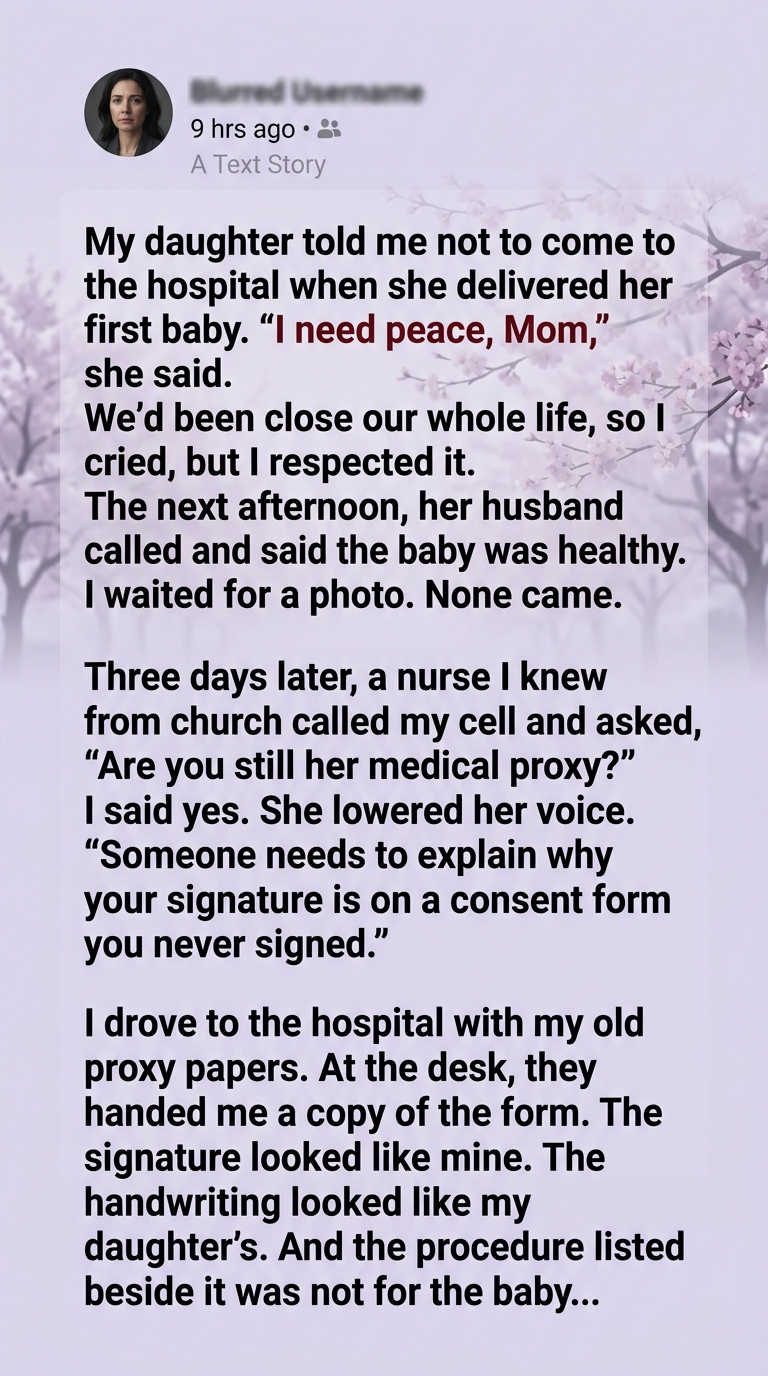
My daughter told me not to come to the hospital when she delivered her first baby.
“I need peace, Mom,” she said.
We had been close our whole lives, so the words hurt more than I let her see.
“Of course,” I told her. “Whatever you need.”
After we hung up, I sat on the edge of my bed and cried.
I wanted to be there.
I wanted to hold my grandchild the moment he or she arrived.
I wanted to hear my daughter’s voice.
But she was an adult.
She was becoming a mother.
And if she needed space, I would respect that.
The next afternoon, her husband, Mark, called.
“The baby is healthy,” he said.
Relief washed over me.
“Boy or girl?”
“A girl.”
I smiled through tears.
“Is Emma okay?”
“She’s exhausted, but yes.”
“Can I see a picture?”
“Soon.”
I waited.
An hour passed.
Then another.
No photograph.
No text.
No call.
I told myself they were busy.
Newborns were exhausting.
Hospitals were chaotic.
I wasn’t going to be the demanding mother who expected immediate updates.
So I waited.
One day passed.
Then another.
Still nothing.
On the third morning, my phone rang.
It was someone I knew from church.
A nurse named Patricia.
Her voice was unusually quiet.
“Claire, are you still Emma’s medical proxy?”
I sat up.
“Yes.”
“Did Emma ever tell you she changed it?”
“No.”
Patricia took a breath.
“Someone needs to explain why your signature is on a consent form you never signed.”
My blood ran cold.
“What?”
“I shouldn’t be calling you about this.”
“Patricia, what’s happening?”
“I can’t discuss her medical details over the phone.”
“Then tell me what I need to do.”
“You need to come to the hospital.”
I was already grabbing my coat.
“I’m coming.”
I drove there without remembering half the journey.
At the desk, I gave them my identification.
“I’m here for Emma Carter.”
The receptionist checked the computer.
Then looked at me strangely.
“Are you family?”
“I’m her mother.”
She hesitated.
“I’ll call someone.”
A few minutes later, a hospital administrator appeared.
“Mrs. Carter?”
“Yes.”
“Can we speak privately?”
She led me into a small office.
I sat down.
She placed a folder in front of me.
“This is the consent form Patricia mentioned.”
I opened it.
My name was printed beneath the signature line.
Claire Carter.
The signature looked like mine.
But it wasn’t.
I knew my signature.
I’d signed it thousands of times.
This one was almost perfect.
Almost.
But there was something wrong with the final letter.
My handwriting didn’t curve that way.
I looked at the administrator.
“I didn’t sign this.”
She nodded.
“I understand.”
“What procedure is this for?”
She looked uncomfortable.
“That’s why we need you here.”
I read the form again.
Then I saw the procedure listed.
It wasn’t for the baby.
It was for Emma.
My daughter.
The consent authorized an emergency procedure involving her medical treatment.
I felt dizzy.
“Who signed this?”
“We don’t know.”
“But this is my signature.”
“It appears to be.”
“I didn’t sign it.”
“We know that now.”
I stared at her.
“What happened?”
She folded her hands.
“After Emma delivered the baby, she developed complications.”
My heart stopped.
“What kind?”
“I can’t give you all the details without confirming your authorization.”
“I am her medical proxy.”
“Exactly.”
She pointed to the form.
“Which is why we’re trying to understand how this was signed.”
I called Mark.
No answer.
Again.
No answer.
Then I texted him.
I’m at the hospital. Call me immediately.
A minute later, my phone rang.
Mark.
“What are you doing there?”
“What’s happening to Emma?”
Silence.
“Mark?”
“She needs a procedure.”
“I know.”
“How?”
“I was contacted because someone forged my signature.”
He said nothing.
Then I heard his voice change.
“Claire…”
“Who signed that form?”
“I don’t know.”
“You were there.”
“I was scared.”
“You were her husband.”
“I didn’t know what to do.”
“Where is my daughter?”
“In recovery.”
“Is she conscious?”
“No.”
My stomach dropped.
“What procedure did she have?”
Silence.
“Mark.”
“She had a blood transfusion.”
I stared at the form.
That wasn’t the procedure listed.
“What else?”
Nothing.
“Mark, what did you authorize?”
“I didn’t authorize anything.”
“Then who did?”
He hung up.
I immediately called the administrator.
“There’s more.”
She looked at me.
“My son-in-law just told me my daughter had a blood transfusion.”
She nodded.
“She did.”
“But that’s not what this form says.”
Her expression changed.
“No.”
“What does it authorize?”
She looked at the document.
“A surgical procedure.”
“What surgery?”
She hesitated.
“Removal of tissue from her reproductive system.”
My hands went numb.
“What?”
The room seemed to tilt.
“Why?”
“We don’t know.”
“Was it performed?”
“No.”
“Then why was the consent form in the system?”
“That is what we’re investigating.”
I stared at the signature.
Someone had forged my name.
Someone had attempted to authorize surgery on my daughter.
And Emma had specifically told me not to come to the hospital.
I suddenly understood why.
Maybe she hadn’t been trying to shut me out.
Maybe someone had wanted me away.
The administrator called hospital security.
Then the compliance officer.
Then the police.
Within an hour, investigators were asking questions.
Who had access to Emma’s records?
Who had access to her room?
Who had access to the electronic medical system?
Who knew I was her medical proxy?
Then they found something.
The forged form had been created from a workstation assigned to Mark.
My stomach dropped.
“Mark?”
The investigator nodded.
“He logged into the system several times during the night.”
“Why?”
“We’re still determining that.”
Then we discovered another detail.
The forged consent wasn’t created after Emma became unconscious.
It had been prepared before she delivered the baby.
That meant someone had planned it.
The investigators searched Mark’s phone records.
They found messages between him and a woman I’d never met.
The first message was from two weeks earlier.
“Once she’s admitted, we need the paperwork ready.”
The second:
“Her mother can’t be there.”
Then:
“Make sure she doesn’t know.”
My hands began shaking.
“Who is that?”
The investigator looked at me.
“Do you know a woman named Rachel?”
I shook my head.
“No.”
Mark’s sister.
I knew the name.
But I had never met her.
The investigator explained that Rachel worked for a private fertility clinic.
Suddenly, the pieces began fitting together.
Emma had struggled with pregnancy.
She and Mark had privately discussed fertility treatments.
But she had never told me the details.
Apparently, Mark had convinced her to undergo a procedure after delivery that could have affected her future fertility.
Emma had refused.
She wanted to make her own decision later.
Mark hadn’t accepted that.
The forged consent form was an attempt to make it appear that Emma’s medical proxy had authorized the procedure while she was incapacitated.
And my daughter had apparently sensed something was wrong.
That was why she had told me not to come.
Not because she didn’t love me.
Because Mark had convinced her that too many people around her would create stress.
But the truth was much darker.
Mark had been trying to control who had access to her.
When Emma finally regained consciousness, the first thing she asked was,
“Is my baby okay?”
I stood beside her bed.
“Yes.”
She looked at me.
Then her eyes filled with tears.
“Mom?”
I took her hand.
“I’m here.”
She began crying.
“I didn’t want you to come because Mark said I needed peace.”
I squeezed her hand.
“It’s okay.”
“No.”
She shook her head.
“It’s not.”
She told me that during the pregnancy, Mark had become increasingly controlling.
He wanted access to all her medical records.
He insisted on attending every appointment.
He repeatedly pressured her to make decisions about future pregnancies.
And after the delivery, he’d told her that she was too exhausted to make important decisions.
Then, while she was sedated, someone attempted to use my forged signature.
Emma looked at me.
“I thought I could trust him.”
I said nothing.
Sometimes there was nothing useful to say.
The hospital investigation eventually confirmed that the consent form was fraudulent.
The police found evidence connecting Mark and Rachel to the creation of the document.
The planned procedure had never been performed.
But the attempt itself was enough to trigger criminal charges.
Mark was removed from the hospital under police supervision.
Rachel was questioned separately.
And the hospital changed its procedures for proxy verification.
Most importantly, Emma’s medical decisions were returned entirely to her.
Her daughter was healthy.
That became the center of everything.
The baby was tiny.
Perfect.
Completely unaware of the chaos surrounding her arrival.
Emma named her Lily.
The first time I held Lily, I cried so hard that Emma laughed.
“You’re going to spoil her.”
“Absolutely.”
“You’ve been waiting three days.”
“Three days too long.”
She smiled.
Then she looked at me seriously.
“Mom?”
“Yes?”
“Thank you for coming when you found out.”
I kissed her forehead.
“I’ll always come when you need me.”
She looked at Lily.
“I know.”
Months later, Emma and Lily moved into a small apartment of their own.
Mark was no longer part of their household.
Emma began rebuilding her life slowly.
Therapy.
Legal proceedings.
Learning how to trust her own instincts again.
And I became the grandmother who showed up with groceries, diapers, and far too many tiny outfits.
One afternoon, Emma handed me a framed photograph.
It was Lily sleeping.
Underneath it was a sentence:
“She was born safely because someone finally listened.”
I stared at it.
Then I understood why Patricia had called me.
She hadn’t simply noticed a strange signature.
She had recognized the danger.
And because she knew me, she knew I would never have signed that form.
That tiny inconsistency had stopped something terrible from happening.
Years later, Emma still keeps the original forged consent form in a locked file.
Not because she wants to remember the fear.
Because she wants to remember that she had a choice.
Her body was hers.
Her medical decisions were hers.
And no one—not a husband, not a doctor, not a family member—had the right to take that choice away.
As for me, I still think about the signature.
It looked like mine.
It almost fooled everyone.
But almost isn’t enough.
Because sometimes the smallest detail is the thing that saves a life.
And sometimes a phone call from someone who trusts their instincts is the difference between a paperwork error and a tragedy.
My daughter once told me,
“I need peace, Mom.”
I thought she was asking me to stay away.
Now I understand.
She needed someone to protect her peace.
And when the hospital called, I didn’t go there to interfere.
I went because she was my daughter—and someone had tried to make my name say yes when I had never said it at all.