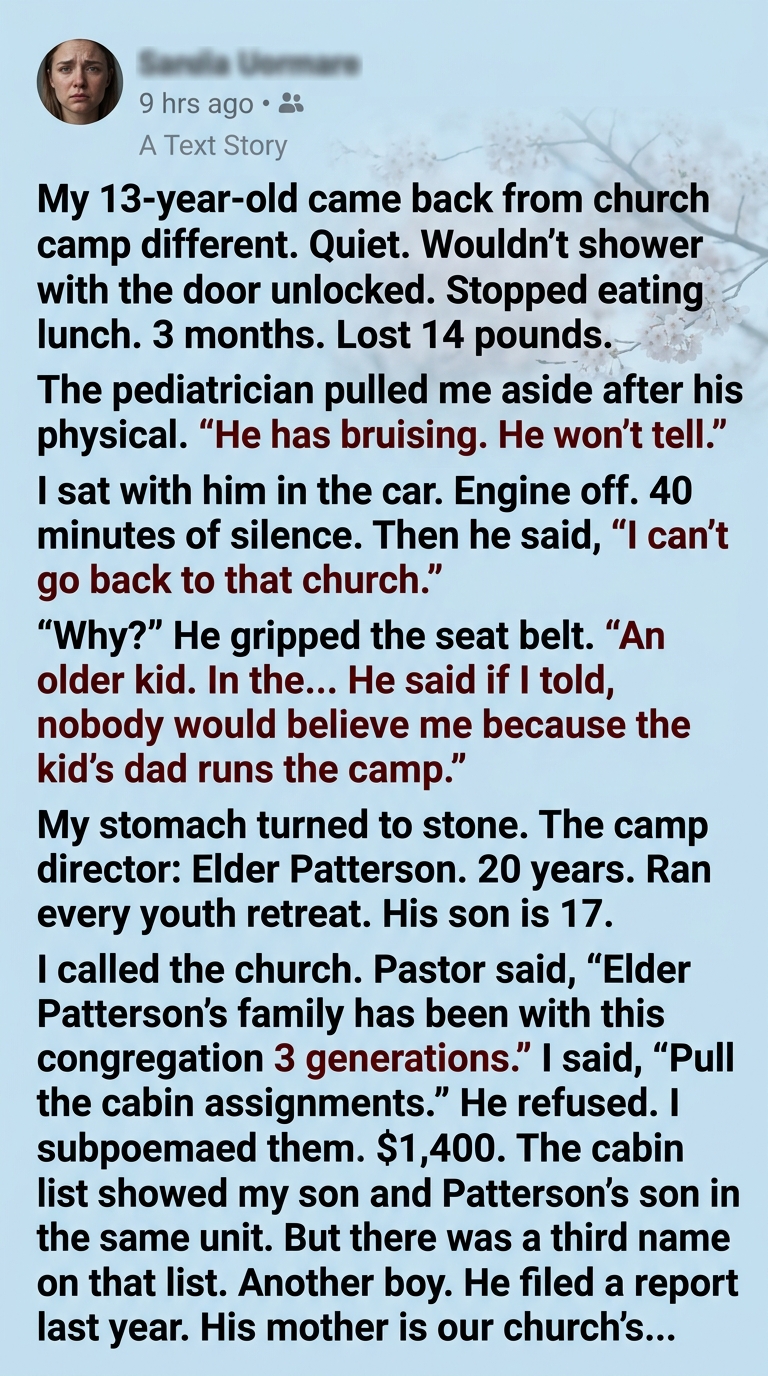
“My 13-year-old came back from church camp different.
Quiet.
He stopped joking at dinner. He wouldn’t shower unless the bathroom door was locked. He stopped eating lunch at school.
At first, I told myself it was homesickness.
Then three months passed.
He lost fourteen pounds.
During his physical, the pediatrician pulled me aside.
“There’s bruising,” she said quietly. “He won’t tell me how it happened.”
My hands went cold.
That evening, I sat beside my son in the parked car.
Engine off.
Neither of us spoke.
Ten minutes.
Twenty.
Thirty.
At forty minutes, he finally whispered, “I can’t go back to that church.”
My heart cracked.
“Why?”
He gripped the seat belt so tightly his knuckles turned white.
“An older kid.”
I waited.
“In the cabin.”
My stomach tightened.
He swallowed hard.
“He said if I told, nobody would believe me because his dad runs the camp.”
I stared through the windshield.
“Who?”
My son finally looked at me.
“Patterson.”
Elder Patterson.
For twenty years, he had been one of the most respected men in our congregation.
He ran every youth retreat.
He organized the summer camps.
He led fundraisers.
People trusted him.
His seventeen-year-old son, Caleb, was considered a model teenager.
I drove home and immediately called the church.
The pastor answered.
I told him what my son had disclosed.
There was a long silence.
Then he said, “I think you need to be careful about making accusations.”
“My son has bruising.”
“I understand.”
“No. I don’t think you do.”
He sighed.
“Elder Patterson’s family has been with this congregation for three generations.”
I felt something inside me snap.
“I don’t care if they’ve been here for three hundred years. Pull the cabin assignments.”
“We’re not going to turn church records over based on an allegation.”
“Then I’ll find another way.”
I hung up.
The next morning, I contacted an attorney.
He told me what to request and how to request it.
The subpoena cost me $1,400.
It was the most expensive piece of paper I’d ever purchased.
And it was worth every penny.
Two weeks later, the records arrived.
I spread the cabin assignments across my kitchen table.
My son’s name was there.
Caleb Patterson’s name was there.
Same cabin.
Same week.
Same retreat.
But there was a third name.
I stared at it.
Then I recognized it.
Evan Miller.
Evan was fourteen.
His mother worked at our church.
Not just attended.
She handled the church’s financial records.
She was the person who counted donations every Sunday.
The woman everyone trusted with the money.
I called her.
She answered on the second ring.
“Is everything okay?”
I asked if Evan had ever told her anything about camp.
Silence.
Then she whispered, “Why?”
I told her what my son had said.
She didn’t respond for several seconds.
Finally, she said something that made my blood run cold.
“Evan filed a report last year.”
I sat down.
“What kind of report?”
“He said something happened in that cabin.”
My voice dropped.
“Who did he name?”
She started crying.
“Caleb.”
I couldn’t breathe.
“Why didn’t I know this?”
“Because the church told us it was handled.”
“Handled how?”
“They said Evan misunderstood something. They said Caleb denied it. Elder Patterson said his son was being targeted because people were jealous of their family.”
I closed my eyes.
“One year ago,” I whispered.
“Yes.”
“And they let him go back?”
Another silence.
Then she said, “They told me if I kept pushing, I would destroy the youth program.”
That sentence stayed with me.
Not the allegation.
Not the excuses.
That sentence.
They were more worried about the youth program than the children inside it.
I contacted law enforcement.
This time, I didn’t call the church first.
I handed investigators everything.
My son’s medical records.
The cabin assignments.
The subpoenaed documents.
And Evan’s mother’s statement.
They opened an investigation.
Within days, they interviewed Evan separately from his parents.
Then my son.
Then several other children who had attended the same retreats.
I didn’t ask my son what he said.
I didn’t need to.
One afternoon, an investigator called me.
“Your son wasn’t the only child who reported concerns.”
My knees nearly gave out.
“How many?”
“We’re still determining that.”
The church finally called an emergency meeting.
The pastor stood in front of the congregation and talked about rumors, accusations, and protecting the church’s reputation.
I stood up.
“You keep saying reputation.”
Everyone turned.
“What about the children?”
Nobody answered.
I held up the cabin assignment.
“You had a report last year.”
The room went completely silent.
“You had a child tell you something was wrong. You investigated it yourselves. You decided the family’s reputation mattered more than finding out the truth.”
Elder Patterson stood.
“You have no right to accuse my family publicly.”
I looked at him.
“I didn’t accuse anyone.”
I placed the document on the table.
“I asked for the records. The records answered.”
His face changed.
For the first time, he didn’t look like the respected elder everyone knew.
He looked frightened.
The investigation continued for months.
There were interviews.
Records.
Messages.
Witness statements.
And eventually, enough evidence for authorities to take action against Caleb and to investigate whether adults had concealed prior reports.
The church’s leadership changed.
Several people resigned.
The youth program was suspended and rebuilt under outside oversight.
But none of that erased what happened.
My son struggled for a long time.
He hated being asked questions.
He hated church buildings.
He hated the smell of campfire smoke.
For months, he slept with his bedroom door locked.
We found a counselor who specialized in helping children recover after traumatic experiences.
We didn’t tell him how quickly he had to heal.
We didn’t tell him to forgive.
We didn’t tell him to go back to church.
We simply told him one thing over and over.
“You did nothing wrong.”
One Sunday, almost a year later, he asked me something.
“Dad?”
“Yeah?”
“Do you think God was mad at me?”
I felt my throat tighten.
“No.”
He looked down.
“Even though I stopped going?”
I put my arm around him.
“Especially then.”
He leaned against me.
Then he whispered, “I think I want to go somewhere else.”
So we did.
Not because we had stopped believing.
Because we finally understood that faith should never require a child to stay silent.
Months later, my son went on a small day trip with a different youth group.
When I picked him up, he opened the car door and smiled.
A real smile.
The first one I’d seen in a long time.
“How was it?” I asked.
He shrugged.
“Good.”
Then he added, “Nobody told me I had to keep secrets.”
I had to look away for a moment.
Because that was when I realized something.
The most important document I had ever obtained wasn’t the subpoena.
It wasn’t the cabin list.
It wasn’t even the report.
It was the moment my son finally understood that his voice mattered more than someone else’s reputation.
And the third name on that cabin list?
It wasn’t just another name.
It was the name that proved my son had never been the only child who needed someone to listen.
Sometimes the truth doesn’t arrive as one dramatic confession.
Sometimes it arrives as a list.
A bruise.
A child’s silence.
A mother’s unanswered question.
And one piece of paper that finally makes it impossible for everyone else to pretend they didn’t know.
I paid $1,400 for that subpoena. But what it uncovered was worth far more: the truth they had spent a year trying to bury.