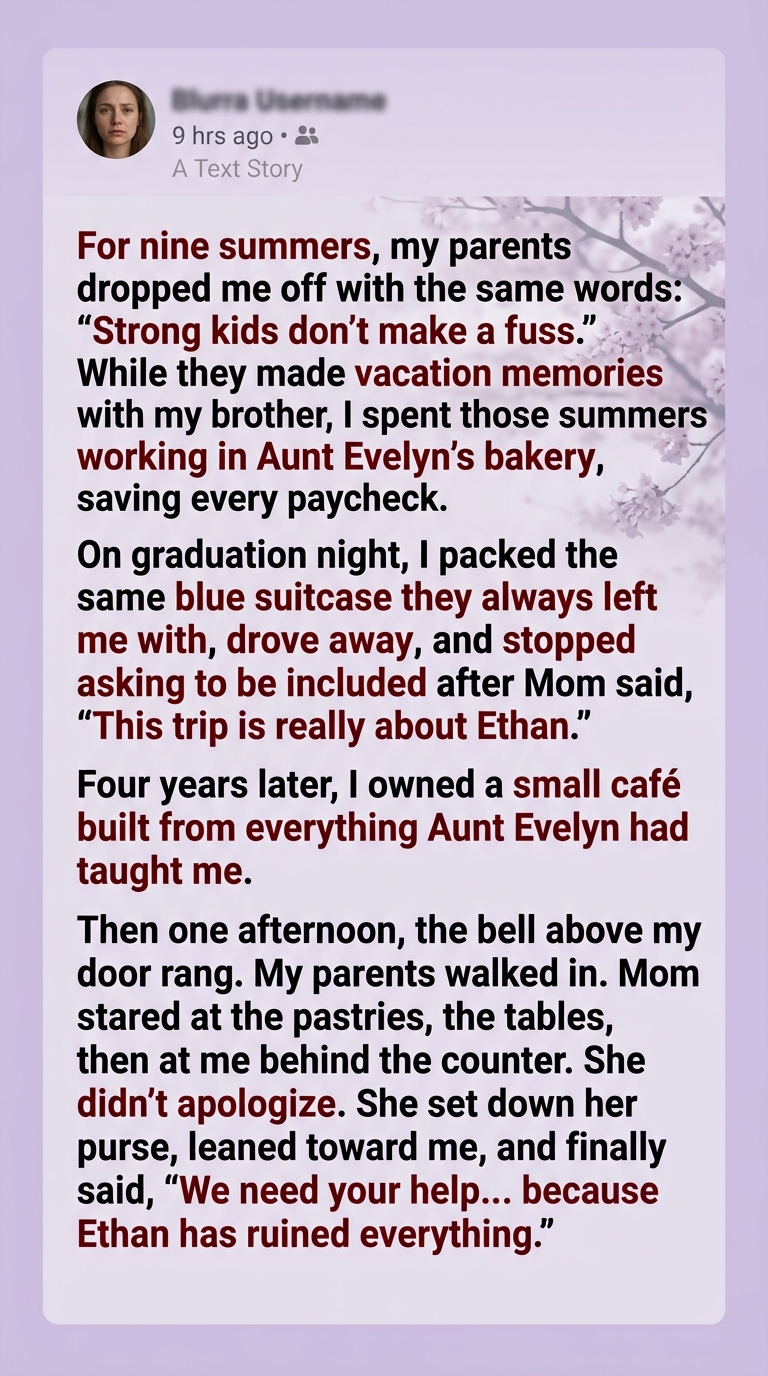
For nine summers, my parents dropped me off at the same place with the same words:
“Strong kids don’t make a fuss.”
Then they drove away.
Every summer.
While they took my younger brother Ethan on vacations, I spent mine working in Aunt Evelyn’s bakery.
At first, I thought it was punishment.
I was eight the first time they left me there.
My parents were taking Ethan to Florida.
They had packed his little suitcase with new clothes, sunscreen, and a camera.
My suitcase was old and blue.
They put it in the back of the car and drove me to Aunt Evelyn’s bakery three hours away.
Mom hugged me quickly.
“Be good.”
Dad smiled.
“Strong kids don’t make a fuss.”
Then they drove away.
I stood on the sidewalk watching their car disappear.
Aunt Evelyn came outside.
She put her arm around me.
“You hungry?”
I nodded.
She took me inside.
That summer, I learned how to knead dough.
I learned how to measure flour.
I learned that yeast could be temperamental.
And I learned something else.
A bakery had a rhythm.
Wake before sunrise.
Mix.
Proof.
Bake.
Clean.
Repeat.
At the end of the summer, Aunt Evelyn handed me my first paycheck.
It wasn’t much.
But I stared at it like it was a treasure.
“What should I do with it?” I asked.
She smiled.
“Whatever you want.”
I bought a small pair of headphones.
My parents never knew.
The next summer, they dropped me off again.
Then the next.
And the next.
For nine summers, my blue suitcase followed the same route.
Home.
Aunt Evelyn’s bakery.
Home.
Aunt Evelyn’s bakery.
Meanwhile, Ethan went to amusement parks.
Beach resorts.
National parks.
Cruises.
He came home with photographs.
Stories.
Souvenirs.
I came home with flour under my fingernails and money in a savings account.
Whenever I complained, Mom said the same thing.
“Ethan needs more attention.”
Or:
“You’re independent.”
Or:
“Strong kids don’t make a fuss.”
So I stopped making a fuss.
Eventually, I stopped asking.
The final summer was different.
I was eighteen.
Graduation was approaching.
My parents were planning another family trip.
I asked Mom,
“Can I come this time?”
She didn’t even look up from her phone.
“This trip is really about Ethan.”
That was the moment something inside me went quiet.
I went upstairs.
Pulled my old blue suitcase from the closet.
Packed my clothes.
Then I left.
I didn’t slam the door.
I didn’t scream.
I didn’t ask them to stop me.
I simply drove back to Aunt Evelyn’s bakery.
She was waiting for me.
She looked at my suitcase.
Then at me.
“You staying?”
I nodded.
She hugged me.
“You can stay as long as you need.”
I worked there for another year.
Then two.
I learned everything.
How to price products.
How to negotiate with suppliers.
How to calculate food costs.
How to handle difficult customers.
How to make a business survive a bad month.
Most importantly, Aunt Evelyn taught me something my parents never had.
Being independent doesn’t mean you don’t deserve to be cared for.
I saved every paycheck.
Every tip.
Every bonus.
Every dollar.
Four years later, I opened my own café.
It wasn’t huge.
Twelve tables.
A small kitchen.
A pastry counter.
A chalkboard menu.
But it was mine.
I named it Evelyn’s.
The first morning we opened, Aunt Evelyn stood beside me.
She cried.
I cried.
Then she said,
“Look at you.”
I smiled.
“I learned from the best.”
The café grew.
Slowly.
Then quickly.
People came for the cinnamon rolls.
Then the coffee.
Then the atmosphere.
Soon, we had regular customers who knew my name.
I hired two employees.
Then four.
I finally understood what Aunt Evelyn had been teaching me all those summers.
I hadn’t been wasting them.
I had been building something.
Then one afternoon, the bell above the café door rang.
I looked up.
And froze.
My parents walked in.
I hadn’t seen them in four years.
Mom looked older.
Dad looked exhausted.
They stood near the entrance.
Mom stared at the pastries.
Then the tables.
Then me.
She didn’t apologize.
She didn’t say hello.
She walked to the counter.
Set down her purse.
And leaned toward me.
“We need your help.”
I stared at her.
“With what?”
She swallowed.
“Ethan.”
I waited.
“He’s ruined everything.”
For a moment, I didn’t know what to say.
Then I remembered something.
Nine summers.
Nine blue-suitcase summers.
Nine times they had chosen him.
I looked at my mother.
“What happened?”
She started crying.
Ethan had gotten into debt.
Not ordinary debt.
Massive debt.
He had started a business with two friends.
They had borrowed money.
Then taken out more loans.
Then used credit cards.
Then borrowed against assets they didn’t actually have.
When the business failed, Ethan blamed everyone else.
My parents had stepped in.
They refinanced their house.
Used their retirement savings.
Sold investments.
Then borrowed again.
They had spent nearly everything trying to rescue him.
Finally, the bank was threatening foreclosure.
Mom looked at me.
“We thought you’d help.”
I almost laughed.
“You thought I’d help?”
“You’re his sister.”
“So were you his parents.”
Dad finally spoke.
“We’re asking because you’re doing well.”
I looked around my café.
“I’m doing well because I worked.”
Mom’s eyes filled with tears.
“We know.”
“No.”
I shook my head.
“You don’t.”
I pointed toward the kitchen.
“See that?”
She nodded.
“I learned how to run that from Aunt Evelyn.”
I pointed toward the pastry counter.
“I learned that.”
Then I pointed toward the bookshelves.
“I paid for those.”
Every piece of the café represented something.
A summer.
A paycheck.
A lesson.
A sacrifice.
Mom whispered,
“We didn’t know.”
“You knew exactly where I was.”
She looked down.
“You chose to leave me there.”
Dad sighed.
“We thought you were okay.”
“I was eight.”
He closed his eyes.
I continued.
“You told me strong kids don’t make a fuss.”
Mom started crying.
“And I believed you.”
Silence.
Then she said,
“We’re sorry.”
It was the first apology I’d heard.
But it wasn’t enough.
Not yet.
I asked,
“How much does Ethan owe?”
Dad gave me a number.
I stared at him.
It was enormous.
“And what do you want me to do?”
“Loan us the money.”
I almost laughed again.
“Why?”
“Because you have savings.”
I looked at my mother.
“How do you know?”
She hesitated.
Then I understood.
They had been watching.
They knew the café was successful.
They knew I had money.
They had come because they believed the daughter they had neglected would rescue the son they had spent her childhood prioritizing.
I walked to the back office.
I returned with a folder.
I placed it on the counter.
“What is this?” Mom asked.
“My business plan.”
She looked confused.
“I made it before I opened the café.”
I opened it.
Every expense.
Every projected revenue.
Every risk.
Every emergency reserve.
Then I showed them one line.
Emergency Fund: $50,000.
Dad looked at it.
“You have that much?”
“I did.”
Mom looked relieved.
I closed the folder.
“I used most of it last year.”
“For what?”
“To help Aunt Evelyn.”
They both stared at me.
Her bakery had needed a new oven.
I had paid for it.
Not because she asked.
Because she had once paid me when nobody else thought my time was worth anything.
Mom whispered,
“So you don’t have the money?”
“I have enough.”
Her eyes brightened.
“Then—”
“But I’m not giving it to Ethan.”
Her face fell.
“Why?”
“Because rescuing him won’t fix what broke him.”
Dad looked angry.
“What are you saying?”
“I’m saying you spent years teaching him that someone would always save him.”
Silence.
“And you spent years teaching me that nobody would.”
Mom began crying again.
I softened.
“I don’t hate you.”
She looked at me.
“But I won’t let you use everything I built to protect him from the consequences of his choices.”
Dad sat down.
For the first time, he looked old.
“What are we supposed to do?”
I thought about Aunt Evelyn.
About the bakery.
About the nine summers.
Then I said,
“You can help him without giving him money.”
I offered to help Ethan make a repayment plan.
Not pay his debts.
Not erase them.
A plan.
He would sell what he could.
Take a job.
Negotiate with creditors.
Close the failed business.
And make monthly payments.
My parents would have to stop financing his mistakes.
They didn’t like the idea.
But they accepted.
Ethan didn’t.
He called me two days later.
“You think you’re better than me?”
“No.”
“You had everything handed to you.”
I almost laughed.
“Everything?”
“You had Aunt Evelyn.”
I paused.
“Yes.”
He became quiet.
“She taught me how to work.”
He said nothing.
Then he hung up.
I thought that was the end.
It wasn’t.
Three months later, Ethan came to the café.
Alone.
He sat at the counter.
I handed him coffee.
He looked at me.
“I owe you an apology.”
I didn’t say anything.
“I spent my whole life thinking Mom and Dad would fix things.”
He looked down.
“They always did.”
I nodded.
“I know.”
“I didn’t understand why you were always at Aunt Evelyn’s.”
“I did.”
He looked surprised.
“I thought they were punishing you.”
“They were.”
He shook his head.
“No.”
He looked around the café.
“I think they were accidentally preparing you.”
I smiled sadly.
“Maybe.”
He reached into his pocket.
He pulled out something small.
A photograph.
It was an old family picture.
We were children.
I was holding my blue suitcase.
Ethan was wearing a bright Hawaiian shirt.
Behind us, our parents were smiling.
He handed me the photograph.
“I found it in Mom’s closet.”
I looked at it.
For years, I had thought that photograph represented everything I’d missed.
But now I saw something else.
The little girl holding the blue suitcase didn’t know what was coming.
She didn’t know she’d spend nine summers learning a trade.
She didn’t know she’d save every paycheck.
She didn’t know she’d build a café.
She didn’t know she’d become the person her family would eventually come asking for help.
But she was strong.
Not because she never made a fuss.
Because she kept going anyway.
I gave the photograph back to Ethan.
“Keep it.”
He smiled.
“Thanks.”
Then he stood.
“I have to get to work.”
I laughed.
“Good.”
He smiled.
“Yeah.”
And he left.
I watched him walk down the street.
Then I went back behind the counter.
The bell above the door rang again.
A customer walked in.
“Morning.”
“Morning.”
“What’s good today?”
I smiled.
“Everything.”
Because for the first time, I meant it.
Those nine summers hadn’t stolen my childhood.
They had changed the direction of my life.
My parents thought they were leaving me somewhere because I was strong enough to handle it.
They never understood that Aunt Evelyn didn’t just keep me busy.
She taught me how to build something no one could take away.
And years later, when my parents walked into the café asking me to rescue the son they had always prioritized, I finally understood the difference between being forgotten and being free.
I didn’t save Ethan.
I didn’t save my parents.
I simply refused to let the little girl with the blue suitcase disappear again.
She had spent nine summers being left behind.
This time, she chose where she was going.