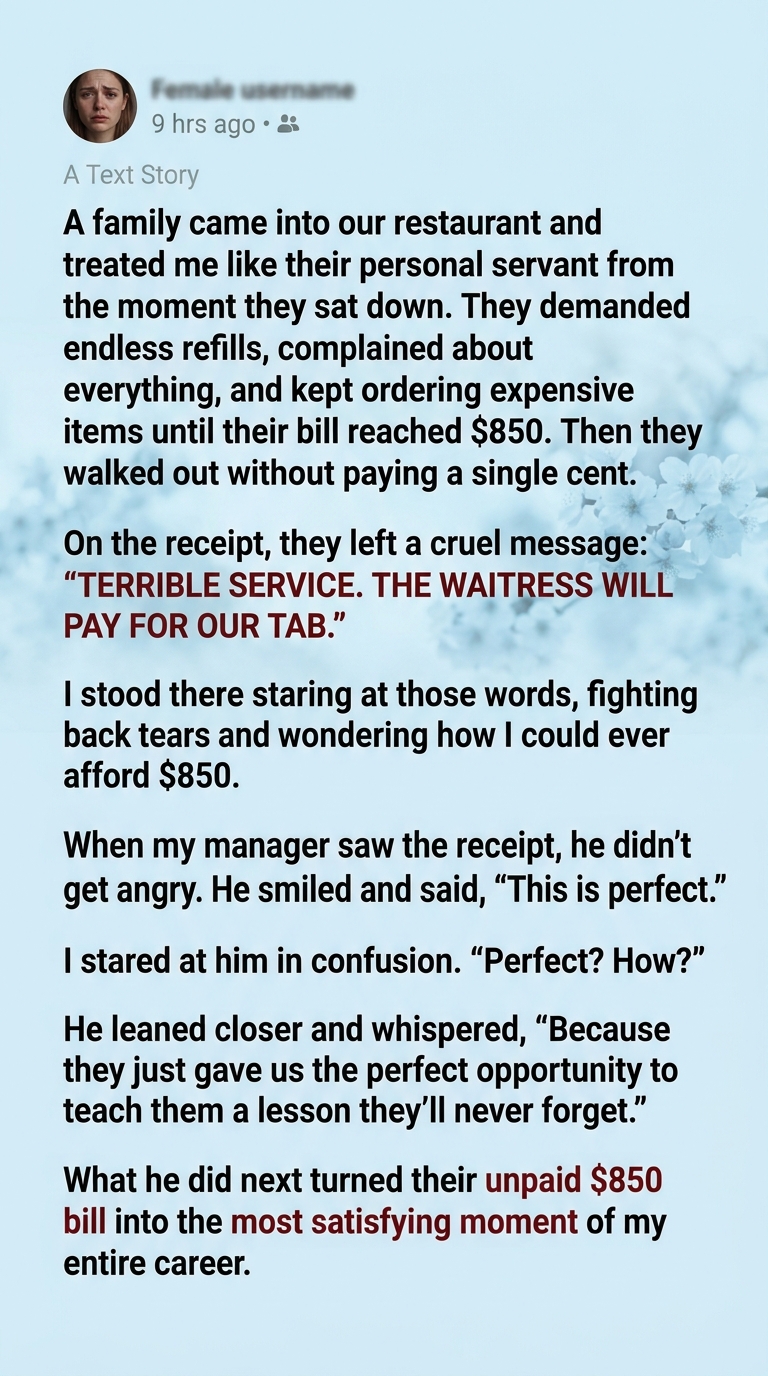
A family came into our restaurant on a Saturday night and treated me like their personal servant from the moment they sat down.
There were five of them.
A father, a mother, two teenage boys, and a grandmother.
They didn’t say hello.
The father dropped into the booth and snapped his fingers.
“Water. Lemon.”
His wife didn’t even look at me.
“And bring bread. The good kind.”
I smiled politely.
“Of course.”
I had been a waitress at Bellamy’s for almost six years. I’d dealt with rude customers before.
But something about this family was different.
They weren’t simply demanding.
They seemed to enjoy making me uncomfortable.
I brought the water.
“Too warm,” the father said.
The mother tasted hers.
“Too much lemon.”
One of the boys frowned.
“I don’t drink water.”
I stared at him.
“What would you like instead?”
“Coke.”
“Diet or regular?”
He rolled his eyes.
“Regular.”
The other boy immediately said, “I’ll have lemonade.”
I wrote everything down.
“Anything else?”
The grandmother pointed at the breadbasket.
“This is stale.”
“It was baked this morning.”
She looked at me as if I’d personally insulted her.
“Then this morning was too long ago.”
I replaced it.
Then came the orders.
Steak.
Lobster.
Two expensive appetizers.
A bottle of wine.
Desserts.
Then another round of drinks.
Every time I returned, someone wanted something else.
More butter.
More sauce.
A different fork.
Extra napkins.
Fresh ice.
Another basket of bread.
By the time I delivered the main courses, I had walked back and forth between their table and the kitchen so many times my feet were throbbing.
Then the father called me over.
“Excuse me.”
“Yes?”
“My steak is wrong.”
I looked at his plate.
He had eaten almost half of it.
“What seems to be the problem?”
“I don’t like it.”
“I can have the kitchen remake it.”
“No.”
He pushed the plate toward me.
“Take it back and bring me another one.”
I hesitated.
“I’m sorry, but because you’ve already eaten part of it—”
He slammed his fork down.
“Are you arguing with me?”
“No.”
“Then do your job.”
I took the plate.
My manager, David, was standing near the kitchen entrance.
He saw everything.
When I walked past him, he quietly asked,
“You okay?”
I nodded.
“I’m fine.”
I wasn’t.
But I couldn’t afford to lose my job.
Three hours later, their table was covered with empty plates and glasses.
The bill came to $850.47.
The father picked it up.
He studied it for a few seconds.
Then he laughed.
“Eight hundred and fifty dollars?”
His wife smiled.
“That’s ridiculous.”
“You ordered all of it,” I said carefully.
The father looked at me.
“We’re not paying this.”
My stomach dropped.
“I’m sorry?”
He stood up.
“Terrible service.”
The mother gathered her purse.
The boys laughed.
The grandmother slowly stood.
I thought maybe they were joking.
They weren’t.
The father walked toward the door.
“Wait,” I said. “Sir, your bill.”
He didn’t turn around.
I followed them.
“You need to settle the check.”
The mother looked over her shoulder.
“Maybe if you’d provided better service.”
Then they walked out.
All five of them.
Without paying a cent.
I stood frozen.
I returned to the table.
The receipt was sitting underneath the empty wine glass.
I picked it up.
At the bottom, in thick black ink, someone had written:
“TERRIBLE SERVICE. THE WAITRESS WILL PAY FOR OUR TAB.”
My hands started shaking.
Eight hundred and fifty dollars.
I couldn’t afford eight hundred and fifty dollars.
I made barely enough to cover rent, groceries, and my mother’s medication.
I stared at the words until they blurred.
Then David walked over.
He took the receipt from my hand.
He read it.
And smiled.
I stared at him.
“Why are you smiling?”
He looked at me.
“This is perfect.”
“Perfect?”
I thought he had lost his mind.
“They just stole $850 from us!”
David shook his head.
“No.”
He pointed at the receipt.
“They just gave us the perfect opportunity to teach them a lesson they’ll never forget.”
I didn’t understand.
“What are you talking about?”
He folded the receipt.
“Did you get their name?”
“No.”
“License plate?”
I thought for a moment.
“Yes.”
I had noticed it when they pulled into the parking lot.
David smiled again.
“Good.”
He walked toward the office.
“Come with me.”
Inside, he pulled up the restaurant’s security system.
There were cameras everywhere.
Dining room.
Entrance.
Parking lot.
Cash register.
Kitchen hallway.
He rewound the footage.
The family appeared on screen.
David paused it.
“Now watch.”
We watched the father slip his credit card out of his wallet.
He had paid with the same card at the bar two weeks earlier.
David clicked another screen.
The family had apparently been coming to Bellamy’s for months.
Not just us.
Three other restaurants owned by the same restaurant group.
David opened another file.
“Look at this.”
There were complaints.
Repeated complaints.
Same family.
Same behavior.
They ordered expensive meals.
Demanded replacements.
Claimed food was defective.
Then threatened bad reviews or accused servers of poor service when presented with the bill.
Several restaurants had comped their meals just to avoid confrontation.
“They’ve been doing this for over a year,” David said.
I stared at the screen.
“So why haven’t they been stopped?”
David leaned back.
“Because every restaurant treated each incident like an isolated problem.”
Then he pulled out another document.
“Until tonight.”
He showed me something else.
Their reservation.
They had booked the table under the father’s real name.
Richard Collins.
David typed the name into the restaurant group’s customer database.
A warning appeared.
Richard Collins and family.
Multiple unpaid disputes.
Repeated refund requests.
Threats against staff.
Suspected organized dine-and-dash behavior.
I looked at David.
“You knew?”
“We suspected.”
“Then why did you let them order all that?”
“Because I needed proof.”
He turned toward me.
“And tonight, they gave us plenty.”
The next morning, David called the restaurant group’s regional director.
Then the restaurant’s attorney.
Then the local police department.
We gave them everything.
Security footage.
Receipts.
Reservation records.
Vehicle information.
Previous incidents from other locations.
Most importantly, we had the footage showing Richard intentionally leaving without paying after being told he needed to settle the bill.
The police weren’t interested in whether he liked the steak.
They were interested in the pattern.
And there was one more thing David had discovered.
The family had done the same thing at another restaurant the previous month.
That restaurant had quietly paid the bill themselves.
But this time, the owners decided to cooperate.
The evidence was overwhelming.
Two days later, Richard received a call.
He returned to Bellamy’s.
This time, he didn’t walk in laughing.
He walked in looking furious.
He marched straight toward David.
“You called the police?”
David nodded.
“You refused to pay your bill.”
Richard lowered his voice.
“You’re going to regret this.”
David smiled.
“No.”
Richard glanced at me.
“She was terrible.”
I said nothing.
David placed a folder on the counter.
“Your original bill was $850.47.”
Richard crossed his arms.
“We’re not paying it.”
David opened the folder.
“That’s fine.”
Richard looked confused.
“Because the restaurant group has now submitted documentation of your previous incidents to the police.”
His face changed.
“What?”
David continued.
“You have two options.”
Richard stared at him.
“Pay the $850.47 and the documented charges from the other locations, or let the investigators handle it.”
Richard’s wife stepped through the door behind him.
She had heard everything.
“How much?”
David handed her the document.
Her eyes widened.
It wasn’t just $850.
There were four other unpaid restaurant bills.
Together, they totaled more than $3,600.
Richard’s face turned red.
“You’re extorting us.”
David shook his head.
“No. We’re asking you to pay for what you consumed.”
The police arrived a few minutes later.
Richard suddenly became very quiet.
His wife started crying.
The grandmother sat down.
And one of the teenage boys whispered,
“Dad, just pay them.”
Richard looked at me.
For the first time that night, there was no arrogance in his face.
Only embarrassment.
He paid the bill.
Then he paid the other restaurants.
But David wasn’t finished.
He placed one final document in front of him.
It was a formal notice.
The entire restaurant group had banned Richard and his family from every location.
Richard stared at it.
“You’re banning us?”
David nodded.
“Yes.”
“Over one bill?”
David leaned forward.
“No.”
He tapped the folder.
“Over every server you humiliated, every restaurant you cheated, and every time you made someone else pay for your choices.”
Richard said nothing.
Then he looked at me.
“I didn’t mean for you to actually pay.”
I finally spoke.
“You wrote it on the receipt.”
His eyes dropped.
I continued.
“You didn’t know me. You didn’t know what I could afford. You didn’t know what kind of night I’d already had.”
I paused.
“But you knew you were trying to scare me.”
He didn’t answer.
They left.
No shouting.
No insults.
No dramatic threats.
Just silence.
After they were gone, I returned to the table.
The $850 bill was still there.
David walked over.
“You all right?”
I nodded.
“Yeah.”
He smiled.
“You know what the best part is?”
“What?”
“You didn’t have to pay a single dollar.”
I laughed.
For the first time that night, I really laughed.
A week later, David called me into his office.
I thought I was in trouble.
Instead, he handed me an envelope.
Inside was a bonus.
“What’s this?”
“Your share of the service recovery bonus.”
I stared at him.
“I can’t take this.”
“You earned it.”
I looked at the amount.
It was enough to cover nearly a month’s expenses.
My eyes filled with tears.
David shook his head.
“Don’t cry.”
“I thought I was going to lose my job.”
“You didn’t.”
“I thought I’d have to pay $850.”
“You didn’t.”
“And you knew what to do the whole time?”
He smiled.
“I knew we needed to stop treating people like that family as customers we were afraid to lose.”
He pointed toward the dining room.
“We don’t need customers who believe money gives them permission to humiliate people.”
Six months later, I was promoted to shift supervisor.
David said he wanted me to teach new servers something he wished someone had taught me years earlier.
“Never confuse good service with allowing someone to abuse you.”
I still remember that $850 receipt.
I kept a photocopy of it.
Not because I’m bitter.
Because every time I see those words—
“THE WAITRESS WILL PAY FOR OUR TAB.”
—I remember how powerless I felt that night.
And then I remember what happened next.
They thought they could make me responsible for their bad behavior.
Instead, their own words became the evidence that finally stopped them.
They walked out believing a waitress would pay their $850 bill.
They never imagined that the receipt would be the very thing that made them pay for everything they had done before.