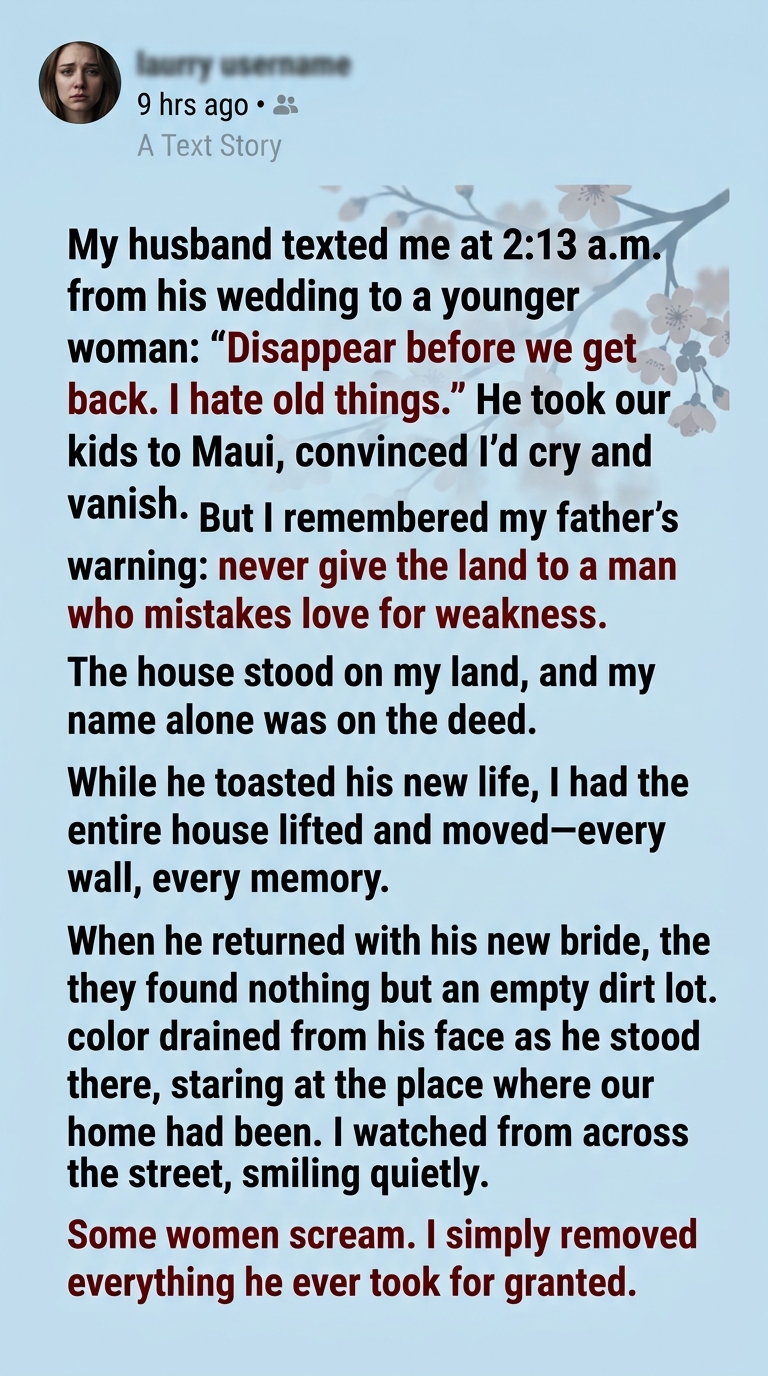
My husband texted me at 2:13 a.m. from his wedding to a younger woman.
The message was only one sentence:
“Disappear before we get back. I hate old things.”
I read it twice.
Then I looked across the bedroom at the man I’d been married to for twenty-seven years.
Except he wasn’t there.
He was in Maui.
Getting married.
To another woman.
He had taken our children with him, apparently believing that once he returned with his new bride, I would have cried myself empty, packed a suitcase, and disappeared.
He had no idea what I was about to do.
I didn’t reply.
I didn’t call.
I didn’t scream.
I simply sat on the edge of our bed and remembered something my father had told me years ago.
“Never give the land to a man who mistakes love for weakness.”
At the time, I hadn’t understood why he’d said it.
Now I did.
The house had never belonged to my husband.
Not legally.
Not financially.
Not even technically to both of us.
The land belonged to me.
My father had given it to me before I married.
The deed had my name alone on it.
When my husband and I built the house twenty-four years earlier, I paid for most of the construction from my inheritance.
But over the years, my husband had started calling it “our property.”
Then “my house.”
Then eventually, when talking to other people, simply “my place.”
I never corrected him.
I thought marriage meant sharing.
Apparently, he thought sharing meant eventually taking.
The morning after his message, I called an attorney.
Then I called a structural moving company.
The attorney asked one question.
“Are you the sole legal owner of the land?”
“Yes.”
“And the house?”
“Yes.”
He looked at the documents.
“Then you have options.”
I chose one.
I was going to move the house.
Not sell it.
Not demolish it.
Not leave it behind.
Move it.
The house was a two-story craftsman with a wide porch, four bedrooms, a stone fireplace, and the oak staircase my father had helped me design.
Every room held a memory.
The kitchen where our children had grown up.
The hallway where I’d measured their heights.
The bedroom where I’d stayed awake beside my husband after surgery.
The porch where my father had sat drinking coffee before he died.
My husband believed he was taking all of that with him.
He wasn’t.
Three days later, a crew arrived.
The first thing they did was disconnect the utilities.
Then they reinforced the foundation.
Hydraulic jacks were positioned underneath the house.
Steel beams slid beneath the structure.
The workers moved with the precision of people who had done the impossible before.
My neighbor, Carol, watched from across the street.
“What are they doing?”
“Moving the house.”
She stared at me.
“Moving the whole house?”
I nodded.
“Why?”
I handed her my husband’s text.
She read it.
Then looked at me.
“Oh.”
Exactly.
The work took nearly two weeks.
Neighbors came outside every day.
People slowed their cars to stare.
The house rose inch by inch.
Then the entire structure was loaded onto a specialized transport system.
I had already purchased a new piece of land about eight miles away.
A quiet lot overlooking a wooded creek.
The house was moved there.
Every wall.
Every window.
Every cabinet.
Every photograph I wanted.
Even the old porch swing.
I kept the family photographs.
The children’s height marks from the doorframe.
My father’s workbench.
The brass light fixture he’d installed himself.
I left behind nothing I considered mine.
The dirt lot where the house had stood was perfectly level.
Empty.
Silent.
My husband was still in Maui.
I received another text.
Landing Sunday.
Then:
Hope you found somewhere to go.
I didn’t respond.
Sunday afternoon, I waited.
A rental car pulled into the driveway.
My husband stepped out.
He was wearing a linen shirt.
Beside him was the woman he’d married.
She was younger than me by nearly fifteen years.
They were laughing.
Then they stopped.
My husband looked toward the house.
There was no house.
He stood completely still.
The woman beside him frowned.
“Where is it?”
He didn’t answer.
He walked forward.
Slowly.
Then faster.
He reached the edge of the empty lot.
His face went white.
“No.”
The woman looked around.
“What’s going on?”
He turned in circles.
“No.”
He pulled out his phone.
Dialed me.
I watched from across the street.
I answered.
“What?”
“Where is the house?”
I smiled.
“Which house?”
“Our house.”
I looked at the empty lot.
“No.”
He became angry.
“What did you do?”
“I moved it.”
There was silence.
“You can’t move a house.”
“I just did.”
“That was my house!”
I almost laughed.
“No.”
“You’re insane.”
“My attorney disagrees.”
He looked toward the new wife.
She was staring at him now.
“What is she talking about?”
My husband covered the phone.
I could see him trying to explain.
He couldn’t.
Finally he said,
“You knew this was coming?”
“I knew you were leaving.”
“That doesn’t mean you can take the house!”
“I didn’t take it.”
I paused.
“I took what was already mine.”
He stared across the street at me.
For the first time in twenty-seven years, I saw fear in his eyes.
Not sadness.
Not regret.
Fear.
Because he’d finally realized something.
He had spent years confusing access with ownership.
He thought because I loved him, he had a permanent claim on everything I had built.
He was wrong.
His new wife walked toward me.
“You moved an entire house because he left you?”
I looked at her.
“No.”
She waited.
“I moved it because it belonged to me.”
She glanced at my husband.
“Did you know?”
He didn’t answer.
She slowly turned back to him.
“You told me this was your house.”
He swallowed.
“It was.”
She looked at me.
“Legally?”
I smiled.
“Not even close.”
Her face changed.
She stepped away from him.
My husband followed.
“Don’t start.”
She stared at him.
“You told me we were going to live here.”
“We will.”
“Where?”
He looked at the empty lot.
“I’ll figure something out.”
She laughed once.
It wasn’t a happy laugh.
“You don’t even own the land.”
He said nothing.
She turned toward me.
“I think I need to go.”
My husband grabbed her arm.
“Wait.”
She pulled away.
“You lied to me.”
“I didn’t lie.”
“You told me everything was yours.”
He looked at me.
Then at her.
Then back at the empty lot.
The woman got into the rental car.
She left.
My husband remained standing there.
Alone.
I walked across the street.
He watched me approach.
“You planned this.”
“I planned to protect myself.”
“You could have just left.”
I looked at him.
“You told me to disappear.”
“I was angry.”
“You sent it at 2:13 in the morning from your wedding.”
He looked down.
“I know.”
“You took our children to Maui without telling me the marriage ceremony was happening.”
His jaw tightened.
“I thought you would make a scene.”
“I didn’t.”
“No.”
He looked at the empty lot.
“You didn’t.”
Then he asked quietly,
“Where is the house?”
I smiled.
“Safe.”
“Can I see it?”
“No.”
“Why?”
“Because you don’t live there.”
His eyes filled with tears.
“Twenty-seven years.”
“Yes.”
“You’re really throwing all of it away?”
I shook my head.
“No.”
“I am keeping it.”
He stared at me.
I continued.
“I’m keeping the house.”
“The memories.”
“The land.”
“My father’s porch swing.”
“The kitchen.”
“The garden.”
“The life I built.”
I paused.
“The only thing I’m throwing away is the man who thought he owned it.”
He looked broken.
For a moment, I almost felt sorry for him.
Then I remembered his message.
I hate old things.
I wondered whether he realized that people aren’t furniture.
You can’t replace them because they’re no longer new.
You can’t trade a twenty-seven-year marriage for a younger version and expect the old life to remain waiting when you return.
I left him standing there.
The next morning, I went to my new house.
The movers had finished setting everything in place.
The house looked almost exactly the same.
But it felt different.
Free.
I walked into the kitchen.
My father’s old clock was hanging on the wall.
The porch swing creaked softly in the wind.
I opened the back door.
The creek was visible through the trees.
I stood there for a long time.
Then my phone rang.
It was my oldest daughter.
“Mom?”
“Yes?”
“Dad told us what happened.”
I waited.
“Are you okay?”
I smiled.
“I’m better than okay.”
She laughed.
“Did you really move the house?”
“Yes.”
There was silence.
Then she said,
“That’s the most Mom thing you’ve ever done.”
I laughed.
She asked,
“Can we come see it?”
“Of course.”
That weekend, my children came.
They walked through the front door and stared.
Everything they remembered was there.
The kitchen table.
The staircase.
The fireplace.
Their height marks.
The old blue couch.
Even the dent in the hallway wall from when our youngest threw a toy at his brother.
My daughter touched the wall.
“You really brought everything.”
I smiled.
“Not everything.”
She knew what I meant.
My husband didn’t come.
He eventually rented a small apartment.
The woman from Maui never returned.
The divorce took several months.
Because the land and house were legally mine, there was little for him to claim.
He tried to argue that the house had been a marital asset.
The court disagreed.
The deed didn’t lie.
The construction records didn’t lie.
The inheritance documents didn’t lie.
And neither did his own message.
His attorney asked whether I intended to sell the property.
“No.”
“Why not?”
I looked out the window.
“Because it’s my home.”
Years later, people still ask me why I went to such extreme lengths.
Why didn’t I simply sell the house?
Why didn’t I walk away?
Why did I move every wall, every cabinet, every memory?
The answer is simple.
Because leaving isn’t always the same thing as losing.
Sometimes leaving means taking your life with you.
My husband thought he was starting a new life.
He believed the old house was part of the past.
He believed I’d disappear.
He believed love had made me weak.
But he forgot something.
My father had warned me long before I ever met him:
“Never give the land to a man who mistakes love for weakness.”
I never did.
And when my husband finally came home with his new bride, he discovered something he should have understood twenty-seven years earlier.
The house wasn’t what made it a home.
I did.
And the woman he thought he could replace had simply taken her home with her.