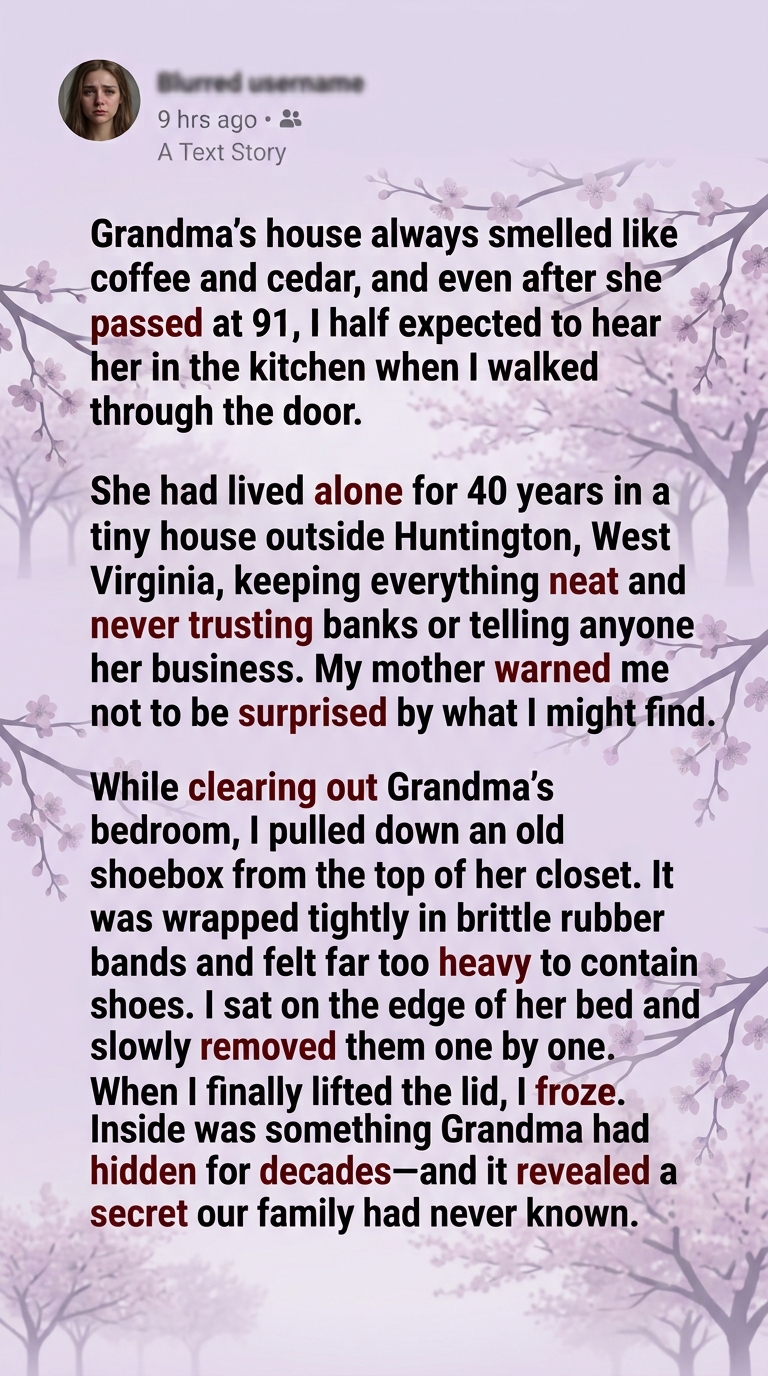
Grandma’s house always smelled like coffee and cedar.
Even after she passed at ninety-one, I half expected to hear her in the kitchen whenever I walked through the front door.
The old coffee pot was still sitting on the counter.
Her cedar chest was still against the wall.
Her slippers were beside her favorite chair.
Everything looked exactly the same.
Except Grandma was gone.
She had lived alone for forty years in a tiny house outside Huntington, West Virginia.
She didn’t trust banks.
She didn’t talk about money.
She didn’t tell people her business.
If someone asked how she was doing, she’d smile and say,
“I’m still here.”
That was Grandma.
My mother warned me before we started cleaning the house.
“Don’t be surprised by what you find.”
I laughed.
“What could she possibly have?”
Mom gave me a strange look.
“You didn’t know Grandma as well as you think.”
I didn’t understand what she meant until the third day.
We were cleaning her bedroom.
I opened drawers full of handkerchiefs.
Found old receipts.
Buttons.
A collection of birthday cards.
Then I looked toward the top shelf of her closet.
There was an old shoebox.
It was wrapped tightly in brittle rubber bands.
I pulled it down.
It was surprisingly heavy.
“Mom?”
She looked over.
“What?”
“Did Grandma keep something in here?”
Mom shook her head.
“I’ve never seen it.”
I sat on the edge of Grandma’s bed.
One by one, I removed the rubber bands.
They snapped as I pulled them away.
Finally, I lifted the lid.
And froze.
Inside were bundles of envelopes.
Dozens of them.
Some were yellow with age.
Some were tied with string.
There were bank deposit slips.
Photographs.
Newspaper clippings.
And a small black notebook.
But that wasn’t what made my hands shake.
At the very bottom was a thick envelope.
Across the front, in Grandma’s handwriting, were four words:
FOR MY FAMILY — 2024
I looked at Mom.
“What year did she write this?”
Mom’s face changed.
“I don’t know.”
Grandma had died only two weeks earlier.
I opened the envelope.
Inside was a letter.
The first line read:
“If you’re reading this, I finally ran out of time.”
My stomach tightened.
I kept reading.
“There’s something I’ve carried for forty-seven years. I didn’t tell your mother. I didn’t tell your uncles. And I didn’t tell the police.”
I looked up.
“Mom…”
She was already crying.
“What does it say?”
I continued.
“In 1977, something happened that changed our family forever.”
Then came a name.
Evelyn Carter.
My mother gasped.
I had never heard that name.
“Who is Evelyn?”
Mom didn’t answer.
I looked at her.
“Mom?”
She whispered,
“I don’t know.”
But her face told me she did.
I read the next paragraph.
“Evelyn was sixteen years old when she disappeared.”
My heart started pounding.
Grandma had written that Evelyn had been the daughter of a woman who worked at the small textile mill where Grandma had cleaned offices.
One night in October 1977, Evelyn didn’t come home.
Her mother reported her missing.
Police searched.
Neighbors searched.
There were newspaper articles.
But Evelyn was never found.
Grandma had been one of the last people known to have seen her.
She had never told anyone.
According to the letter, Grandma had seen Evelyn arguing with a man outside the mill.
A man Grandma recognized.
My grandfather’s younger brother.
My great-uncle Raymond.
I stopped reading.
“Mom.”
She shook her head.
“No.”
“You knew?”
“I knew there had been a missing girl.”
“Did you know Uncle Raymond was involved?”
“I didn’t.”
I kept reading.
Grandma wrote that she hadn’t reported what she saw because Raymond had threatened her.
He told her that if she spoke, her husband would lose his job.
Her children would be taken away.
And Evelyn would never be found.
Grandma had been twenty-seven.
She had two small children.
She was terrified.
So she stayed silent.
But she didn’t forget.
The shoebox contained everything she had secretly collected over the next forty-seven years.
Newspaper articles.
Photographs.
Copies of police reports.
Handwritten notes.
Names.
Dates.
And bank receipts.
I picked up the black notebook.
Inside were hundreds of entries.
Grandma had spent decades tracking the people connected to Evelyn’s disappearance.
She had found addresses.
Vehicle registrations.
Property records.
Even old newspaper advertisements.
She had never stopped looking.
Then I found a photograph.
It showed a teenage girl standing beside a creek.
On the back Grandma had written:
“Evelyn, summer 1977.”
I stared at it.
She looked happy.
Alive.
Then I noticed something behind her.
A wooden sign.
Partially visible.
I recognized the place.
A campground near the Ohio River.
Mom looked at the photograph.
“I remember that place.”
“You went there?”
“When I was little.”
I turned the photograph over again.
There was another note.
“She was here the night she disappeared.”
We called the police.
They initially treated the information as an old, unsolved case.
But the evidence was unusually detailed.
The detective took everything from the shoebox.
He also asked about Raymond.
We told him he had died in 1998.
That seemed to close one door.
But the detective didn’t stop.
He found archived records.
Then something unexpected appeared.
A bank record.
A withdrawal made two days after Evelyn disappeared.
The account belonged to Raymond.
The amount was significant for 1977.
Grandma had written beside it:
“Why would he need this after she vanished?”
The detective followed the trail.
The money had been used to purchase a used truck.
The truck was registered to Raymond.
The same truck appeared in an old police report.
It had been seen near the campground.
Then came the breakthrough.
One of Grandma’s newspaper clippings contained a tiny classified advertisement.
She had circled it.
It was from 1978.
A woman named Helen Morris was looking for information about a missing teenage girl.
The girl was Evelyn.
But Helen wasn’t Evelyn’s mother.
She lived three counties away.
Why was she looking for Evelyn?
Investigators found Helen.
She was eighty-seven.
And she remembered everything.
She told them Evelyn had come to her house in 1977.
Alive.
Frightened.
She had asked for help.
Helen said she had wanted to call the police.
But before she could, Raymond arrived.
Evelyn ran.
Helen never saw her again.
Then Helen remembered something she’d forgotten for decades.
Evelyn had left behind a small suitcase.
Inside was a photograph.
The same photograph Grandma had kept.
And a handwritten address.
An address in another state.
Investigators followed it.
The house no longer existed.
But county records showed that a young woman had lived there under a different name.
The name was Elaine Harper.
And there was a birth certificate.
For a baby girl.
Born in 1979.
Mother:
Elaine Harper.
Father:
Unknown.
The detective looked at us.
“Your grandmother may have been right.”
A DNA search was conducted.
And three weeks later, the detective called.
“She’s alive.”
I dropped the phone.
“What?”
“Evelyn is alive.”
She was seventy-three years old.
She had spent decades living under another name.
She had never returned because she believed Raymond would find her.
She had eventually built a life.
She had a daughter.
Two grandchildren.
And she had carried the memory of that night for forty-seven years.
When investigators contacted her, she asked one question.
“Is Mary still alive?”
Grandma’s name was Mary.
I told the detective she had died.
Evelyn cried.
Then she said,
“She was the only person who tried to help me.”
That wasn’t what Grandma’s letter had said.
Grandma had always believed she had failed.
She wrote:
“I was afraid. I should have gone to the police. I should have told everyone. I have carried that guilt every day since.”
But Evelyn remembered it differently.
That night, Grandma had apparently approached her outside the mill.
She had given her money.
Told her to run.
And promised she would keep looking.
Evelyn believed Grandma had saved her life.
She had simply never known where Grandma went afterward.
The truth was even more complicated.
Grandma had secretly sent money to Evelyn for years.
Small amounts.
Always cash.
Always through intermediaries.
She had never known whether Evelyn received it.
The bank receipts in the shoebox were proof.
Grandma had spent decades trying to help the girl she’d been too afraid to save openly.
At the bottom of the box was one final envelope.
This one had no date.
It contained a photograph.
A young woman.
Standing beside two children.
On the back Grandma had written:
“I think she made it.”
Then beneath that:
“If I was wrong, forgive me.”
I cried when I read it.
Not because Grandma had solved the mystery.
Because she had spent forty-seven years carrying it alone.
She had never trusted banks.
Never trusted people.
Never told anyone her business.
But she had trusted one thing:
That eventually, somebody would find the truth.
Months later, Evelyn came to Grandma’s house.
She stood on the porch for several minutes before entering.
Then she walked into the kitchen.
The old coffee pot was still there.
The cedar chest was still in the corner.
She touched the counter.
“She always made coffee this strong.”
My mother stared at her.
“You knew?”
Evelyn smiled.
“She used to make it for me when I was sixteen.”
Mom began crying.
So did I.
Evelyn walked into Grandma’s bedroom.
She saw the empty space where the shoebox had been.
Then she said,
“She kept everything.”
I nodded.
“She never stopped looking.”
Evelyn touched the bedspread.
“I know.”
“How?”
She smiled sadly.
“Because she was the reason I kept going.”
Before she left, she gave me something.
A small folded piece of paper.
It was an old note Grandma had written in 1977.
It said:
“You are not what happened to you. Get somewhere safe. Live.”
I read it three times.
Then I understood why Grandma had hidden the shoebox.
She wasn’t hiding money.
She was hiding a promise.
A promise she had made to a frightened sixteen-year-old girl nearly half a century earlier.
She had kept that promise until the day she died.
Grandma’s house still smells like coffee and cedar.
Her chair is still in the corner.
Her recipe cards are still in the kitchen.
But now there’s something else in the house.
A framed photograph of Evelyn.
Alive.
Smiling.
Surrounded by her children and grandchildren.
We placed it beside Grandma’s photograph.
Because after forty-seven years, two women who had been separated by fear finally had their stories put back together.
And every time I look at that old shoebox, I think about what Grandma taught us without ever saying it aloud:
Some secrets are buried because someone is ashamed.
Others are buried because someone is still trying to protect the truth.
Grandma had hidden hers for forty-seven years.
But she hadn’t hidden it forever.
She had left us a trail.
And eventually, we followed it home.