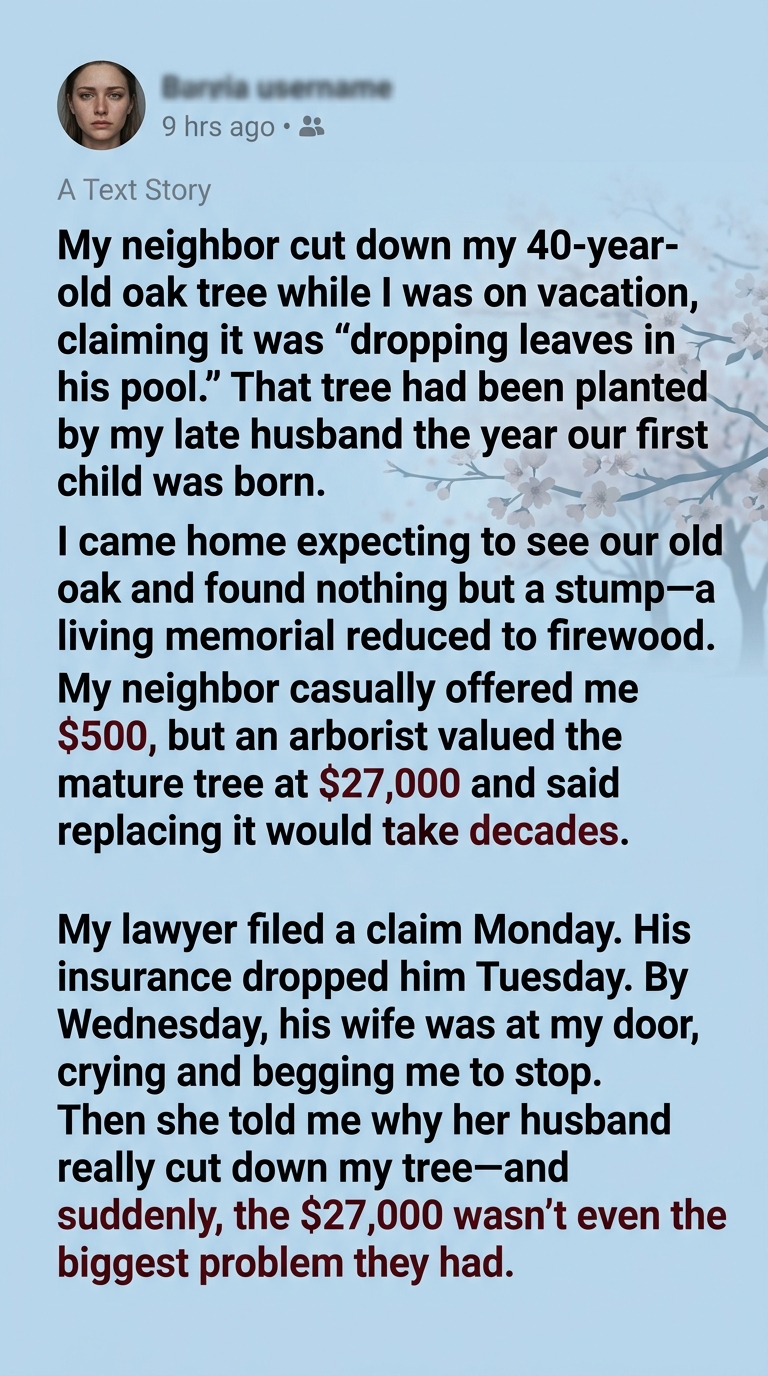
My neighbor cut down my 40-year-old oak tree while I was on vacation.
He claimed it was “dropping leaves in his pool.”
That was the excuse.
But the tree had stood in my yard for four decades.
My late husband, Daniel, planted it the year our first child was born.
I still remembered that day.
Daniel had come home carrying a tiny oak sapling in a bucket.
“Forty years from now,” he told me, “this thing will be bigger than the house.”
I laughed.
“You’re planning that far ahead?”
He kissed my forehead.
“For once, yes.”
We planted it together.
Our son, Michael, was still a baby.
Over the years, that tree became part of our family.
We measured our children’s heights against its trunk.
We hung Christmas lights from its branches.
Daniel built a small bench beneath it.
When our daughter was married, she took pictures beneath it.
And after Daniel died, I spent countless afternoons sitting on that bench, listening to the wind move through the leaves.
It wasn’t just a tree.
It was the last living thing Daniel had planted with his own hands.
Then I went away for ten days to visit my daughter.
I came home on a Sunday afternoon.
I pulled into my driveway.
And immediately knew something was wrong.
The backyard looked strangely empty.
I got out of my car.
I stared through the gate.
There was no oak.
Just a stump.
For several seconds, I couldn’t breathe.
I dropped my suitcase.
“No…”
I walked into the backyard.
The stump was enormous.
Fresh saw marks covered the top.
Branches were scattered across the neighbor’s property.
Some had already been cut into logs.
I stood there with my hand over my mouth.
Daniel’s tree was gone.
Then my neighbor, Greg, walked out of his back door.
He looked completely relaxed.
“Oh, you’re home.”
I stared at him.
“You cut down my tree.”
Greg shrugged.
“It was becoming a problem.”
“A problem?”
“Leaves were constantly blowing into my pool.”
I couldn’t believe what I was hearing.
“You cut down a forty-year-old oak because of leaves?”
“It was overhanging my property.”
“It was on my property.”
He shrugged again.
“Well, some of it was over the fence.”
I looked at the stump.
“You destroyed my tree.”
“I’ll give you five hundred dollars.”
I laughed.
Not because anything was funny.
Because I didn’t know what else to do.
“Five hundred dollars?”
“It’s more than fair.”
I pointed toward the stump.
“You just cut down something my husband planted forty years ago.”
Greg rolled his eyes.
“It’s a tree.”
That sentence changed everything.
I went inside and called my lawyer.
Her name was Rachel.
She asked me to send photographs.
Then she asked for my property survey.
Then the original landscaping records.
The next morning, she sent an arborist to inspect the stump.
He spent nearly two hours measuring it.
When he finished, he looked at me.
“Mrs. Harris, this was an exceptional mature oak.”
“How much was it worth?”
He hesitated.
“Replacement value?”
“Yes.”
“Approximately twenty-seven thousand dollars.”
I stared at him.
“Twenty-seven thousand?”
“And that’s not including the sentimental value.”
He explained that a tree of that size and age couldn’t simply be replaced by planting another oak.
A new tree would take decades to reach comparable maturity.
Rachel filed a claim that Monday.
The claim included the arborist’s report, photographs, property records, and evidence that Greg had hired the tree service himself.
On Tuesday, Greg’s insurance company contacted him.
That afternoon, I received a phone call.
“Mrs. Harris?”
“Yes?”
“This is Greg’s insurance adjuster. We need to discuss the unauthorized removal of the tree.”
“I’d be happy to.”
The adjuster told me they were reviewing the claim.
Then she said something unexpected.
“Given the circumstances, we’re also reviewing whether Mr. Lawson’s policy remains valid.”
Apparently, Greg had initially told the insurer the tree had been “dead and dangerous.”
The photographs proved otherwise.
It had been completely healthy.
By Wednesday morning, Greg’s wife, Karen, knocked on my door.
She looked exhausted.
Her eyes were red.
“Please,” she whispered.
“Please stop the claim.”
I stared at her.
“Why?”
She started crying.
“Because my husband didn’t cut down that tree for the reason he told you.”
I stepped aside.
“Come in.”
She sat at my kitchen table.
Her hands were shaking.
“He told me you were away,” she said.
“And?”
“He said he needed to remove the tree because it was damaging our pool.”
I waited.
“That wasn’t true.”
“What was the real reason?”
Karen looked toward the window.
Then she lowered her voice.
“He found something underneath it.”
My heart skipped.
“What?”
“A metal box.”
I stared at her.
“What kind of box?”
“I don’t know.”
“Where is it?”
Karen swallowed.
“My husband has it.”
I stood.
“What was inside?”
She shook her head.
“He didn’t tell me everything.”
“Karen.”
She looked at me.
“Please understand. I didn’t know what he was going to do.”
“What did he find?”
She took a breath.
“Documents.”
“What documents?”
“Old ones.”
She pulled her phone from her purse.
Then she showed me a photograph.
It was a picture of the stump.
Taken from the other side of the fence.
Near the roots was a dark rectangular hole.
My stomach tightened.
“When did he find the box?”
“The day he cut down the tree.”
“Why didn’t he tell me?”
Karen looked at me.
“Because he knew you’d never agree to him taking it.”
I called Rachel.
She arrived less than an hour later.
Karen repeated everything.
Rachel asked her several questions.
Then she said,
“Does your husband know you’re here?”
Karen shook her head.
“He thinks I’m trying to convince you to drop the claim.”
Rachel looked at me.
“Don’t confront him.”
That evening, we obtained an emergency preservation order.
Greg was required to preserve anything removed from my property.
The next morning, investigators arrived.
Greg wasn’t home.
But his attorney was.
Under the order, they searched the garage.
They found the metal box hidden behind a stack of paint cans.
Inside were documents wrapped in plastic.
Some were nearly forty years old.
There were property maps.
Bank records.
Construction permits.
And photographs.
One photograph made me sit down.
It showed my husband.
Daniel.
Standing beside our oak tree.
The photograph had been taken the day we planted it.
I stared at his face.
Then I noticed someone else in the background.
A man standing beside the fence.
Greg’s father.
I looked at Rachel.
“Why would his father be there?”
She didn’t answer.
We kept looking.
The oldest document was a handwritten agreement dated 1984.
It concerned the development of our neighborhood.
The land where our homes now stood had once belonged to a larger family property.
And buried among the paperwork was something nobody in our neighborhood knew.
A strip of land running along the back of several properties had been improperly transferred decades earlier.
According to the documents, my husband had purchased our home with the correct boundary.
But the neighboring property had been built several feet across the legal line.
Including Greg’s pool.
Rachel’s eyes widened.
“That’s why he cut the tree.”
I didn’t understand.
“He wanted the tree gone?”
“He wanted access.”
She pointed to the survey.
The oak’s roots extended beneath the disputed strip.
More importantly, the tree stood directly over an old drainage easement.
Greg had been trying to sell his house.
And the buyer’s survey had apparently discovered the boundary problem.
If the encroachment became known, Greg could be forced to remove part of his pool and pay substantial costs.
But there was another problem.
The documents in the box showed that Greg’s father had known about the boundary issue when he sold the property to Greg.
And there was evidence he had concealed it.
Greg hadn’t cut down my tree because of leaves.
He had destroyed it because its roots and location were physical evidence of the original boundary.
He thought removing the tree would make the evidence disappear.
But he hadn’t realized the original survey was still in the metal box beneath it.
The irony was almost unbelievable.
The tree he destroyed to hide the problem had led us directly to the documents proving it.
But then Rachel found something else.
A bank statement.
A payment from Greg to a contractor.
The description read:
“Removal — rear property obstruction.”
The date was three days before my vacation ended.
He had planned the whole thing.
The arborist later testified that the tree had been healthy.
The property survey confirmed it was entirely on my land.
Greg’s insurer denied coverage for the intentional destruction.
The buyer walked away from Greg’s house.
And the county opened an investigation into the decades-old property records.
Greg eventually admitted what he had done.
He thought removing the oak would eliminate the boundary evidence.
Instead, it exposed everything.
The final settlement was far larger than the original $27,000 tree valuation.
Greg had to pay for the tree, legal costs, environmental restoration, and damages connected to the unauthorized removal.
He also had to correct the property encroachment.
But I refused to let the money become the end of the story.
I had another oak planted.
Not a forty-year-old tree.
That was impossible.
Instead, my children helped me choose a young sapling.
We planted it exactly where Daniel’s tree had stood.
Michael brought his children.
My daughter brought hers.
We placed Daniel’s old garden bench beneath it.
Before we finished, Karen came over.
She stood beside me.
“I am so sorry,” she said.
I looked at the tiny tree.
“So am I.”
She started crying again.
“I never wanted any of this.”
“I know.”
Then she asked,
“Do you hate us?”
I thought about Greg.
About the chainsaw.
About the stump.
About the metal box.
About Daniel.
“No,” I said.
“But I don’t trust you anymore.”
She nodded.
“I understand.”
Years from now, this new oak will be large.
Maybe not forty years old.
Maybe not as beautiful as the one Daniel planted.
But it will grow.
And my grandchildren will sit beneath it.
They’ll hear stories about their grandfather.
I’ll tell them about the tiny sapling he carried home in a bucket.
I’ll tell them how he promised it would outlive him.
And I’ll tell them about the neighbor who thought he could erase forty years with a chainsaw.
Because in the end, Greg didn’t just cut down a tree.
He uncovered a secret buried beneath it.
And the $27,000 tree wasn’t even the biggest problem he had.
The biggest problem was that the roots weren’t the only thing connecting my property to the truth.