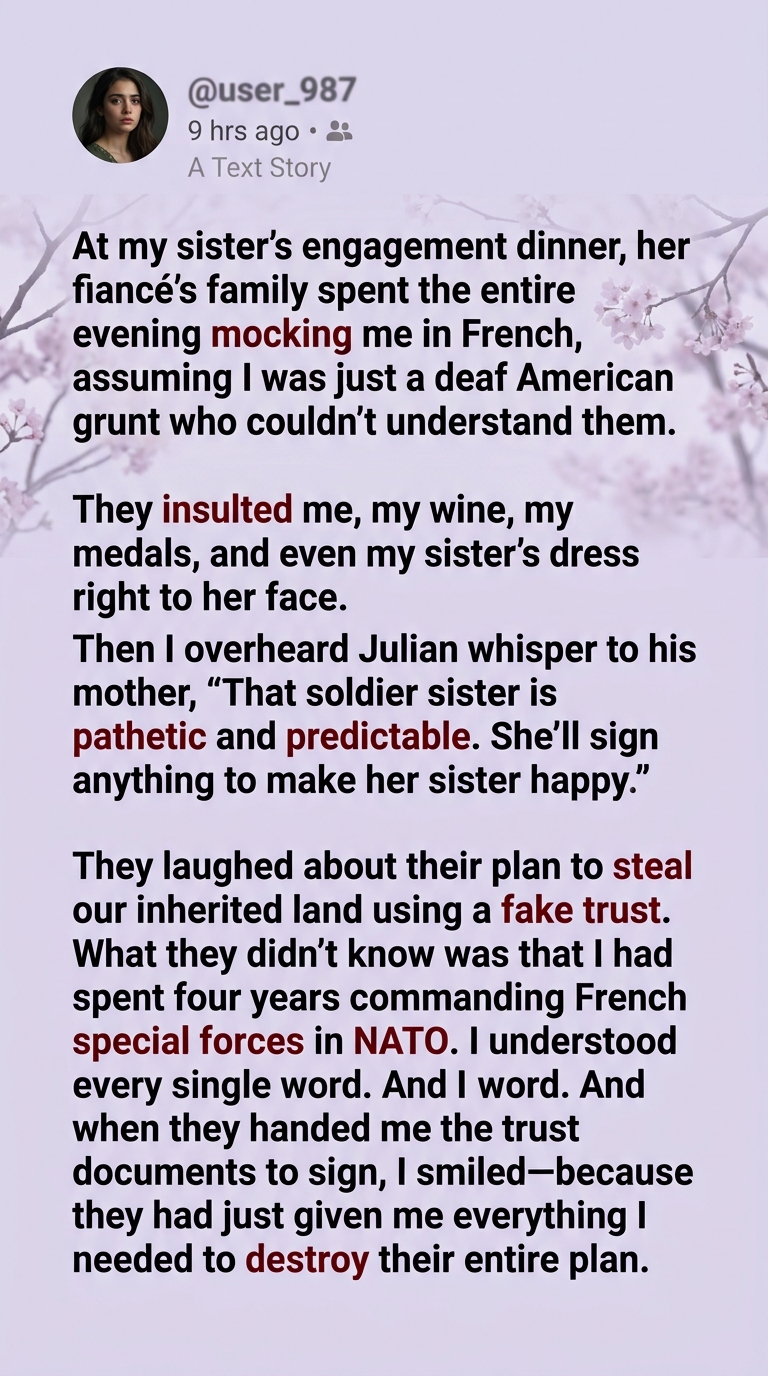
At my sister’s engagement dinner, her fiancé’s family spent the entire evening mocking me in French.
They thought I was deaf.
More accurately, they thought I was a deaf American grunt who couldn’t understand a word they were saying.
They were wrong.
Very wrong.
My name is Claire Bennett, and for four years I had commanded a French special-forces unit as part of a NATO assignment.
I spoke French fluently.
I understood every insult.
Every joke.
Every whispered conversation.
And by the end of that dinner, I knew my sister’s fiancé’s family was planning to steal something that had belonged to ours for generations.
But I didn’t say a word.
Not yet.
My younger sister, Emma, was engaged to a man named Julian Moreau.
At first, I liked him.
He was charming.
Educated.
Polished.
He came from an old French family that owned vineyards and several properties in Europe.
Julian always spoke respectfully to Emma.
But something about his family bothered me.
They looked at me differently.
Not because I was a soldier.
Because they had already decided what kind of soldier I was.
A rough American who didn’t belong in their world.
At the engagement dinner, Julian’s mother, Isabelle, greeted me with an exaggerated smile.
“So you’re the famous sister.”
I smiled.
“I suppose I am.”
She laughed.
Then turned to her husband and said something in French.
Everyone at the table laughed.
I understood it perfectly.
She looks exactly like what I expected.
I pretended not to notice.
Dinner continued.
They criticized the wine I had chosen.
They laughed at my military medals.
One of Julian’s cousins picked up my service medal and asked whether it was “a participation trophy.”
Emma looked uncomfortable.
“Please don’t.”
Isabelle waved her hand.
“Oh, we’re only joking.”
Then she looked at my uniform jacket hanging over the back of my chair.
“What does someone like you even do at a dinner like this?”
I smiled.
“Eat.”
Emma nearly laughed.
Julian didn’t.
He looked embarrassed.
But his family continued.
They mocked my clothes.
My accent.
My career.
Then they started discussing Emma’s wedding dress.
They didn’t realize she could understand enough French to know they were criticizing it.
Emma’s face fell.
I reached beneath the table and squeezed her hand.
“Don’t react,” I whispered.
She looked at me.
“How are you so calm?”
I smiled.
“Training.”
Later, I stepped away from the table to get some air.
That’s when I heard Julian.
He was standing near the hallway with his mother.
They didn’t know I was there.
Julian spoke quietly in French.
“That soldier sister is pathetic and predictable.”
His mother laughed.
“She’ll sign anything to make her sister happy.”
I stopped.
Then Julian said something that made my entire body go cold.
“Once the trust is transferred, the land will be ours.”
I stayed perfectly still.
His mother whispered,
“And she doesn’t know about the old restriction?”
“No.”
“What if she asks questions?”
Julian laughed.
“She won’t.”
Then came the sentence that changed everything.
“She thinks she’s protecting her sister.”
I stepped back before they could see me.
My heart was pounding.
The land.
They were talking about our land.
My grandfather had left a large rural property to my sister and me.
It had been in our family for generations.
There was an old farmhouse.
Several hundred acres of woodland.
And a small lake.
Developers had offered millions for it over the years.
We always refused.
The land had never been about money.
It was family.
Julian knew that.
His family knew that.
And apparently, they had found a way to take it.
The next morning, Emma called me.
“Claire?”
“What’s wrong?”
“Julian’s father wants us to sign some trust documents.”
I sat upright.
“What documents?”
“He says they’re just for estate planning.”
“Don’t sign anything.”
She paused.
“Why?”
I couldn’t tell her everything yet.
“Because I want a lawyer to look at them first.”
She sighed.
“Julian says you’re being paranoid.”
“Maybe.”
Then I added,
“But let me be paranoid for both of us.”
Two days later, Julian invited us to his parents’ house.
They had prepared coffee, pastries, and a thick folder.
Julian smiled.
“These are very simple.”
I opened the folder.
The documents were in English.
That was their first mistake.
The trust was designed to transfer our inherited property into a private holding structure.
The beneficiary would initially be Emma and me.
But there was a clause buried near the end.
If either beneficiary transferred her interest under certain circumstances, the remaining trustee could acquire control of the property.
And the proposed trustee?
Julian’s father.
I read it twice.
Then looked up.
“What’s this section?”
Julian smiled.
“Standard language.”
His mother laughed.
“Don’t worry. It’s complicated.”
I nodded.
“I can see that.”
Julian slid a pen toward me.
“Just sign here.”
I picked up the pen.
His mother smiled.
I smiled back.
Then I signed.
Julian’s eyes lit up.
Emma looked confused.
“Claire?”
I handed the documents back.
“Thank you.”
Julian smiled.
“You see? Nothing to worry about.”
I stood.
“Nothing at all.”
What they didn’t know was that I hadn’t signed their trust.
I had signed a duplicate copy of the documents.
Before arriving, I had photographed every page and had my attorney prepare a legally meaningless acknowledgment form that looked almost identical to the signature page.
The actual documents remained unsigned.
But I needed them to believe otherwise.
Because now I had what I needed.
Their plan.
Their names.
Their proposed trustee.
And their signatures.
My attorney sent the documents to a specialist in international trusts and property law.
The results were worse than I expected.
The trust wasn’t merely designed to control the land.
It was designed to isolate it from us.
Julian’s family had already formed a development company.
They planned to borrow against the property once they controlled the trust.
Then they intended to sell portions of the land to another company they secretly controlled.
The entire arrangement would have looked like a legitimate investment transaction.
Except it wasn’t.
It was fraud.
There was one problem for them.
The original inheritance documents contained a restriction my grandfather had placed on the property.
Neither Emma nor I could permanently transfer ownership without independent legal certification that we understood the transaction and had received separate counsel.
The fake trust attempted to bypass that requirement.
And they had made another mistake.
They had put the fraudulent arrangement in writing.
My attorney contacted the authorities.
Then we waited.
Three weeks later, Julian called Emma.
He sounded irritated.
“The trust isn’t finalized.”
Emma looked at me.
I nodded.
She put him on speaker.
“What’s wrong?”
“Your sister’s lawyer is interfering.”
Emma frowned.
“She has a lawyer?”
Julian went silent.
Then he said,
“You didn’t tell me she was involved.”
Emma looked at me.
“She isn’t interfering.”
I finally spoke.
“She is.”
Julian recognized my voice.
“Claire.”
“Yes.”
His tone changed immediately.
“You’ve misunderstood the documents.”
“No.”
I opened the folder.
“I understood every word.”
Silence.
Then I switched to French.
Fluently.
“Especially the parts you discussed at the engagement dinner.”
The line went completely silent.
Julian didn’t answer.
His mother did.
“You speak French?”
I smiled.
“I commanded French special forces for four years.”
Another silence.
Then I added,
“So yes. I understood you.”
Julian’s breathing became audible.
“You were listening?”
“I wasn’t supposed to.”
I paused.
“But you weren’t exactly whispering.”
His mother began shouting.
I calmly interrupted.
“Don’t worry. I saved the recordings.”
That wasn’t entirely true.
I hadn’t recorded their private conversation.
But their expressions told me they didn’t know that.
What I did have was enough.
The documents.
The trust.
The corporate records.
The emails.
The signatures.
And the bank correspondence showing they had already approached lenders about using the property as collateral.
The case moved quickly.
Investigators determined that Julian’s family had attempted similar transactions involving other properties.
Several shell companies were connected.
The fake trust was dismantled.
The development company was investigated.
And the attorney who prepared the documents admitted he had been given incomplete information by Julian’s father.
Emma ended the engagement.
It broke her heart.
For months, she blamed herself.
She kept saying,
“How could I not see it?”
I told her the truth.
“Because you loved him.”
She cried.
“I feel stupid.”
“You aren’t stupid.”
“You knew.”
“I knew how to listen.”
I touched her hand.
“You knew how to love.”
Eventually, Emma understood something.
The person who betrayed her wasn’t her sister.
It was the man who had convinced her that trusting him meant ignoring everyone else.
Months later, we returned to the family property.
The farmhouse looked exactly as it had when we were children.
The old oak trees were still there.
The lake was still quiet.
Emma stood beside me.
“Grandpa would have hated what they tried to do.”
I smiled.
“He would have hated the paperwork more.”
She laughed.
Then she looked at me.
“You really understood everything they said that night?”
“Every word.”
She shook her head.
“What were you thinking?”
I looked across the land.
“I was thinking that people reveal themselves when they think nobody understands them.”
Emma smiled.
“And you let them.”
“Yes.”
“Why?”
I looked at her.
“Because sometimes the strongest move isn’t telling someone you know.”
I paused.
“It’s letting them give you the evidence.”
She nodded.
The wind moved through the trees.
For generations, our family had protected that land.
And now it was ours again.
Not because I had fought them with anger.
Not because I had threatened them.
Not because I was a soldier.
But because I stayed calm long enough for them to believe their own arrogance would protect them.
They thought I was a deaf American grunt.
They thought I was predictable.
They thought I’d sign anything to make my sister happy.
They were right about one thing.
I would do almost anything to protect my sister.
They just never imagined that protecting her meant understanding every word they said when they thought I couldn’t hear them.