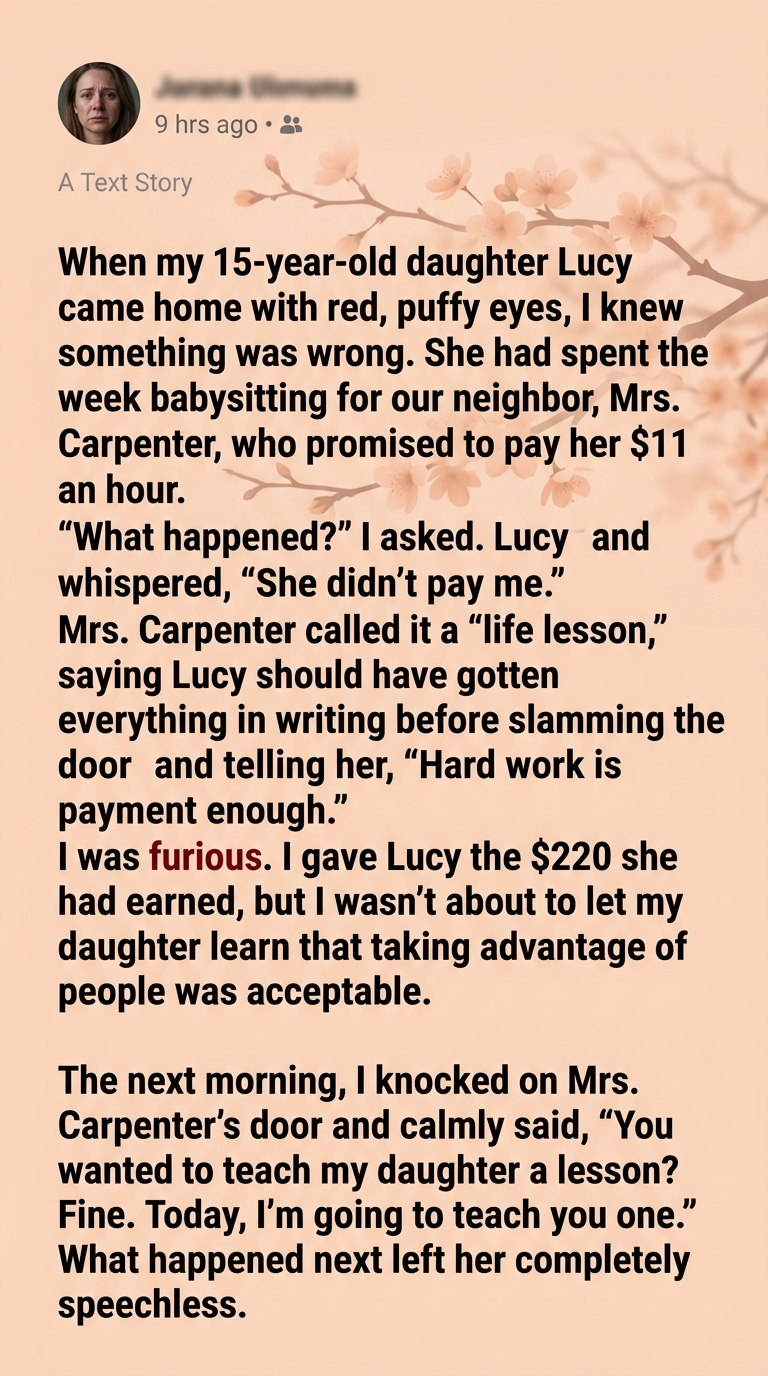
When my 15-year-old daughter Lucy came home with red, puffy eyes, I knew something was wrong.
She had spent the entire week babysitting for our neighbor, Mrs. Carpenter.
She had promised to pay Lucy $11 an hour.
Lucy had worked five evenings.
Four hours each night.
Twenty hours total.
She should have earned $220.
“What happened?” I asked.
Lucy wiped her eyes.
“She didn’t pay me.”
I thought I’d misunderstood.
“Who?”
“Mrs. Carpenter.”
“What did she say?”
Lucy looked down.
“She said it was a life lesson.”
My stomach tightened.
“What kind of life lesson?”
Lucy swallowed.
“She said I should have gotten everything in writing before I started.”
“And?”
“She said hard work is payment enough.”
I stared at my daughter.
She had spent the week feeding Mrs. Carpenter’s two children, helping the younger one with homework, washing dishes, putting away toys, and getting them ready for bed.
She had done everything she’d been asked to do.
And now the woman was refusing to pay her.
I drove to Mrs. Carpenter’s house.
She opened the door with an annoyed expression.
“I don’t appreciate being confronted about this.”
“Lucy worked twenty hours for you.”
“And?”
“You promised her $11 an hour.”
Mrs. Carpenter shrugged.
“She should have gotten it in writing.”
“She was fifteen.”
“Then she should learn.”
I felt my anger rising.
“You don’t teach a teenager responsibility by breaking your word.”
She crossed her arms.
“Hard work is payment enough.”
Then she closed the door.
I stood there for several seconds.
Then I went home.
I gave Lucy $220 from my own wallet.
She looked at me.
“Mom, you don’t have to.”
“Yes, I do.”
“But she should pay you back.”
“I’ll handle that.”
Lucy hugged me.
I held her tightly.
Then I told her something.
“Working hard should never make you ashamed to expect fairness.”
The next morning, I knocked on Mrs. Carpenter’s door.
She opened it.
Before she could speak, I smiled politely.
“You wanted to teach my daughter a lesson?”
She sighed.
“Yes.”
“Fine.”
I took a step closer.
“Today, I’m going to teach you one.”
She raised an eyebrow.
“What exactly are you going to teach me?”
“That when you make a promise to a child, you don’t get to rewrite it after the work is finished.”
She laughed.
“You can’t force me to pay her.”
“No.”
I nodded.
“But I can make sure everyone understands what happened.”
Her smile disappeared.
I held up my phone.
“I have the text messages between you and Lucy.”
Mrs. Carpenter froze.
The messages showed her agreeing to $11 an hour.
She had even written:
You’re doing me a huge favor. I’ll make sure you’re paid Friday.
Then I showed her something else.
“Lucy also kept a record of every hour she worked.”
Mrs. Carpenter scoffed.
“So?”
“So this isn’t a misunderstanding.”
I paused.
“You hired her.”
She said nothing.
“You agreed to a rate.”
Silence.
“She performed the work.”
Nothing.
“And then you decided the agreement no longer mattered.”
Mrs. Carpenter’s face hardened.
“Are you threatening me?”
“No.”
I smiled.
“I’m giving you a choice.”
She crossed her arms.
“What choice?”
“You can pay Lucy the $220 you owe her.”
“And if I don’t?”
“Then I’ll let the school counselor know what happened.”
She laughed.
“The school isn’t going to care about a babysitting dispute.”
“Maybe not.”
I nodded.
“But I also contacted three other parents in the neighborhood.”
Her expression changed.
“What?”
I pulled out my phone.
“Two of them told me you have done this before.”
She went completely still.
“One teenager said you promised $12 an hour for yard work and then gave him $40 for six hours.”
Another had cleaned her house for a weekend.
She’d been promised $100.
She received $20.
Mrs. Carpenter’s face turned pale.
I hadn’t known about those incidents before that morning.
But once I started asking questions, the pattern became obvious.
This wasn’t a lesson.
It was a habit.
Mrs. Carpenter had discovered that teenagers were easy to exploit because they often didn’t know how to challenge adults.
She called it teaching responsibility.
It was simply refusing to pay.
Then I did something she didn’t expect.
I handed her an envelope.
She looked at it.
“What is this?”
“Your invoice.”
She stared at me.
“For what?”
“Twenty hours of parenting advice.”
She looked at me like I had lost my mind.
I smiled.
“I’m kidding.”
Then I opened the envelope.
Inside was a printed copy of the messages, the work log, and a simple written demand for payment.
“I’m not asking for anything extra.”
I looked her in the eyes.
“Just what you promised.”
She shook her head.
“You’re being ridiculous.”
“No.”
I stepped back.
“You were.”
Then I turned around.
I expected her to slam the door.
Instead, she called after me.
“Wait.”
I stopped.
She disappeared inside.
A moment later, she returned holding a check.
$220.
She handed it to me.
“Fine.”
I looked at the check.
Then at her.
“This isn’t for me.”
“I know.”
She sighed.
“It’s for Lucy.”
I took it.
Then she said something I didn’t expect.
“I didn’t think she’d actually tell you.”
I stared at her.
“That’s the problem.”
She looked down.
“I thought she was just a kid.”
“She is.”
I nodded.
“And that’s exactly why you should have treated her fairly.”
I went home and gave Lucy the check.
She stared at it.
“She paid?”
“Yes.”
Lucy smiled.
Then she frowned.
“Did you yell at her?”
“No.”
“What did you do?”
“I showed her the truth.”
Lucy hugged me.
“Thank you.”
But the story didn’t end there.
That afternoon, Mrs. Carpenter came to our house.
She looked uncomfortable.
“I owe you an apology.”
I invited her inside.
She sat down.
“I’ve done this before.”
“I know.”
She looked surprised.
“I didn’t realize you knew.”
“I didn’t.”
She looked at the floor.
“My husband lost his job last year. Money got tight. I started convincing myself that every little amount I saved mattered.”
She paused.
“Then it became easier.”
“Easier to not pay teenagers?”
“Yes.”
She wiped her eyes.
“I kept telling myself I was teaching them something.”
I nodded.
“Sometimes people give their bad behavior a respectable name because the real name makes them uncomfortable.”
She looked at me.
“What should I do?”
“Pay everyone you owe.”
She nodded.
“And apologize.”
She nodded again.
“And don’t hire anyone until you can afford to pay them.”
She whispered,
“I will.”
Over the next week, she contacted the other teenagers.
She paid them what she owed.
Not everyone forgave her.
Some didn’t want anything to do with her again.
And that was their right.
Lucy eventually started babysitting again.
But this time, she created a simple written agreement.
Hours.
Rate.
Payment date.
Responsibilities.
Her first new client was another family down the street.
Before Lucy left for the first evening, she showed me the agreement.
I smiled.
“You’re learning.”
She smiled back.
“From you?”
“Hopefully.”
She laughed.
“No. From Mrs. Carpenter.”
I raised an eyebrow.
Lucy shrugged.
“She taught me exactly what kind of employer I don’t want to be.”
I laughed.
Months later, Lucy opened a savings account with the money she earned from babysitting.
She saved enough to buy her first used car.
She also started helping younger kids in our neighborhood understand how to keep records of their work and agree on payment beforehand.
One evening, she came home and said,
“Mom?”
“Yes?”
“Mrs. Carpenter asked if I’d babysit again.”
I looked at her.
“What did you say?”
“I said yes.”
I smiled.
“Really?”
“Yeah.”
“Why?”
Lucy shrugged.
“She paid me in advance.”
We both laughed.
Mrs. Carpenter had finally learned the lesson.
Not because someone embarrassed her.
Not because someone threatened her.
But because she discovered that teenagers aren’t invisible simply because they’re young.
They work.
They deserve respect.
And when you make a promise to them, your word is the first thing they should be able to trust.
As for Lucy, she learned something even more important.
Being young doesn’t mean you have to accept being treated unfairly.
And standing up for yourself doesn’t require shouting.
Sometimes, all it takes is a calm voice, a written record, and the courage to say:
“You wanted to teach my daughter a lesson. Fine. Now it’s your turn.”