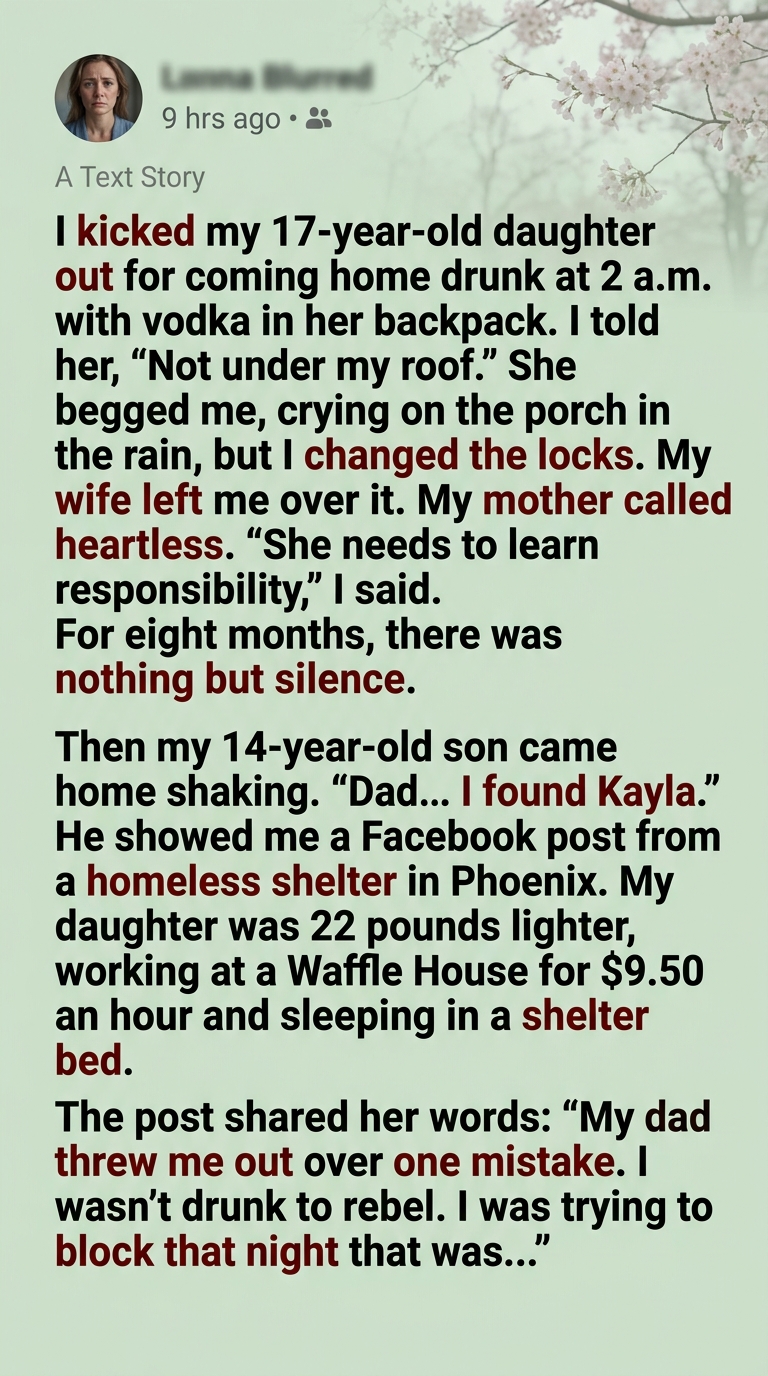
I kicked my seventeen-year-old daughter out for coming home drunk at 2 a.m. with a bottle of vodka in her backpack.
“Not under my roof.”
Those were the words I said.
She begged me.
She cried on the porch in the rain.
And I changed the locks.
At the time, I thought I was being a good father.
I thought consequences were supposed to hurt.
I thought if I made the punishment severe enough, Kayla would understand that actions had consequences.
I didn’t understand that I was punishing a child for something I didn’t know how to see.
Kayla had always been a good kid.
She got decent grades.
She babysat for neighbors.
She worked weekends at a grocery store.
She wasn’t perfect, but she wasn’t reckless either.
So when I found her stumbling through the front door at two in the morning, my first reaction was anger.
Then I smelled the alcohol.
“What is that?”
She froze.
I saw the backpack.
“Open it.”
“Dad…”
“Open it.”
Her hands shook as she unzipped it.
There was a bottle of vodka inside.
I felt betrayed.
“You’re seventeen.”
“I know.”
“You’ve been drinking?”
She started crying.
“I made a mistake.”
I was furious.
“You think this is a mistake?”
“Yes.”
“No. This is a choice.”
She tried to explain.
I didn’t listen.
I was already thinking about punishment.
“You’re done.”
Her eyes widened.
“What?”
“You’re leaving.”
She stared at me.
“Dad, please.”
“Not under my roof.”
My wife, Melissa, came running downstairs.
“What are you doing?”
“She came home drunk.”
Melissa looked at Kayla.
Then at me.
“She’s seventeen.”
“Exactly.”
“She’s scared.”
“She should be.”
Kayla stepped toward me.
“Dad, please don’t.”
I opened the front door.
Rain was pouring outside.
She stood on the porch in a sweatshirt and jeans, crying so hard she could barely speak.
“I don’t have anywhere to go.”
“You should have thought about that before you drank.”
“Dad…”
I closed the door.
Melissa stared at me.
“What have you done?”
“I’m teaching her responsibility.”
“No,” she whispered.
“You’re abandoning her.”
That night, Melissa slept at her sister’s house.
The next morning, she told me she was leaving.
I thought she would cool down.
She didn’t.
Three days later, she filed for separation.
My mother called me heartless.
My friends told me I’d gone too far.
I defended myself every time.
“She needs to learn responsibility.”
I said it so often that eventually I started believing it.
For eight months, there was silence.
No calls.
No messages.
Nothing.
I didn’t know where Kayla was.
Part of me expected her to come home.
Another part of me was too proud to admit I wanted her to.
Then one afternoon, my fourteen-year-old son, Ethan, came home shaking.
“Dad.”
He was holding his phone.
“What happened?”
He couldn’t answer.
“Ethan?”
He turned the screen toward me.
There was a Facebook post from a homeless shelter in Phoenix.
A young woman was sitting in a cafeteria.
Her hair was shorter.
Her face was thinner.
But I recognized her immediately.
Kayla.
My daughter.
The caption said she had been staying at the shelter and working nearby.
Then I saw the words that destroyed me.
Working at a Waffle House for $9.50 an hour.
Twenty-two pounds lighter.
Sleeping in a shelter bed.
I sat down.
Ethan was crying.
“She wrote something.”
I scrolled.
Kayla had agreed to share her story anonymously to encourage other teenagers who were struggling.
Then I saw her words.
My dad threw me out over one mistake.
I couldn’t breathe.
Then the next sentence appeared.
I wasn’t drunk to rebel.
I stared at the screen.
I was trying to block that night that was…
The post ended there.
I looked at Ethan.
“What night?”
He shook his head.
“I don’t know.”
I read the sentence again.
And suddenly, eight months of silence became something else.
Not defiance.
Not punishment.
A warning I had missed.
I called Melissa.
She answered after several rings.
“Have you seen Kayla?”
“Yes.”
“I need to talk to you.”
“About what?”
I sent her the post.
She called me back almost immediately.
“She tried to tell us.”
My stomach dropped.
“What?”
“The night you threw her out.”
“What are you talking about?”
“She told me she had been at a party because she didn’t want to be home.”
“Why?”
Melissa started crying.
“She said something happened.”
“What happened?”
“She wouldn’t tell me.”
“Why didn’t you tell me?”
“Because you were already furious.”
I closed my eyes.
“She said someone had hurt her.”
The room seemed to disappear around me.
“What?”
“She said she couldn’t remember everything.”
My hands started shaking.
“Why didn’t she tell me?”
“She tried.”
I remembered that night.
Her crying.
Her saying, “Dad, please.”
I had assumed she was asking me not to punish her.
I had never asked what she was afraid of.
Melissa continued.
“She said she had been drinking because she wanted to stop thinking about what happened.”
I couldn’t speak.
The vodka hadn’t been the beginning of the story.
It had been the end of something I had never bothered to ask about.
I called the shelter.
They wouldn’t give me details without Kayla’s permission.
But they agreed to pass along my message.
I left one sentence.
“Tell her I want to see her. Not to punish her. To listen.”
Two days later, my phone rang.
It was Kayla.
Neither of us spoke for several seconds.
Then she whispered:
“Hi, Dad.”
I closed my eyes.
“Hi, sweetheart.”
She started crying.
“So you finally know?”
“I know I failed you.”
“No.”
“Yes.”
“You didn’t know.”
“I should have asked.”
Silence.
Then she said:
“I didn’t know how to tell you.”
I told her she didn’t have to tell me everything over the phone.
I only wanted to know one thing.
“Are you safe?”
“Yes.”
“Are you eating?”
“Yes.”
“Do you have somewhere to sleep tonight?”
“Yes.”
I swallowed.
“Can I come see you?”
She didn’t answer immediately.
Finally:
“Okay.”
I flew to Phoenix the next morning.
When I saw her, I almost didn’t recognize her.
She had lost twenty-two pounds.
Her hands looked smaller.
She seemed older than seventeen.
I wanted to hug her.
But I didn’t know if she wanted me to.
So I stood several feet away.
“I’m sorry.”
She looked at me.
“For what?”
“For changing the locks.”
Her face crumpled.
“I thought you hated me.”
“I never hated you.”
“You made me sleep outside.”
“I know.”
“You said I wasn’t welcome.”
“I know.”
“You didn’t even ask why I drank.”
That sentence destroyed me.
I sat down.
“You’re right.”
She looked away.
“I kept thinking if I told you, you’d blame me.”
I shook my head.
“I might have been angry. But I should have listened.”
She finally looked at me.
“I didn’t need you to punish me.”
“I know.”
“I needed you to ask why.”
I nodded.
“I should have.”
She told me what she could.
Not everything.
Not that day.
But enough for me to understand that the alcohol had been an attempt to numb herself after an experience she had not been prepared to process.
She had been frightened.
Ashamed.
Confused.
And instead of finding safety at home, she found a locked door.
The people who helped her in Phoenix became the first adults she trusted enough to talk to.
They connected her with counseling and a victim advocate.
I didn’t demand details.
I didn’t demand forgiveness.
I simply asked what she needed.
The answer surprised me.
“Don’t fix everything.”
I looked at her.
“Just stay.”
So I stayed.
I helped arrange a safer living situation.
I paid for what I could without making decisions for her.
I met with her counselor.
I learned how trauma could affect behavior.
I learned that teenagers don’t always say, “Something terrible happened to me.”
Sometimes they say:
“I don’t want to go home.”
Sometimes they drink.
Sometimes they become angry.
Sometimes they shut down.
Sometimes they make one terrible decision because they’re trying to escape something they don’t know how to describe.
And sometimes adults mistake the symptom for the cause.
I had.
Months later, Kayla returned home.
Not because I demanded it.
Because she decided she wanted to.
Melissa and I were no longer married, but she came too.
We sat together at the kitchen table.
The same kitchen where I had once yelled at Kayla.
This time, nobody raised their voice.
We made new rules.
Real rules.
If Kayla drank, there would be consequences.
But the consequences would never involve abandoning her.
If something happened, she could call.
Any hour.
Any day.
No questions first.
Safety first.
Conversation second.
Punishment last.
Ethan listened quietly.
Later, he came into my room.
“Dad?”
“Yeah?”
“Are you still going to make her responsible?”
I smiled sadly.
“Yes.”
He frowned.
“But not by yourself.”
I understood what he meant.
Responsibility isn’t the same as punishment.
And being a parent isn’t about making your child afraid enough to behave.
It’s about being the person they can run toward when they’re terrified.
Kayla eventually finished high school.
She continued counseling.
She worked part-time.
She gained the weight back.
But the most important thing she regained was her voice.
She eventually told me something I’ll never forget.
“Dad, I don’t need you to forget what happened.”
I looked at her.
“I don’t think I ever could.”
“I need you to remember that I survived it.”
I nodded.
“I will.”
She smiled.
“And remember that I came home.”
I reached for her hand.
“I’ll remember that too.”
For years, I thought the worst thing I had done was let my daughter drink.
It wasn’t.
The worst thing I did was see her pain and mistake it for rebellion.
I thought changing the locks would teach her responsibility.
Instead, it taught her that she couldn’t come to me when she was hurting.
And that is a lesson no parent should ever teach their child.
I can’t undo that rainy night.
I can’t erase the eight months she spent away from us.
I can’t give her back the trust I broke.
But I can spend the rest of my life earning it.
Because children do need consequences.
They need boundaries.
They need accountability.
But they also need a door that never becomes a wall.
And if my daughter ever comes home at two in the morning again, scared, confused, angry, drunk, or unable to explain what happened, I know exactly what I’ll do.
I’ll open the door.
I’ll sit beside her.
And before I ask what she did wrong, I’ll ask the question I should have asked the first time.
“Kayla, what happened to you?”