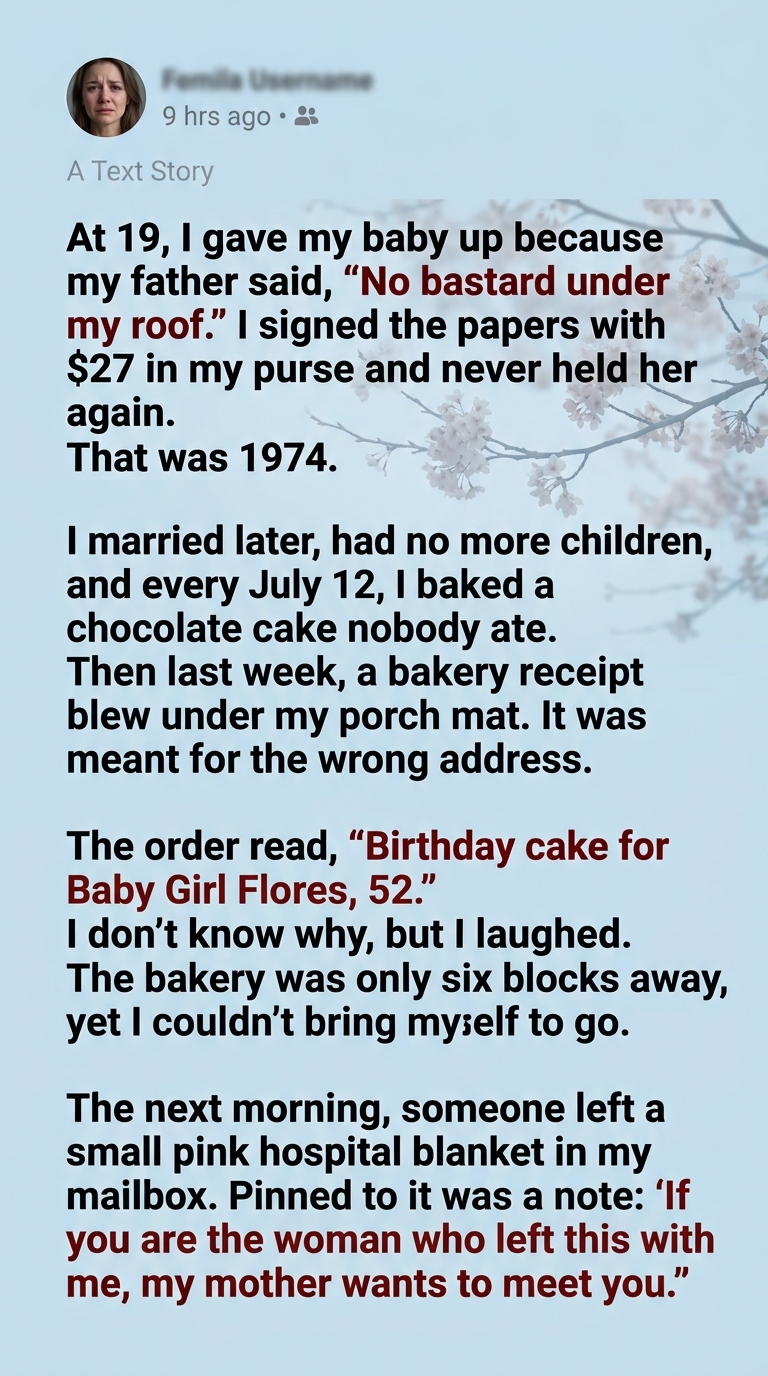
At nineteen, I gave my baby up because my father said, “No bastard under my roof.”
I signed the papers with twenty-seven dollars in my purse.
Then I walked out of the hospital without her.
I never held her again.
That was 1974.
For fifty-two years, I carried one date in my heart.
July 12.
Her birthday.
I didn’t know what she looked like.
I didn’t know her favorite color.
I didn’t know whether she liked chocolate cake.
But every July 12, I baked one anyway.
Chocolate.
Always chocolate.
I would put a single candle in the middle, sit at my kitchen table, and stare at it until the frosting hardened.
Nobody ever ate it.
Sometimes I threw it away the next morning.
Sometimes I froze a slice and convinced myself that maybe someday I’d have someone to share it with.
I married when I was twenty-eight.
My husband, Robert, knew about the baby.
He never judged me.
We couldn’t have children together, and eventually we stopped talking about it.
Robert died eleven years ago.
After that, the house became very quiet.
But every July 12, I still baked the cake.
Last week, something strange happened.
I was sweeping my front porch when a receipt blew underneath the mat.
I picked it up.
It was from a bakery six blocks away.
The address wasn’t mine.
I almost threw it away.
Then I noticed the order.
Chocolate birthday cake.
Name: Baby Girl Flores, 52.
I stared at it.
Baby Girl.
The name they had written on my hospital bracelet.
The name I had carried in my memory because I never knew what her adoptive parents called her.
I laughed.
It wasn’t a happy laugh.
It was the kind that escapes when something is too impossible to understand.
“That’s not funny,” I whispered.
The bakery was six blocks away.
I could have walked there.
But I couldn’t.
I was afraid.
Afraid that someone had made a mistake.
Afraid that they hadn’t.
Afraid that after fifty-two years, the past had finally learned my address.
The next morning, I opened my mailbox.
There was a small pink hospital blanket inside.
I knew it immediately.
Not because I remembered its color.
Because of the tiny embroidered flower in one corner.
I had sewn that flower myself.
My hands began shaking.
Pinned to it was a note.
Only one sentence.
“If you are the woman who left this with me, my mother wants to meet you.”
I sat down on the porch.
For several minutes, I couldn’t move.
Then I looked at the blanket again.
I remembered the hospital.
The white walls.
The smell of disinfectant.
My father standing beside my bed.
His voice.
“No bastard under my roof.”
I had been nineteen.
Terrified.
Alone.
I had no money.
No job that could support a baby.
No place to live.
And no one telling me that there might be another way.
So I signed.
I told myself it was temporary.
I told myself she would have a better life.
I told myself that someday, if I was strong enough, I’d find her.
But someday kept moving.
And eventually, I was fifty.
Then sixty.
Then seventy.
By then, I didn’t know if searching for her would be an act of love or selfishness.
So I stayed silent.
Until the blanket arrived.
That afternoon, I walked to the bakery.
The bell above the door rang when I entered.
A young woman behind the counter looked up.
“Can I help you?”
I put the receipt on the counter.
“This was delivered to my house.”
She looked at it.
Then at me.
Her expression changed.
“You’re Elena Flores?”
My heart stopped.
“Yes.”
She glanced toward the back.
“She’s here.”
I almost walked out.
“Who?”
The young woman swallowed.
“Your daughter.”
I couldn’t breathe.
A woman stepped through the doorway.
She was in her early fifties.
Dark hair streaked with silver.
Brown eyes.
A small scar above her eyebrow.
She stopped when she saw me.
Neither of us spoke.
Then she whispered:
“Mom?”
I closed my eyes.
I had imagined that word thousands of times.
But never like this.
Not in a bakery.
Not from a stranger who had my eyes.
I sat down.
She sat across from me.
Her name was Maria.
Her adoptive parents had called her Maria from the beginning.
She told me they had never hidden the adoption from her.
“They told me I was adopted when I was little.”
I nodded.
“Were they good to you?”
She smiled.
“They were wonderful.”
Something inside me relaxed.
“I’m glad.”
“They told me you were nineteen.”
I looked down.
“I was.”
“They said you gave me up because you wanted me to have a better life.”
I swallowed.
“That wasn’t the whole truth.”
She waited.
“My father wouldn’t let me keep you.”
She nodded slowly.
“I know.”
“You know?”
She reached into her purse.
“That’s why I’m here.”
She pulled out a folder.
Inside were copies of my original adoption documents.
My signature.
My father’s address.
The hospital records.
Then she pulled out a photograph.
It was old and faded.
A young woman stood outside a hospital window.
I recognized her immediately.
Me.
I looked at Maria.
“Where did you get this?”
“My adoptive mother.”
“She knew?”
“She knew there was more to the story.”
Maria explained that her adoptive parents had spent years trying to preserve every piece of information about my identity that the adoption agency would legally allow them to keep.
When Maria turned eighteen, she received the non-identifying records.
At twenty-one, she began searching.
She found fragments.
A town.
A hospital.
A surname.
But not me.
Then, years later, she took a DNA test.
That changed everything.
A distant relative appeared in the database.
The trail eventually led to my niece.
Maria contacted her.
My niece told her the truth.
I was alive.
I still lived in the same state.
And every year, on July 12, I baked a chocolate cake.
Maria laughed when she told me.
“You always wondered why I liked chocolate.”
I stared at her.
“You like chocolate?”
She smiled.
“It’s my favorite.”
I started crying.
She reached across the table.
“Mom.”
I covered her hand with mine.
“I’m sorry.”
She squeezed my fingers.
“I know.”
“I should have found you.”
“You were nineteen.”
“I should have tried harder.”
“Maybe.”
The honesty hurt.
But I appreciated it.
She wasn’t pretending fifty-two years hadn’t happened.
Neither was I.
“I thought about you every day,” I whispered.
She looked at me.
“Did you?”
“Every single day.”
“Even after you married?”
“Yes.”
“Even when you had no more children?”
“Yes.”
She looked down.
“I used to wonder if you ever thought about me.”
I smiled through my tears.
“Every July 12.”
She went very still.
“The cake?”
I nodded.
“How did you know?”
“I saw your Facebook post.”
I frowned.
“What post?”
Maria smiled.
“You posted a picture of a chocolate cake every year.”
I stared at her.
I had forgotten.
For years, I had posted the same photograph with no explanation.
A cake.
One candle.
No name.
No caption.
Just the date.
July 12.
Maria had seen it years ago.
She didn’t know whether it was meant for her.
But she hoped.
Then she told me why she had ordered the cake.
“My birthday is coming.”
I nodded.
“And I wanted to know if you would recognize the name.”
“Baby Girl Flores.”
She smiled.
“It was the name on my first hospital record.”
I laughed softly.
“That was cruel.”
“A little.”
We both laughed.
For the first time, the silence between us didn’t feel painful.
It felt like something new.
A beginning.
Then she told me about the blanket.
“I found it in my adoptive mother’s belongings after she died.”
I touched the pink fabric.
“She kept it?”
“For fifty-two years.”
I closed my eyes.
That little blanket had survived longer than my marriage.
Longer than my father’s life.
Longer than the house I grew up in.
It had crossed decades to find its way back to me.
“I thought she had thrown it away,” I whispered.
“She couldn’t.”
Maria looked at me.
“Neither could I.”
We spent the next four hours talking.
She showed me photographs.
Her wedding.
Her children.
Her husband.
The house where she grew up.
Her adoptive parents.
I learned that she became a teacher.
That she loved gardening.
That she hated flying.
That she laughed exactly like my mother.
And that she had a habit of tapping her fingers against a table when she was nervous.
I did that too.
At the end of the afternoon, she asked:
“Would you like to come to my house?”
I couldn’t answer.
She smiled.
“You don’t have to.”
“I’d like to.”
So I went.
Her house was warm and messy and alive.
There were photographs everywhere.
Children.
Grandchildren.
Friends.
A family.
I stood in the doorway, overwhelmed.
Maria touched my arm.
“This is my life.”
I smiled.
“It’s beautiful.”
Then she took me to the kitchen.
On the counter was a chocolate cake.
One candle.
She had ordered it from the bakery.
My eyes filled with tears.
“You remembered.”
She smiled.
“You did too.”
That night, I went home carrying a photograph.
Maria had given it to me.
It showed her at five years old, sitting on her adoptive father’s shoulders.
I put it beside my bed.
For the first time in fifty-two years, July 12 didn’t feel like a date I had to survive.
It felt like a birthday.
Her birthday.
And mine too, in a strange way.
Because fifty-two years earlier, I had become a mother.
I just hadn’t been allowed to be one.
We didn’t pretend everything was suddenly perfect.
There were difficult conversations.
There were questions I couldn’t answer.
There were years we couldn’t get back.
Maria sometimes felt angry.
I sometimes felt guilty.
But we kept meeting.
Coffee.
Lunch.
Family dinners.
Small things.
Real things.
One afternoon, she asked me a question I’d secretly been afraid of.
“Do you regret giving me up?”
I thought about it carefully.
“I regret that you were separated from me.”
She waited.
“But I don’t regret wanting you to have a safe life.”
She nodded.
“I needed to hear that.”
I held her hand.
“I don’t want to rewrite your childhood.”
“Good.”
“I want to know the woman you became.”
She smiled.
“Then we’re going to need a lot of time.”
I laughed.
“We have some catching up to do.”
The following July 12, I baked a chocolate cake.
But this time, I didn’t make it for nobody.
Maria came over.
She brought her children.
Her husband.
And three grandchildren I had never known existed.
We put candles on the cake.
Maria looked at me.
“Did you always make chocolate?”
“Every year.”
“Why?”
I smiled.
“Because I hoped you’d like it.”
She laughed.
Then she hugged me.
For fifty-two years, I thought the birthday cake was a symbol of everything I’d lost.
That day, I finally understood what it had really been.
Hope.
It had waited quietly in my kitchen.
One cake.
One candle.
One date.
Every year.
Until the little girl I had once called Baby Girl finally came home.
Not to erase the past.
Not to pretend fifty-two years hadn’t happened.
But simply to sit across from me and say the words I had waited half a century to hear.
“Mom, can I have a piece of cake?”
I smiled.
“Of course.”
And for the first time, somebody ate the cake.
It was worth waiting fifty-two years for that first bite.