My thirteen-year-old came home from church camp completely different.
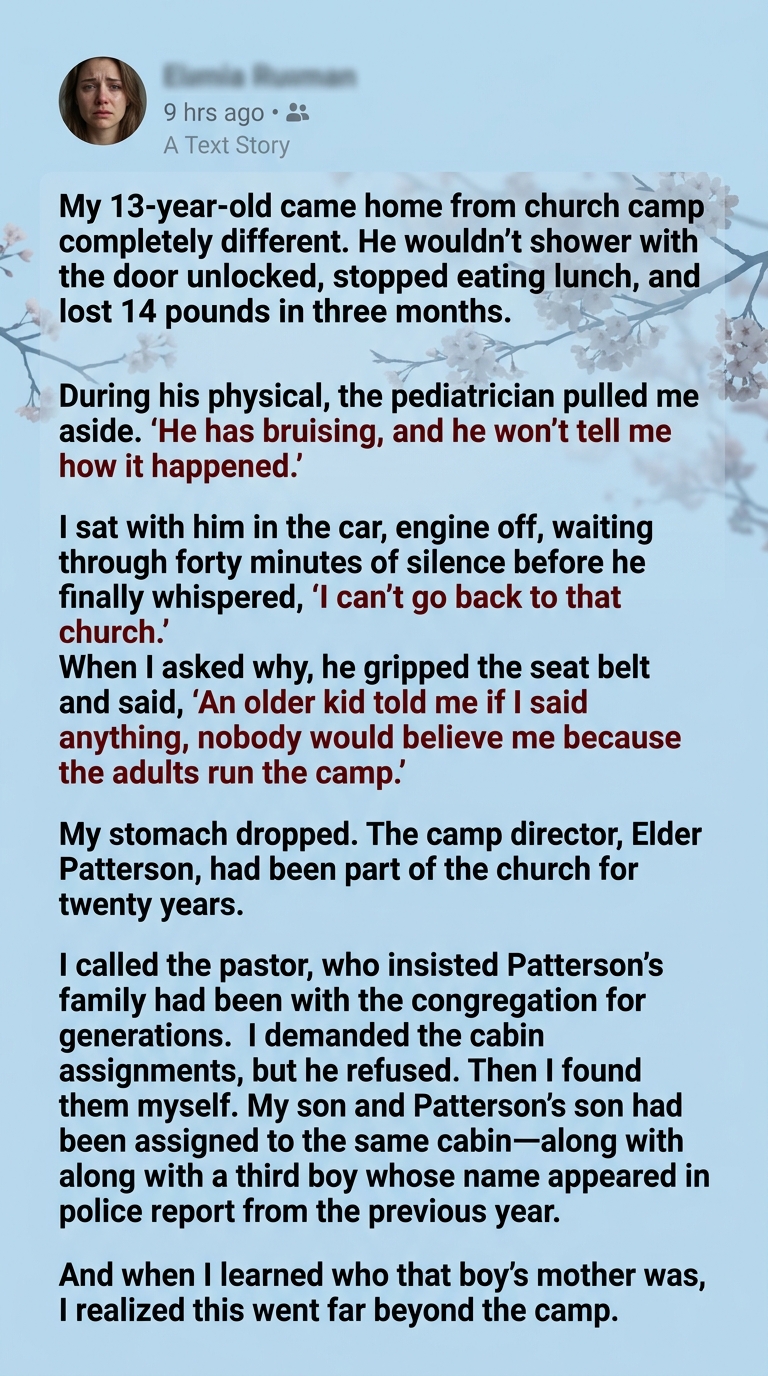
Before camp, Noah never stopped talking.
After camp, he barely spoke at all.
He wouldn’t shower unless the bathroom door was locked.
He stopped eating lunch.
He started sleeping with his bedroom light on.
And over the next three months, he lost fourteen pounds.
I kept asking him what happened.
“Nothing.”
“Did someone hurt you?”
“No.”
“Did someone scare you?”
He would shake his head.
Then he’d disappear into his room.
I tried not to push.
I failed.
I pushed because I was his father.
I pushed because something was obviously wrong.
And I pushed because I was terrified that if I waited too long, whatever had happened would become something he carried alone.
During his physical, the pediatrician pulled me aside.
“There are bruises I can’t explain,” she said quietly.
My stomach tightened.
“What did he say?”
“He wouldn’t tell me.”
“Did he mention camp?”
She nodded.
“He became very upset when I asked.”
That afternoon, I picked Noah up from school.
Instead of driving home, I parked in an empty lot.
I turned off the engine.
I didn’t ask another question.
We sat there.
Ten minutes.
Twenty.
Thirty.
Almost forty.
Finally, Noah whispered:
“I can’t go back to that church.”
I turned toward him.
“Okay.”
He gripped the seat belt.
“Why?”
His eyes filled with tears.
“Because an older kid told me if I said anything, nobody would believe me.”
My heart dropped.
“Why wouldn’t they believe you?”
“Because the adults run the camp.”
I didn’t ask him for details.
I simply said:
“You don’t have to tell me everything right now.”
He looked at me.
“You believe me?”
“Yes.”
That was when he started crying.
I held him until he stopped shaking.
Then I called his pediatrician.
Then I contacted police.
Then I contacted a child-advocacy center.
I wanted Noah interviewed by professionals who knew how to talk to children without making them relive something unnecessarily.
The first name that came up was Elder Patterson.
Patterson had been part of the church for twenty years.
He was respected.
His family was respected.
His son, Caleb, volunteered with younger campers.
His wife organized church events.
When I called the pastor, Reverend Collins, I expected concern.
Instead, I got defensiveness.
“Elder Patterson is one of the most trusted men in our congregation.”
“I didn’t ask whether he was trusted.”
“I think you should be careful about making accusations.”
“My son came home terrified.”
“We take children’s safety very seriously.”
“Then give me the cabin assignments.”
There was silence.
“I can’t release information about other minors.”
“I’m asking for my son’s cabin.”
“Those records are confidential.”
I hung up.
That night, I searched everything I could find about the camp.
Old newsletters.
Parent posts.
Photographs.
Archived church pages.
Then I found a PDF from the previous summer.
A cabin roster.
Noah had been in Cabin Four.
So had Caleb Patterson.
And another boy.
Marcus Bell.
The name bothered me.
I searched it.
I found a news article from the previous year.
Marcus had been involved in an incident at another youth program.
The article was vague because he was a minor.
But there had been a police report.
I called the detective listed in the article.
He couldn’t tell me what had happened.
But after I explained why I was calling, he said:
“Your concern is worth investigating.”
I asked:
“Who reported the original incident?”
He gave me a name.
Rachel Bell.
Marcus’s mother.
I searched her.
And that’s when I realized the camp was much bigger than one cabin.
Rachel Bell wasn’t just a parent.
She was the church’s child-safety coordinator.
The person parents were supposed to contact if they had concerns about children.
I called her.
She asked me to meet her.
We sat across from each other in a coffee shop the next morning.
She looked like she hadn’t slept.
“I know why you’re here,” she said.
“How?”
“Because my son went through something similar last year.”
My stomach tightened.
“What happened?”
She shook her head.
“I can’t give you details about another child. But I can tell you this.”
She opened her purse.
“I tried to report it.”
“To whom?”
“The pastor.”
“And?”
“He told me the situation had been handled.”
“Handled how?”
“I don’t know.”
She looked down.
“That was the problem.”
She pulled out a folder.
“I was told there was no evidence.”
I opened it.
Inside were copies of emails.
Meeting notes.
Messages.
One email was from Rachel to Reverend Collins.
It said she was concerned about an older youth’s behavior toward younger boys.
The response from church leadership said they would “address the matter internally.”
I looked up.
“Did they contact police?”
“No.”
“Child services?”
“No.”
“Anyone outside the church?”
She shook her head.
“They said they didn’t want to damage a young man’s future over an allegation.”
I felt sick.
“Who was the young man?”
Rachel didn’t answer.
She didn’t have to.
I already knew.
Caleb Patterson.
The pastor’s trusted volunteer.
Elder Patterson’s son.
The same boy assigned to Noah’s cabin.
Rachel continued.
“Marcus was told not to talk about it.”
“By whom?”
“Adults.”
That single word hit me harder than anything else.
Not one person.
Not one mistake.
Adults.
People who were supposed to know better.
People who had decided protecting the church was more important than asking difficult questions.
Then Rachel said:
“There’s something else you need to know.”
She pulled out another document.
A list of names.
Children who had attended the camp over several years.
Beside some names were short notes.
Requested different cabin.
Parent complaint.
Didn’t want to return.
Unexplained bruising.
Behavior change.
I stared at the list.
“How long has this been happening?”
“I don’t know.”
“Why did you keep this?”
“Because I knew someday someone would ask.”
I looked at her.
“You knew?”
“I suspected.”
She wiped her eyes.
“I was told to trust the leadership.”
That afternoon, I gave everything to the detective.
The investigation expanded.
Police requested camp records.
They interviewed former campers and parents.
They reviewed complaints that had been handled privately.
They examined messages between church leaders.
They spoke with Rachel.
And they interviewed Noah through a child-advocacy center.
Noah never had to sit across from Caleb.
He never had to confront Patterson.
He didn’t have to prove anything by himself.
Adults finally took responsibility for the investigation.
Slowly, more families came forward.
One parent had complained about a cabin assignment the previous year.
Another had withdrawn her son from camp without explaining why.
A counselor had reported concerns but was told she had misunderstood what she saw.
And the same family name kept appearing.
Patterson.
Eventually, investigators discovered that church leadership had received multiple warnings about inappropriate behavior involving youth programs.
Some had been documented.
Others had been discussed verbally.
Instead of consistently reporting concerns to the appropriate authorities, leaders had repeatedly attempted to resolve matters internally.
That became the center of the investigation.
The question was no longer simply:
“What happened at camp?”
It became:
“Who knew, and what did they do after they knew?”
The answer devastated the congregation.
Several leaders were removed from their positions.
The church brought in independent child-safety professionals.
Camp operations were suspended while authorities investigated.
And Caleb was prohibited from having contact with children during the investigation.
Elder Patterson stopped appearing at church.
But the most important change happened at home.
Noah started counseling.
His appetite slowly returned.
He gained back the weight he’d lost.
He began sleeping with his bedroom door open again.
One night, I found him sitting on the back steps.
I sat beside him.
“Can I ask you something?”
He nodded.
“Do you still blame yourself?”
He looked confused.
“For what?”
“For not telling me sooner.”
He looked down.
“I thought you wouldn’t believe me.”
I swallowed.
“I’m sorry.”
He looked at me.
“You don’t have to be sorry.”
“Yes, I do.”
“Why?”
“Because you should never have had to wonder whether your dad would believe you.”
He was quiet for a moment.
Then he said:
“I know now.”
I put my arm around him.
“You never have to earn my belief by giving me every detail.”
He leaned against me.
“I know.”
Months later, the investigation resulted in criminal proceedings involving the people whose conduct had been established by investigators and prosecutors.
I won’t pretend the ending was simple.
There was no single courtroom moment that repaired everything.
There were children who still needed counseling.
Parents who felt guilty for not seeing warning signs.
Adults who had to face decisions they wished they could undo.
And a church community forced to confront something it had spent years avoiding.
But one thing changed permanently.
The phrase “He’s a respected member of the church” stopped being treated as evidence of safety.
Because reputation is not protection.
A position is not protection.
A family name is not protection.
Policies written on paper are not protection unless people follow them.
Protection means listening when a child says something feels wrong.
It means taking unexplained injuries seriously.
It means reporting concerns instead of hiding them.
And it means never asking a frightened child to carry the burden of proving what an adult should have investigated.
A year after everything happened, Noah asked me if we could drive past the old church.
I asked if he was sure.
He nodded.
We stopped in the parking lot.
He stared at the building for a long time.
Then he said:
“It doesn’t scare me anymore.”
I looked at him.
“Good.”
He smiled.
“But I don’t want to go inside.”
“You don’t have to.”
He nodded.
Then he took my hand.
We sat there for another minute before driving away.
I used to think faith meant trusting people.
Now I understand that faith doesn’t require turning off your questions.
You can respect a church and still demand accountability.
You can respect a leader and still investigate a complaint.
And you can love a community without protecting its secrets.
My son taught me that.
He came home from camp carrying fear.
He left that experience knowing something different.
That when he speaks, someone will listen.
That when he says no, someone will respect it.
And that when something is wrong, protecting the institution is never more important than protecting the child.
The cabin assignment was what first caught my attention.
But it wasn’t the cabin that frightened me most.
It was discovering how many adults had known enough to ask questions—and chose not to.
**My son wasn’t the first child who needed someone to listen.
He was simply the one who finally found someone who did.**