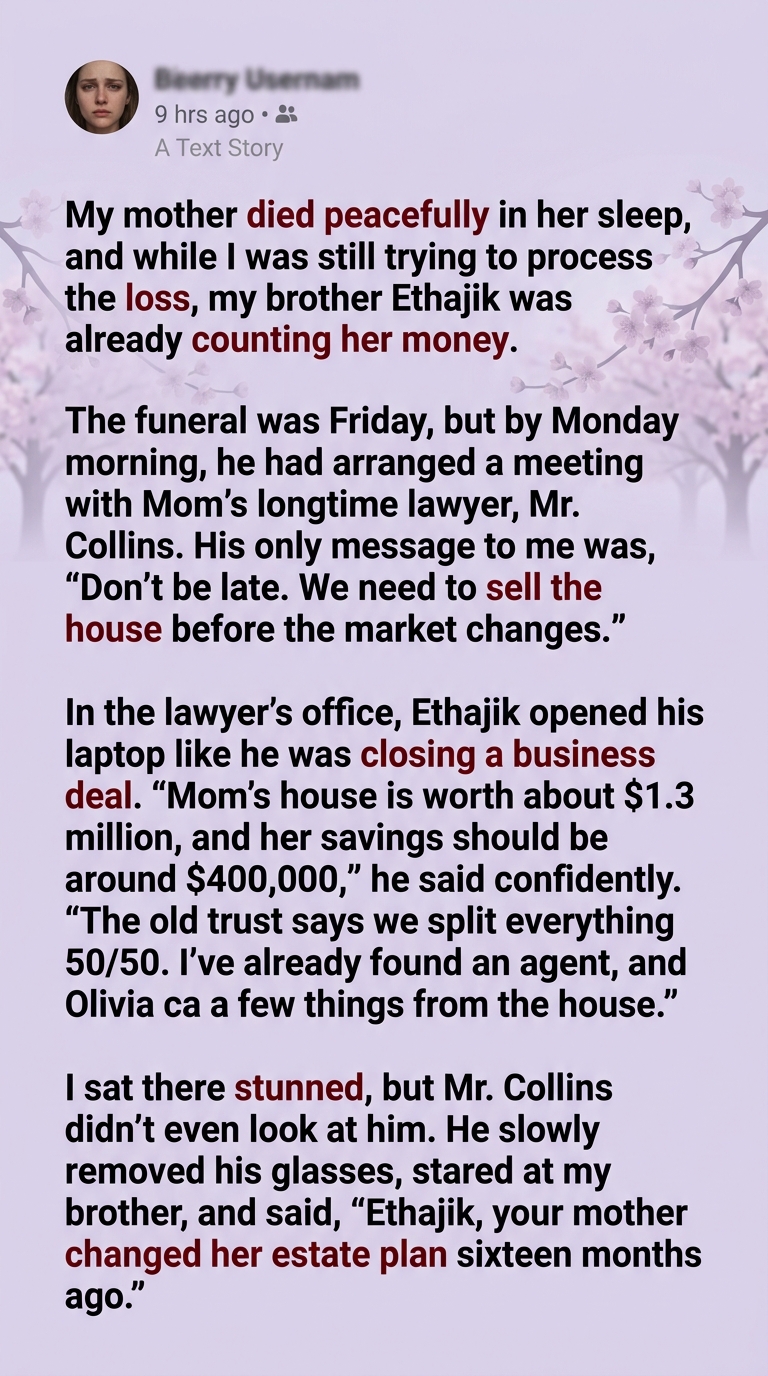
My mother died peacefully in her sleep.
There was no dramatic final moment.
No ambulance.
No last-minute hospital room.
She simply went to bed one evening and never woke up.
My brother, Ethajik, seemed to process her death differently than I did.
While I was still trying to remember the sound of her voice, he was already counting her money.
The funeral was Friday.
By Monday morning, he had arranged a meeting with Mom’s longtime lawyer, Mr. Collins.
His only message to me was:
“Don’t be late. We need to sell the house before the market changes.”
I stared at my phone.
Our mother had been dead for three days.
He was talking about the market.
I almost didn’t go.
But I knew Mom had trusted Mr. Collins for decades.
So I went.
Ethajik was already sitting in the lawyer’s office when I arrived.
He opened his laptop like he was closing a business deal.
“Mom’s house is worth about $1.3 million,” he said. “Her savings should be around $400,000.”
I stared at him.
He continued.
“The old trust says we split everything fifty-fifty. I’ve already found an agent.”
He looked at me.
“Olivia can take a few things from the house.”
I couldn’t believe what I was hearing.
“Olivia?”
His wife.
He nodded.
“She wants Mom’s dining set.”
I looked at Mr. Collins.
He hadn’t said a word.
Ethajik kept talking.
“We should move quickly. The house has been sitting there empty, and we don’t want to lose money.”
Then Mr. Collins slowly removed his glasses.
He looked directly at my brother.
“Ethajik, your mother changed her estate plan sixteen months ago.”
My brother stopped typing.
“What?”
“Sixteen months ago.”
He laughed.
“That doesn’t make sense.”
“It does.”
“No. Mom never told me.”
Mr. Collins folded his hands.
“She wasn’t required to.”
Ethajik leaned forward.
“Are you saying the trust changed?”
“Yes.”
“What did she change?”
Mr. Collins looked at me.
Then back at him.
“Nearly everything.”
My brother’s face tightened.
“What does that mean?”
“It means the document you’re referring to is no longer the controlling estate plan.”
Ethajik looked at me.
“You knew?”
“No.”
He turned back to the lawyer.
“Then what did she do?”
Mr. Collins opened a file.
“She created a new revocable trust.”
My brother shook his head.
“Why?”
“Your mother gave her reasons.”
“What reasons?”
Mr. Collins paused.
“I can tell you what the documents say.”
He slid a copy across the desk.
I picked it up.
The first page contained Mom’s name.
Then mine.
Then a list of assets.
I started reading.
My name appeared repeatedly.
Not as a co-owner.
As beneficiary.
The house.
A portion of her investments.
Several accounts.
And something called the “Family Education Fund.”
I looked up.
“What is this?”
Mr. Collins explained.
Mom had placed the house into the new trust.
She had also created a separate fund for her grandchildren’s education.
Then I saw something that made me stop.
Ethajik wasn’t listed as an equal beneficiary.
He wasn’t even listed the way I expected.
His share was limited.
And it came with conditions.
He would receive a smaller distribution over time rather than a direct fifty-percent share.
My brother stared at the document.
“This is fake.”
Mr. Collins didn’t react.
“It’s notarized.”
“Mom wouldn’t do this.”
“She did.”
“Why?”
Mr. Collins looked at him.
“Your mother was very clear about why.”
Ethajik slammed his laptop shut.
“What did she say?”
Mr. Collins reached into the file.
“She left a letter.”
He handed it to me.
“Both of you should read it.”
My hands trembled as I opened the envelope.
Mom’s handwriting filled the first page.
My children,
I stopped.
For a moment, I couldn’t continue.
Then I read.
If you’re reading this, I’m gone. I hope I’m wrong about the circumstances that brought you here.
I looked at my brother.
He stared at the floor.
I continued.
I have watched both of you become adults. I love you equally. But loving my children equally does not mean pretending their circumstances are equal.
My throat tightened.
Mom explained that she’d changed the estate plan after a conversation with Mr. Collins.
She had realized that leaving everything equally would not create peace.
It would create conflict.
She had watched Ethajik borrow money from family repeatedly.
She had watched Olivia pressure him about the house.
She had heard conversations about selling Mom’s property while she was still alive.
And she had become increasingly worried that her home was being treated like an asset rather than a place filled with memories.
Then I reached a sentence that made my hands shake.
I have heard conversations you don’t know I heard.
My brother looked up.
“What does that mean?”
I kept reading.
I know about the conversation in my kitchen last summer.
Ethajik’s face changed.
I looked at him.
“What conversation?”
He didn’t answer.
Mom continued.
You thought I was asleep upstairs.
My brother stared at the letter.
I kept reading.
You and Olivia discussed selling my house after I died. You discussed how much you could make from it. You discussed whether Olivia should choose the furniture before Olivia and I ever had a conversation about what I wanted.
My brother’s mouth opened.
“No.”
I looked at him.
“You did?”
“It wasn’t like that.”
“Then what was it like?”
He looked away.
Mr. Collins said nothing.
Mom’s letter continued.
I wasn’t angry because you wanted money. Wanting money is not a crime. What hurt me was hearing my home discussed as though I were already gone.
I felt tears forming.
Then came the part I hadn’t expected.
Olivia, you are my daughter-in-law, and I have loved you as part of this family. But you once told Ethajik that Olivia should get the house because she was the one who “knew how to handle money.”
My brother looked stunned.
He whispered:
“She heard that?”
I looked at him.
Mom had heard everything.
The new estate plan wasn’t punishment.
It was protection.
Mom left me the house because I had spent years maintaining it.
She left the education fund for the grandchildren because she wanted something that would continue helping the family.
And she left Ethajik enough money to be secure—but not enough to immediately sell everything and disappear with half the estate.
Then Mr. Collins added another detail.
“There is one more provision.”
“What?”
“Your mother placed the house under a five-year family trust.”
I looked up.
“What does that mean?”
“It can’t be sold during that period without approval from the trustee.”
“Who is the trustee?”
Mr. Collins looked at me.
“You.”
My brother stood.
“You’ve got to be kidding me.”
“No.”
“You made her trustee?”
“I didn’t make anyone anything. Your mother did.”
Ethajik began pacing.
“This is insane.”
“No,” I said quietly.
“It’s Mom’s decision.”
He turned toward me.
“You’re enjoying this.”
I stared at him.
“My mother has been dead for three days.”
He stopped.
“I don’t want her money right now.”
He looked genuinely confused.
“What?”
“I want my mother back.”
That was the first time his expression broke.
He sat down.
For several minutes, neither of us spoke.
Then he whispered:
“I didn’t think she would really do it.”
“Do what?”
“Leave you the house.”
I looked at him.
“Why?”
He didn’t answer.
Eventually, he admitted that he had been struggling financially.
Olivia had debts.
Their business had lost money.
They had been counting on selling the house.
That didn’t excuse what they had done.
But it explained the urgency.
He wasn’t grieving normally because he was terrified.
Terrified that without Mom’s house, his financial problems would become impossible to hide.
Still, there was one thing I couldn’t forgive.
He had tried to sell the house before we had even finished mourning.
Mr. Collins gave us the final instructions.
The house would remain in trust.
The education fund would begin immediately.
Ethajik would receive his inheritance in scheduled distributions.
And certain personal items had been specifically assigned to each of us.
Mom had even left notes explaining why.
My brother received Dad’s old watch.
I received Mom’s recipe books.
We both received photographs.
And the dining table Olivia wanted?
It stayed in the house.
Mom had written:
This table has held too many family dinners to become someone’s quick profit.
I laughed through my tears.
That sounded exactly like her.
A month later, Ethajik came to the house.
He stood in the doorway.
“I’m sorry.”
I looked at him.
“For what?”
“For making everything about money.”
I didn’t say anything.
He continued.
“I was scared.”
“I know.”
“I thought if I didn’t act quickly, I’d lose everything.”
“You almost lost something else.”
He nodded.
“Us.”
I looked at him for a long moment.
“I don’t know if I can trust you yet.”
“I understand.”
“But you can come in.”
He stepped inside.
He walked toward the dining room.
His fingers touched the old table.
“Remember Christmas here?”
I smiled.
“You spilled grape juice all over Mom’s white tablecloth.”
He laughed.
“She blamed you.”
“She always blamed me.”
“You were her favorite.”
“No, I wasn’t.”
He looked at me.
“You were.”
We both laughed.
It was the first normal moment we’d shared since Mom died.
Months later, we started having Sunday dinners at the lake house.
Not every week.
Not perfectly.
But enough.
The education fund eventually paid for our niece’s college tuition.
My nephew used part of it for vocational school.
The house stayed exactly where Mom wanted it.
Not frozen in time.
Alive.
We repaired the porch.
Repainted the kitchen.
Fixed the old fireplace.
But we kept the dining table.
We kept the photographs.
We kept Mom’s handwritten recipes taped inside the cabinet.
And every Christmas, we gathered around that table.
Ethajik never again talked about selling the house.
One Christmas Eve, he raised his glass.
“To Mom.”
I raised mine.
“To Mom.”
He looked around the table.
“She knew us better than we thought.”
I smiled.
“She always did.”
My brother laughed.
“Especially me.”
I nodded.
“Especially you.”
He looked at me.
“You know what the worst part is?”
“What?”
“She knew I’d try to sell the house before she even died.”
I smiled.
“She didn’t know.”
“What?”
“She hoped you wouldn’t.”
That silenced him.
Because that was the real lesson in Mom’s estate plan.
She hadn’t written it because she stopped loving her son.
She had written it because she knew love didn’t require surrendering everything.
She had protected what mattered while leaving him enough to rebuild.
And perhaps that was the final gift she gave both of us.
She forced us to stop fighting over what she owned long enough to remember what she had actually given us.
A family.
A home.
A history.
And one last chance to act like siblings instead of competitors.
The Monday after her funeral, my brother walked into Mr. Collins’s office thinking he was there to divide our mother’s money.
Instead, he discovered that Mom had already divided something much more important.
She had separated her assets from our relationship.
And in doing so, she gave us a chance to save the part of the inheritance that no lawyer could put into a trust.
**Each of us received part of Mom’s estate.
But the greatest thing she left us was the chance to become a family again.**