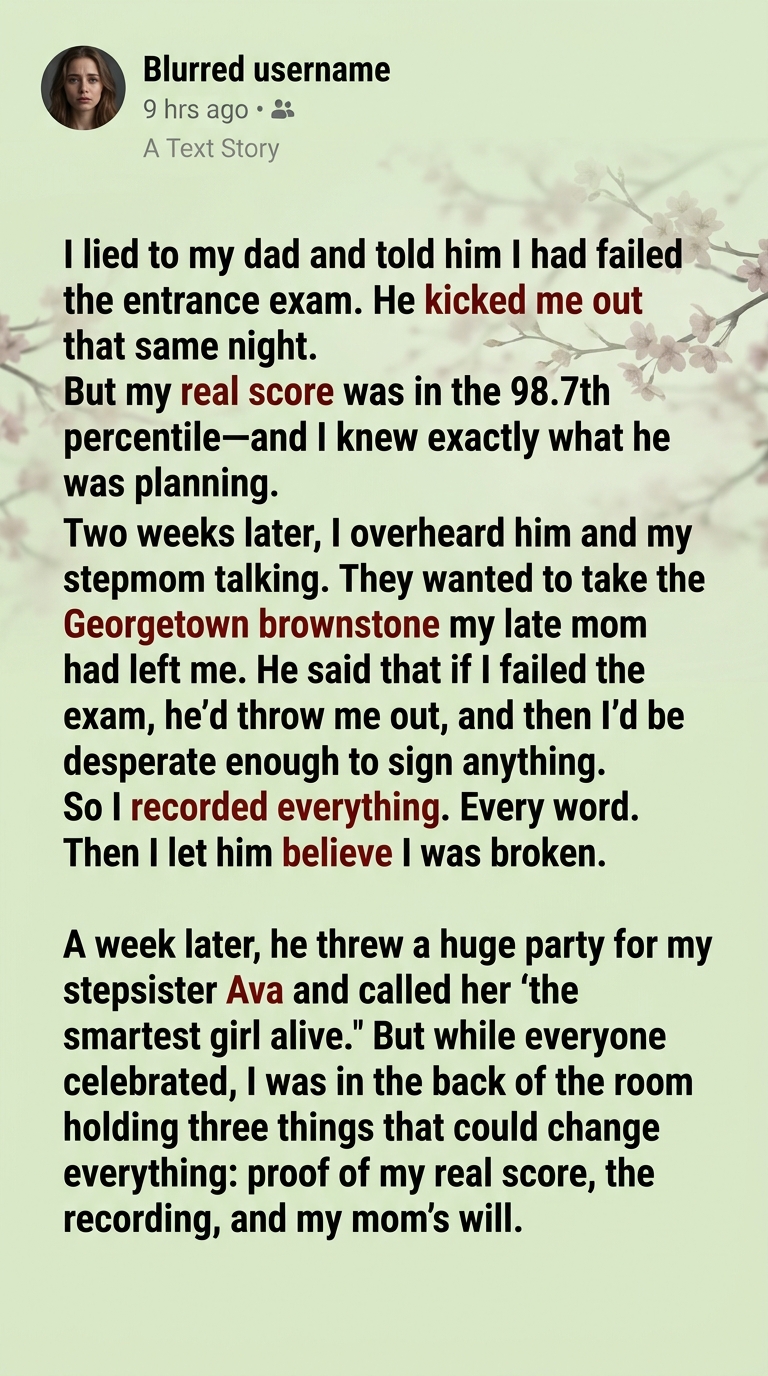
I lied to my dad and told him I had failed the entrance exam.
He kicked me out that same night.
But my real score was in the 98.7th percentile—and I knew exactly what he was planning.
My name is Daniel, and my mother had died when I was fifteen.
Before she died, she left me something my father never expected.
A brownstone in Georgetown.
It wasn’t some enormous mansion.
It was an old three-story brick house with a narrow staircase, a tiny backyard, and ivy climbing one side of the building.
But it was fully paid off.
And Mom had left it to me.
The will was explicit.
The property belonged to me.
Not my father.
Not his future wife.
Not my stepsister, Ava.
Me.
My father hated that.
He never said it directly, but I could tell.
Whenever the subject came up, he would say things like:
“You’re too young to understand what property like that is worth.”
Or:
“Your mother should have put it in a family trust.”
Or:
“Eventually, everything needs to be consolidated.”
I never understood what he meant.
Until the entrance exam.
I’d spent months studying.
My mother had always dreamed of seeing me attend a great university.
The night my score arrived, I stared at the screen for almost a minute.
98.7 percentile.
I had done it.
I had actually done it.
I wanted to tell Dad.
Instead, I looked at him across the kitchen.
He was sitting with my stepmother, Rachel.
Ava was upstairs.
And something in his expression made me hesitate.
So I said:
“I failed.”
My father’s face changed immediately.
Not disappointment.
Opportunity.
“What was your score?”
“I don’t know.”
“You don’t know?”
“I didn’t do well.”
He stood.
“You’ve been wasting everyone’s time.”
Rachel looked at him.
“Maybe give him a few days.”
“No.”
He turned toward me.
“If you can’t take school seriously, you can’t stay here.”
I stared at him.
“You’re kicking me out?”
“You’re eighteen. Figure it out.”
I packed a backpack.
I didn’t argue.
I left that night.
I stayed at a friend’s apartment.
For two weeks, I pretended to be devastated.
I told everyone I had failed.
I acted embarrassed.
Broken.
Lost.
Exactly how my father expected me to feel.
Then one evening, I returned to the house to collect a few things I’d forgotten.
I heard voices in the kitchen.
Dad.
Rachel.
I stopped before entering.
“You’re sure the house is his?” Rachel asked.
My father laughed.
“Technically.”
“Technically?”
“His mother left it to him.”
“So what are we doing?”
“We make him desperate.”
I froze.
Dad continued.
“He’s eighteen. No job. No college. No money.”
Rachel lowered her voice.
“What if he refuses?”
“He won’t.”
“How do you know?”
“Because people sign things when they think they’re about to lose everything.”
My heart started pounding.
“What things?”
“The transfer documents.”
Silence.
Then Rachel said:
“And the house?”
“He’ll sign it over.”
I stood perfectly still.
My father continued.
“Once it’s transferred, Ava can use it after graduation.”
Rachel laughed.
“She’ll love that.”
I pulled out my phone.
I started recording.
Every word.
Every pause.
Every detail.
Then Dad said something that made my blood run cold.
“He’ll think he’s giving it to us temporarily.”
Rachel asked:
“And then?”
“There is no then. Once the deed is transferred, it’s ours.”
I backed away.
I left without taking anything.
That night, I listened to the recording three times.
Then I called the attorney who had handled Mom’s estate.
Mr. Whitaker.
I told him everything.
He didn’t sound surprised.
“Your mother anticipated that there might be pressure around the property.”
“What does that mean?”
“She created safeguards.”
“What kind?”
“I can’t explain everything without reviewing the documents with you.”
We met the next morning.
He brought out Mom’s original will.
Then he showed me a second document.
A separate letter attached to the estate file.
Mom had written:
If Daniel ever tries to pressure my son into transferring this property before he reaches a certain age, I want my attorney notified immediately.
I stared at the page.
“How did she know?”
Mr. Whitaker smiled sadly.
“Your mother knew your father.”
Then he showed me something else.
A trust provision.
My father couldn’t sell the property.
Couldn’t mortgage it.
Couldn’t transfer it.
Couldn’t even claim ownership.
And because the property was already titled properly in my name, he had no legal authority over it.
But the forged transfer documents my father was preparing could still cause a nightmare.
So we prepared.
Mr. Whitaker told me not to confront him.
Not yet.
“Let him believe you’re exactly where he expects you to be.”
So I did.
A week later, my father threw a huge party for Ava.
He rented a private event space.
There were balloons.
A catered dinner.
A photographer.
Family friends.
Neighbors.
Everyone had gathered to celebrate Ava’s supposed academic success.
Dad stood at the microphone.
“My daughter Ava is the smartest girl alive.”
People applauded.
Ava smiled.
I stood in the back of the room.
Nobody knew my real score.
Nobody knew I had been accepted to Georgetown.
Nobody knew I had already signed a lease near campus.
And nobody knew what I was holding.
Three things.
Proof of my real score.
The recording.
And my mother’s will.
My father eventually saw me.
His smile disappeared for half a second.
Then he walked over.
“What are you doing here?”
“I was invited.”
“By whom?”
“Ava.”
He looked irritated.
“You shouldn’t be here.”
“I wanted to congratulate her.”
He glanced toward the crowd.
Then lowered his voice.
“You need to leave.”
I smiled.
“Why?”
“Because you’re embarrassing yourself.”
I pulled a folder from my bag.
“Actually, Dad, I think you’re about to embarrass yourself.”
He stared at me.
“What is that?”
I opened it.
My entrance exam results.
98.7 percentile.
His face went blank.
“You lied.”
“Yes.”
“Why?”
“Because I wanted to know what you’d do if you thought I’d failed.”
He looked toward Rachel.
She had seen the score.
She went pale.
My father grabbed my arm.
I pulled away.
“Don’t touch me.”
Several people nearby turned.
Dad lowered his voice.
“Let’s talk privately.”
“No.”
I pulled out my phone.
“Let’s talk publicly.”
I pressed play.
My father’s voice came through the speaker.
We make him desperate.
Then:
People sign things when they think they’re about to lose everything.
Then:
Once the deed is transferred, it’s ours.
The room became completely silent.
My father stared at the phone.
Rachel whispered:
“Turn that off.”
I didn’t.
The recording continued.
Ava’s face had gone white.
She looked at her father.
“Dad?”
He couldn’t answer.
I took out the copy of Mom’s will.
“My mother left this house to me.”
I held it up.
“She didn’t leave it to Dad.”
I looked at my father.
“She didn’t leave it to Rachel.”
Then I looked at Ava.
“And she didn’t leave it to you.”
Ava started crying.
“I didn’t know.”
“I know.”
My father stepped forward.
“You don’t understand the conversation.”
“I understand perfectly.”
“You were eavesdropping.”
“You were planning to take my house.”
“We were trying to protect you.”
I almost laughed.
“By forcing me out?”
Silence.
“By making me desperate?”
Nothing.
“By getting me to sign away my mother’s property?”
My father looked around the room.
Everyone was watching.
The same people who had just applauded him were now staring at him.
Mr. Whitaker entered through the back door.
I hadn’t told Dad he was coming.
He walked directly toward us.
“Mr. Carter.”
My father froze.
“What are you doing here?”
“Representing Daniel.”
Dad looked at me.
“You planned this.”
“No.”
I looked at the folder.
“Mom planned it.”
Mr. Whitaker handed my father a document.
“This is formal notice that any attempt to transfer, encumber, or interfere with Daniel’s ownership of the Georgetown property will be challenged immediately.”
My father read it.
His hands started shaking.
Then Mr. Whitaker said:
“And we’ve already notified the title company regarding the proposed transfer.”
My father looked up.
“The proposed transfer?”
“Yes.”
“You knew?”
“We knew before you filed it.”
He had already prepared the paperwork.
He had expected me to sign.
He hadn’t realized that Mr. Whitaker had placed an alert on the property.
My father’s entire plan depended on one thing.
Me believing I had nothing.
But I had everything.
My score.
My mother’s will.
The recording.
And, most importantly, the truth.
Ava walked over to me.
She was crying.
“Did Dad really plan to give me the house?”
“He said you could use it after graduation.”
“I didn’t know.”
“I believe you.”
She looked at our father.
Then back at me.
“I don’t want your house.”
I nodded.
“I know.”
She hugged me.
That surprised me.
My father watched silently.
The party ended soon afterward.
There was no more celebration.
No more speeches.
No more photographs.
My father tried to contact me several times afterward.
I didn’t answer immediately.
Eventually, he sent a message.
I made mistakes.
I replied:
You didn’t make one mistake.
You made a plan.
He didn’t respond.
A few weeks later, I moved into the Georgetown brownstone.
I stood in the empty living room with Mom’s will in my hand.
There was still a faint smell of her perfume in the old upstairs closet.
I sat on the floor.
For the first time since she died, I felt like I understood why she’d left the house to me.
It wasn’t about money.
It was about giving me one thing nobody could take away without my permission.
A foundation.
A place that belonged to me.
A choice.
I started university that fall.
I worked part-time.
I kept the house.
Eventually, I rented the lower level to help with expenses.
I didn’t sell it.
I didn’t transfer it.
And I never signed anything under pressure again.
My father and I eventually spoke.
Not because I forgot.
Because I decided I didn’t want anger to control the rest of my life.
He apologized.
A real apology this time.
No excuses.
No “but.”
No blaming circumstances.
Just:
“I was wrong.”
I told him:
“I can forgive you someday.”
He nodded.
“But trust isn’t something you get because you apologize.”
“I know.”
“It has to be earned.”
He accepted that.
It took years.
Our relationship never returned to what it had been.
Maybe it shouldn’t have.
But eventually, we learned how to speak without pretending nothing had happened.
And every July, I still visit the brownstone’s little backyard.
There is an old wooden chair there that belonged to my mother.
I sit in it and think about the night I left my father’s house with a backpack and a lie.
He thought I was broken.
He thought I had failed.
He thought desperation would make me surrender the one thing he wanted.
He was wrong.
The truth was that I had never been powerless.
I had simply been waiting for the right moment to prove it.
And when that moment came, I didn’t need revenge.
I needed three things.
Proof.
The truth.
And my mother’s signature on a promise she had made long before I understood why.
**My father thought he was throwing away a failed eighteen-year-old.
He didn’t realize he was pushing his own son toward the truth—and straight into the life my mother had secretly protected for him.**