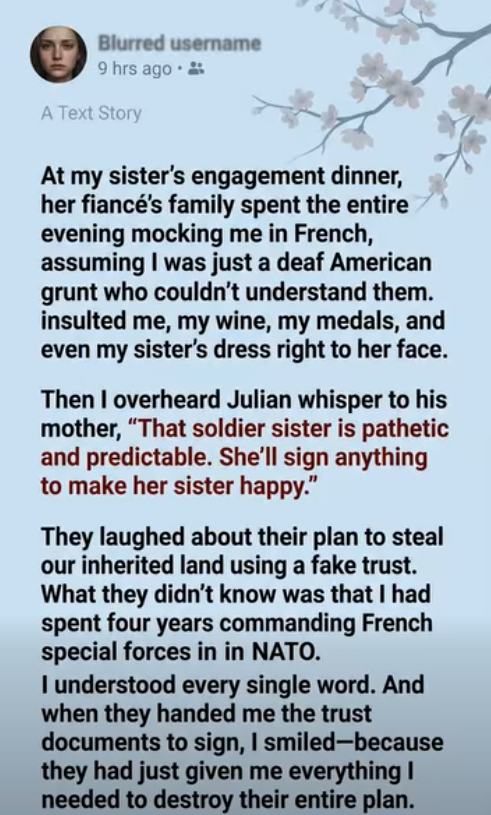
At my sister’s engagement dinner, I realized my future in-laws were laughing at me.
They just didn’t realize I understood every word.
The dinner was held at an expensive French restaurant downtown.
My sister, Claire, was glowing.
She kept touching her engagement ring and looking at Julian as if she’d won the lottery.
I was happy for her.
I really was.
Julian’s family, however, had made it clear from the moment they arrived that they weren’t impressed by me.
I was wearing my dress uniform.
Not because I wanted attention.
Because Claire had asked me to.
“You’re my hero,” she’d said that morning. “I want you there as my sister.”
So I came.
I sat quietly beside her.
I smiled when people spoke to me.
I raised my glass when Julian’s father gave a toast.
And when Julian’s mother began speaking French to the people around her, I didn’t react.
At first, I assumed she was simply more comfortable speaking her native language.
Then I heard my own name.
“Elle est vraiment comme ça?”
Is she really like that?
Julian laughed.
His mother glanced at my medals.
“Elle joue encore au soldat.”
She’s still playing soldier.
I kept eating.
A few minutes later, someone commented on my wine.
Julian’s uncle lifted his glass and said something about Americans not knowing good wine.
They laughed.
Then they started making jokes about my military career.
“Une brute,” someone said.
A brute.
“Une Américaine qui ne sait probablement même pas ce qu’on dit.”
An American who probably doesn’t even know what we’re saying.
I kept my expression neutral.
They thought I couldn’t understand.
That was their first mistake.
I had spent four years commanding French special forces during my NATO assignment.
I had trained with French units.
Briefed French officers.
Negotiated operations in French.
Argued with colonels in French.
Dreamed in French.
I understood every single word.
But I said nothing.
Because I wasn’t there to fight.
I was there for my sister.
Then Julian leaned toward his mother.
He thought he was whispering.
He wasn’t.
“That soldier sister is pathetic and predictable,” he said.
“She’ll sign anything to make Claire happy.”
His mother smiled.
“And the land?”
Julian nodded.
“It’s perfect.”
My hand stopped halfway to my glass.
The land.
My grandfather’s property.
The one piece of our family’s inheritance that had survived generations.
Claire and I had inherited it jointly after our parents died.
It wasn’t just valuable.
It was sentimental.
Our grandfather had built the original farmhouse with his own hands.
He’d planted the orchard.
He’d told us as children that someday the property would belong to both of us.
It was the one thing Claire and I had always promised to protect together.
Apparently, Julian knew exactly how much it was worth.
His mother whispered,
“Once the trust is signed, everything becomes much easier.”
Julian smiled.
“Claire will convince her.”
I looked at my sister.
She was laughing at something Julian had said.
She had no idea.
Or perhaps she did.
I wasn’t sure.
I didn’t say anything.
Dinner continued.
At the end of the evening, Julian approached me.
His smile was warm.
Almost brotherly.
“I’d like to talk to you about something important.”
“Of course.”
He handed me a folder.
“It’s just some estate paperwork.”
I opened it.
There were several pages.
A trust agreement.
Property schedules.
Beneficiary designations.
Power-of-attorney language.
Julian smiled.
“It’s mostly administrative.”
I looked at the first page.
Then the second.
Then the third.
“You just need to sign here,” he said.
I looked up.
“Why?”
“To simplify things.”
“What things?”
“The property.”
He lowered his voice.
“Claire told me how much the land means to you both. This trust protects it.”
I smiled.
“That’s thoughtful.”
He nodded.
“We’re family now.”
I looked at the signature line.
Then at him.
“You’re right.”
He smiled.
“I knew you’d understand.”
I picked up the pen.
And signed.
His smile widened.
I handed the papers back.
“Thank you.”
He walked away.
I watched him disappear into the restaurant.
Then I looked at the signature page.
I hadn’t signed my legal name.
I’d signed an abbreviated version I never used on official documents.
A name that looked plausible.
But wasn’t legally valid.
And more importantly, I hadn’t signed the page they thought I had.
Before leaving the dinner, I had quietly photographed every page of the document.
I also photographed the envelope.
The date.
The names.
The trust company.
Everything.
Then I called Claire.
“Can we talk?”
“Sure.”
“Privately.”
She heard the seriousness in my voice.
“What’s wrong?”
“I need to ask you something.”
We went outside.
I showed her the photographs.
She stared at the papers.
“What is this?”
“That’s what I want to know.”
She shook her head.
“Julian said it was a family trust.”
“Did you know about it?”
“No.”
“Did you know he was planning to transfer the land?”
Her face changed.
“No.”
I watched her carefully.
“Claire, I heard them talking.”
“Who?”
“Julian and his mother.”
Her eyes widened.
“What did they say?”
I switched to French.
She stared at me.
“You understood them?”
“Every word.”
I told her everything.
The jokes.
The insults.
The land.
The trust.
The plan to get my signature.
Claire started crying.
“No.”
“I wish I were wrong.”
She shook her head.
“He loves me.”
“I hope he does.”
“He wouldn’t do this.”
“Then ask him.”
She didn’t.
Not that night.
Instead, we went home separately.
The next morning, Claire called me.
Her voice was shaking.
“I asked him.”
“What did he say?”
“He said you misunderstood.”
“Did he explain the trust?”
“He said it was temporary.”
“Temporary?”
“He said the land would be transferred into a family trust, then returned later.”
I closed my eyes.
“Did he tell you who would control the trust?”
Silence.
“No.”
“That’s because he didn’t want you to know.”
Claire began crying again.
“What do we do?”
“We don’t confront him yet.”
“Why?”
“Because he thinks he has everything he needs.”
I contacted an attorney specializing in property and trust fraud.
I showed her the documents.
She studied them carefully.
Then she looked at me.
“Did you sign this?”
“No.”
“Good.”
She pointed to several clauses.
“This isn’t a protective trust.”
“What is it?”
“A transfer of control.”
She explained that the language would have given a trustee broad authority over the property.
The beneficiaries weren’t simply Claire and me.
There were provisions that could ultimately benefit entities connected to Julian’s family.
If we had signed correctly, undoing the arrangement could have become extremely complicated.
Then the attorney noticed something else.
“This trust references a prior agreement.”
“What agreement?”
“This one.”
She pulled another document from the folder.
It was dated six months earlier.
My signature appeared at the bottom.
Except I had never seen it.
And that signature was much closer to my real signature.
Someone had copied it.
The attorney looked at me.
“This changes everything.”
We reported the forged document.
The authorities began investigating the trust company and the people who had prepared the paperwork.
Then came the part Julian hadn’t expected.
The attorney discovered that the trust company wasn’t independent.
It was controlled by Julian’s uncle.
The same uncle who had mocked me at dinner.
The same uncle who had laughed about Americans not understanding French.
The same uncle who had been sitting three seats away when Julian discussed the land.
The plan had been coordinated.
They had apparently expected Claire and me to sign quickly because they believed I was predictable.
They were wrong.
But I still needed to protect Claire.
So we let them think their plan had worked.
Three days later, Julian called me.
“Everything is moving along,” he said cheerfully.
“Good.”
“You’re comfortable with the trust?”
“Absolutely.”
He laughed.
“I knew you would be.”
I asked,
“When do we finalize?”
“Friday.”
“Perfect.”
That Friday, we arrived at the attorney’s office.
Julian walked in smiling.
His mother came with him.
His uncle was there too.
They expected signatures.
Instead, they found my attorney.
And behind her sat an investigator.
Julian’s smile disappeared.
“What is this?”
My attorney placed the trust documents on the table.
“These documents contain forged signatures.”
Julian looked at me.
“You signed.”
“No.”
“Yes, you did.”
I smiled.
“I told you I signed.”
His face changed.
“You—”
I interrupted him.
“I signed a piece of paper you handed me.”
“But not legally.”
“No.”
My attorney continued.
“And the other signature appearing on the earlier property agreement is demonstrably fraudulent.”
Julian’s mother stood.
“This is absurd.”
The investigator calmly asked her to sit.
Julian looked at me.
“You recorded us?”
“No.”
“Then how—”
I smiled.
“You spent the entire dinner speaking French in front of someone who understands French.”
His face went white.
His mother stared at me.
“You understood?”
“Every word.”
Nobody spoke.
I continued.
“You called me a brute.”
Silence.
“You mocked my medals.”
Silence.
“You called me predictable.”
Julian lowered his eyes.
“And you discussed stealing my family’s land.”
His mother started shaking her head.
“We weren’t stealing anything.”
My attorney slid the documents toward her.
“Then you won’t mind explaining the forged signature.”
She said nothing.
The investigation continued for months.
The people involved eventually faced legal consequences for the fraudulent documents and attempted property transfer.
The land remained in Claire’s and my names.
But the legal victory wasn’t the part that mattered most to me.
It was what happened afterward.
Claire ended her engagement.
It broke her heart.
For a while, she blamed herself.
She kept saying,
“How could I have missed it?”
I told her the truth.
“You didn’t miss it.”
“What?”
“You trusted someone you loved.”
She cried.
“That’s stupid.”
“No.”
I hugged her.
“Trust isn’t stupidity. What someone does with that trust is their responsibility.”
Months later, we went back to the family property.
The old farmhouse was exactly as we’d remembered it.
The orchard was blooming.
Claire walked through the fields.
“I almost gave this away.”
“No,” I said.
“They almost convinced you to.”
She looked at me.
“Why didn’t you tell me at dinner?”
“Because I wanted you to have one more evening without knowing your fiancé was trying to betray you.”
She smiled sadly.
“Even after they insulted you?”
I shrugged.
“I’ve heard worse.”
She laughed.
Then she looked at my medals.
“You know what?”
“What?”
“I’m glad you wore them.”
I smiled.
“Why?”
“Because they thought they were looking at a predictable old soldier.”
She shook her head.
“They never bothered to find out who you actually were.”
I looked across the property.
That was the irony.
They had mistaken silence for weakness.
They had mistaken politeness for ignorance.
They had mistaken patience for surrender.
And most of all, they had assumed that because I loved my sister, I would sign anything placed in front of me.
They were wrong.
I loved my sister enough to protect her.
But I also loved her enough to let her see the truth for herself.
A year later, Claire still lived nearby.
She had started rebuilding her life.
She went back to school.
She traveled.
She laughed more.
And sometimes, when we were sitting on the porch overlooking the land, she’d ask me about my time in France.
I never talked much about the difficult parts.
Instead, I told her about the language.
The food.
The tiny cafés.
The ridiculous arguments over which region had the best bread.
One evening, Claire looked at me and smiled.
“You know what still makes me laugh?”
“What?”
“They spent an entire dinner insulting you in French.”
“Yes.”
“And they had no idea you understood.”
I smiled.
“That wasn’t their biggest mistake.”
She raised an eyebrow.
“What was?”
“They thought understanding the words was the same as understanding the plan.”
Claire laughed.
I looked toward the orchard.
The land was still there.
Our grandfather’s house was still standing.
And the inheritance our family had protected for generations remained exactly where it belonged.
With us.
Not because I had outsmarted someone.
Not because I had won a battle.
But because when people mistake your silence for weakness, sometimes the smartest thing you can do is let them keep talking.