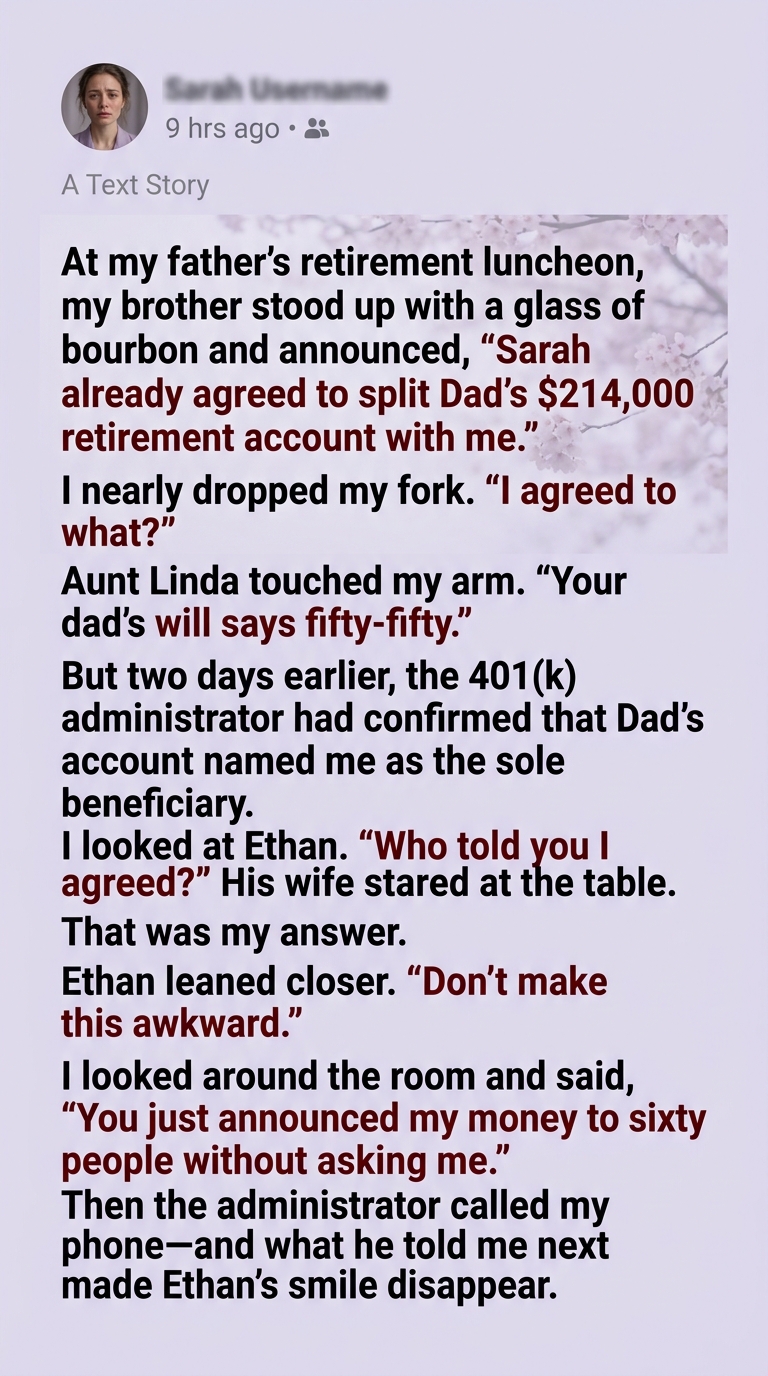
At my father’s retirement luncheon, my brother stood up with a glass of bourbon and announced, “Sarah already agreed to split Dad’s $214,000 retirement account with me.”
I nearly dropped my fork.
“I agreed to what?”
Aunt Linda touched my arm.
“Your dad’s will says fifty-fifty.”
I stared at her.
“That isn’t what the retirement account says.”
Two days earlier, I’d spoken directly with the 401(k) administrator.
He had confirmed something very specific:
I was Dad’s sole beneficiary.
Not Ethan.
Not both of us.
Me.
I looked across the table.
“Who told you I agreed?”
Ethan’s wife suddenly became very interested in her plate.
That was my answer.
Ethan leaned toward me.
“Don’t make this awkward.”
I looked around the room.
“You just announced my money to sixty people without asking me.”
The room went silent.
Ethan laughed.
“It’s Dad’s money. He wanted us to split it.”
“Then why am I the sole beneficiary?”
His smile faded.
“Because the paperwork must be wrong.”
“Which paperwork?”
He didn’t answer.
Then my phone rang.
It was the 401(k) administrator.
I stepped away from the table.
“Hello?”
“Ms. Sarah, I need to make you aware of something before you respond to anyone about the account.”
My stomach tightened.
“What?”
“There was a beneficiary-change request submitted six months ago.”
I froze.
“What?”
“The request was denied.”
“Why?”
“Because the signature didn’t match the records we have on file.”
I stared through the glass doors at my brother.
“Who submitted it?”
The administrator paused.
“Your brother.”
My blood ran cold.
“And there’s something else,” he continued.
“The request wasn’t simply asking to add him as a beneficiary.”
“What was it asking?”
“To remove you completely.”
I couldn’t speak.
He continued.
“We flagged it because your father had personally updated the account two years ago, naming you as the sole beneficiary.”
“Did Dad sign the change?”
“No.”
“Then whose signature was on it?”
The administrator lowered his voice.
“That’s the problem. It appears someone attempted to imitate his signature.”
I looked at Ethan again.
He was watching me.
And suddenly, I understood why he had been so confident.
He didn’t think he’d have to convince me.
He thought I’d already been replaced.
I returned to the table.
Ethan smiled.
“So?”
I sat down.
“You submitted a beneficiary change.”
His face changed.
“What?”
“To Dad’s 401(k).”
“I don’t know what you’re talking about.”
“The administrator called me.”
Ethan’s wife finally looked up.
“Ethan…”
He turned toward her.
“Don’t.”
I looked at her.
“Did you know?”
She started crying.
“I knew he was trying to change something.”
Ethan slammed his glass down.
“It was supposed to be fifty-fifty!”
I stared at him.
“According to who?”
“Dad.”
“Then why did Dad name me as the sole beneficiary?”
“Because you manipulated him.”
The words hung in the air.
I couldn’t believe it.
“You think I manipulated Dad?”
“You were always his favorite.”
There it was.
The real story.
This wasn’t about fairness.
It was about resentment.
Dad had spent years telling Ethan that the retirement account would eventually help both of us.
But two years before his retirement, Dad had changed the beneficiary designation.
I had no idea why.
Until that evening.
After the luncheon, I went home and found an envelope Dad had given me shortly before he died.
I’d never opened it.
I assumed it contained old photographs.
Instead, there was a handwritten letter.
Sarah,
If you’re reading this, I’m probably not around to explain myself.
I know Ethan believes everything should be divided equally.
But equal isn’t always fair.
My eyes filled with tears.
Dad explained that Ethan had repeatedly asked him for money to cover business debts.
Dad had helped several times.
But eventually, he refused.
He didn’t want his retirement savings used to keep rescuing a business that wasn’t sustainable.
He changed the beneficiary because he wanted the account protected for someone who had never asked him for anything.
Me.
Then came the sentence that made me stop breathing.
I don’t want you to feel guilty.
You spent years helping me with things no one else saw.
The account is not payment for loving me.
It’s simply the decision I made with my own money.
I folded the letter.
Then I called Ethan.
“You wanted to know why Dad left the account to me?”
“Yes.”
“I have his letter.”
Silence.
I read it to him.
He didn’t interrupt.
When I finished, he said quietly:
“He really wrote that?”
“Yes.”
He was silent for almost a minute.
Then he whispered:
“I didn’t know.”
“I know.”
“Why didn’t he tell me?”
“Maybe he didn’t want another argument.”
Ethan began crying.
“I thought you took it from me.”
“I never had to take it.”
He hung up.
The following weeks were difficult.
The administrator completed the investigation and confirmed that the attempted beneficiary change had never been accepted.
The original designation remained valid.
The $214,000 would pass according to Dad’s recorded beneficiary designation.
Ethan eventually admitted what he’d done.
He had found an old copy of Dad’s paperwork and convinced himself that changing the beneficiary was simply correcting an unfair decision.
He hadn’t told me because he knew I would object.
His wife apologized for knowing about the attempt and staying silent.
I didn’t know whether I could forgive either of them.
But I decided I wouldn’t let Dad’s final gift become another family war.
I kept the money separate.
I used part of it to pay off Dad’s remaining medical expenses.
Then I created a small scholarship in his name at the community college where he’d once taught.
I also set aside some money for Ethan’s children.
Not for Ethan.
For the kids.
When Ethan found out, he called me.
“You didn’t have to do that.”
“I know.”
“Why?”
“Because Dad taught me something.”
“What?”
“That money isn’t the same thing as love.”
There was a long silence.
Then Ethan said:
“I wish I’d understood that before Dad died.”
“So do I.”
Months later, we held a small memorial for Dad.
About sixty people came.
The same number who had watched Ethan announce my inheritance at that luncheon.
This time, there was no bourbon.
No announcement.
No argument.
Ethan stood beside me.
He looked at Dad’s photograph and said quietly:
“He made his choice. I should’ve respected it.”
I squeezed his shoulder.
For the first time since Dad died, my brother and I weren’t fighting over what he left behind.
We were remembering what he had actually given us while he was alive.
And I finally understood why Dad had named me the sole beneficiary.
It wasn’t because he loved Ethan less.
It was because he trusted me to understand that a gift doesn’t become more loving simply because you divide it.
Sometimes the hardest part of inheriting something isn’t accepting what you receive. It’s refusing to let someone else’s resentment make you feel guilty for receiving it.