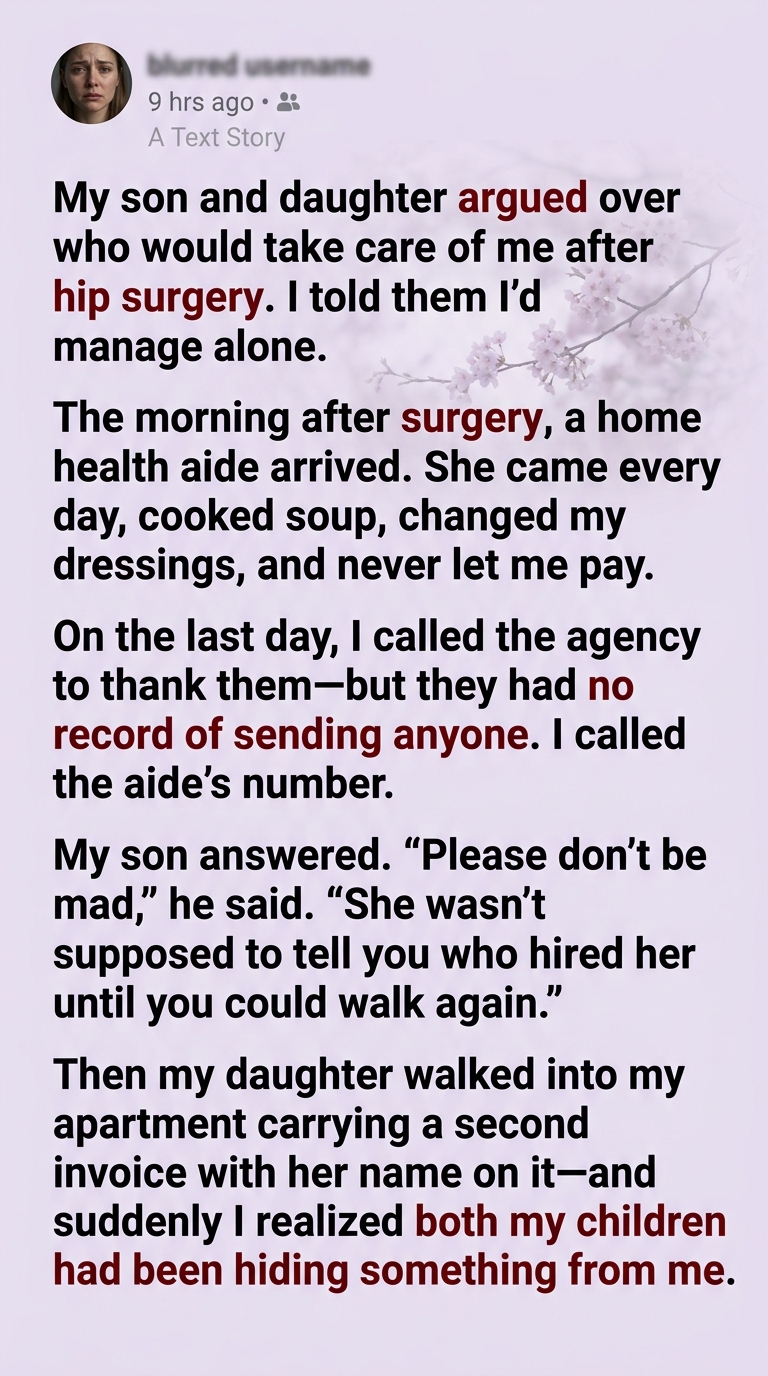
My son and daughter argued over who would take care of me after hip surgery.
I told them both the same thing.
“I’ll manage alone.”
They didn’t believe me.
But they knew I hated feeling dependent on anyone.
The morning after my surgery, someone knocked on my apartment door.
A woman stood there holding a grocery bag.
“Mrs. Carter?”
“Yes?”
“My name is Elena. I’m here to help you.”
“I didn’t hire anyone.”
She smiled.
“I know.”
That should have worried me.
Instead, she walked into my kitchen and started making soup.
She came every morning.
She changed my dressings.
She washed dishes.
She made sure I took my medication.
She even sat beside me when I was too tired to walk from the bedroom to the living room.
Whenever I tried to pay her, she shook her head.
“Someone already took care of that.”
“Who?”
She smiled.
“I’m not allowed to tell you yet.”
I thought she was joking.
For six weeks, she came every day.
Never late.
Never asking for anything.
Then one morning, I took my first unaided walk across the apartment.
Elena clapped.
“You did it.”
I laughed.
“I couldn’t have done it without you.”
She hugged me.
That was the last day she came.
I called the agency listed on her badge to thank them.
The woman on the phone sounded confused.
“Mrs. Carter, we don’t have anyone by that name assigned to you.”
My stomach dropped.
“What?”
“We never sent a home health aide to your address.”
I hung up and called Elena.
A man answered.
My son’s voice.
“Mom?”
I froze.
“Where is Elena?”
Silence.
Then he said:
“Please don’t be mad.”
I sat down.
“What did you do?”
“She wasn’t supposed to tell you who hired her until you could walk again.”
“Who hired her?”
He hesitated.
“We did.”
“We?”
“My sister and I.”
I couldn’t understand.
“Why would you two do this?”
Before he could answer, my apartment door opened.
My daughter walked in carrying a folder.
She looked at me.
Then at the phone.
“Did he tell you?”
I stared at her.
“Tell me what?”
She placed the folder on the table.
Inside was an invoice.
Her name was on it.
The amount was almost identical to the cost of the care I’d received.
I looked at her.
“You paid for this?”
She nodded.
“So did your brother?”
“Yes.”
I looked at my son through the phone.
“Why?”
My daughter sat beside me.
“Because we couldn’t agree on who should take care of you.”
I remembered their argument.
My son had wanted to take time off work.
My daughter had wanted me to stay with her.
They had argued until I finally told them both to stop.
“I thought you were fighting because neither of you wanted the responsibility.”
My son laughed sadly.
“It was the opposite.”
My daughter nodded.
“We were fighting because neither of us wanted the other one to carry it alone.”
I stared at them.
My son explained that he had found Elena through a private caregiving service.
My daughter had secretly paid half.
They had agreed that neither would tell me because they knew I would refuse.
“But why hide the invoices?”
My daughter smiled.
“Because you would’ve insisted on paying us back.”
She was right.
I probably would have.
My son continued.
“We also made a deal with Elena.”
“What deal?”
“She wasn’t supposed to tell you who hired her until you could walk safely again.”
I laughed.
“You two planned all of this?”
“Yes.”
“Behind my back?”
“Yes.”
I shook my head.
“You’re both impossible.”
My daughter smiled.
“That’s what Dad used to say.”
The room went quiet.
My husband had been gone for seven years.
And suddenly, I realized what they’d really been doing.
They weren’t trying to control my recovery.
They were trying to protect me from feeling like a burden.
I looked down at the invoices.
Two payments.
Two names.
Two children who had secretly shared the responsibility I’d been so determined to carry alone.
“I thought I had raised two stubborn children,” I whispered.
My son laughed.
“You did.”
My daughter reached for my hand.
“But you also raised two children who love you.”
I started crying.
So did they.
A week later, I was walking outside with a cane.
My son came over on Saturday.
My daughter came Sunday.
Neither one mentioned the money.
Neither asked whether I needed anything.
They simply sat with me.
One afternoon, Elena stopped by.
I thanked her again.
She smiled.
“They’re good kids.”
I laughed.
“They’re terrible secret-keepers.”
She shook her head.
“No. They’re terrible at letting you worry about them.”
That stayed with me.
Because I’d spent my entire life believing independence meant never needing anyone.
But my children taught me something during those six weeks.
Sometimes accepting help isn’t weakness.
Sometimes it’s the greatest gift you can give the people who love you.
Months later, I was completely recovered.
The invoices were framed and hanging in my hallway.
Not because of the money.
Because of what they represented.
Two siblings who had argued because they both wanted to protect the same person.
And one mother who finally understood that she didn’t have to manage everything alone.
One evening, my son looked at the framed invoices and laughed.
“You’re keeping those?”
“Of course.”
My daughter smiled.
“Why?”
I touched the glass.
“Because the first invoice proves you paid for my care.”
I pointed to the second.
“And the other proves you two finally learned how to work together.”
They laughed.
Then I added:
“And that’s worth more than what either of you paid.”
My children thought they had been hiding something from me.
But the truth was, they had revealed something I’d forgotten.
I wasn’t a burden they were fighting over.
I was a mother they were both still fighting to take care of.