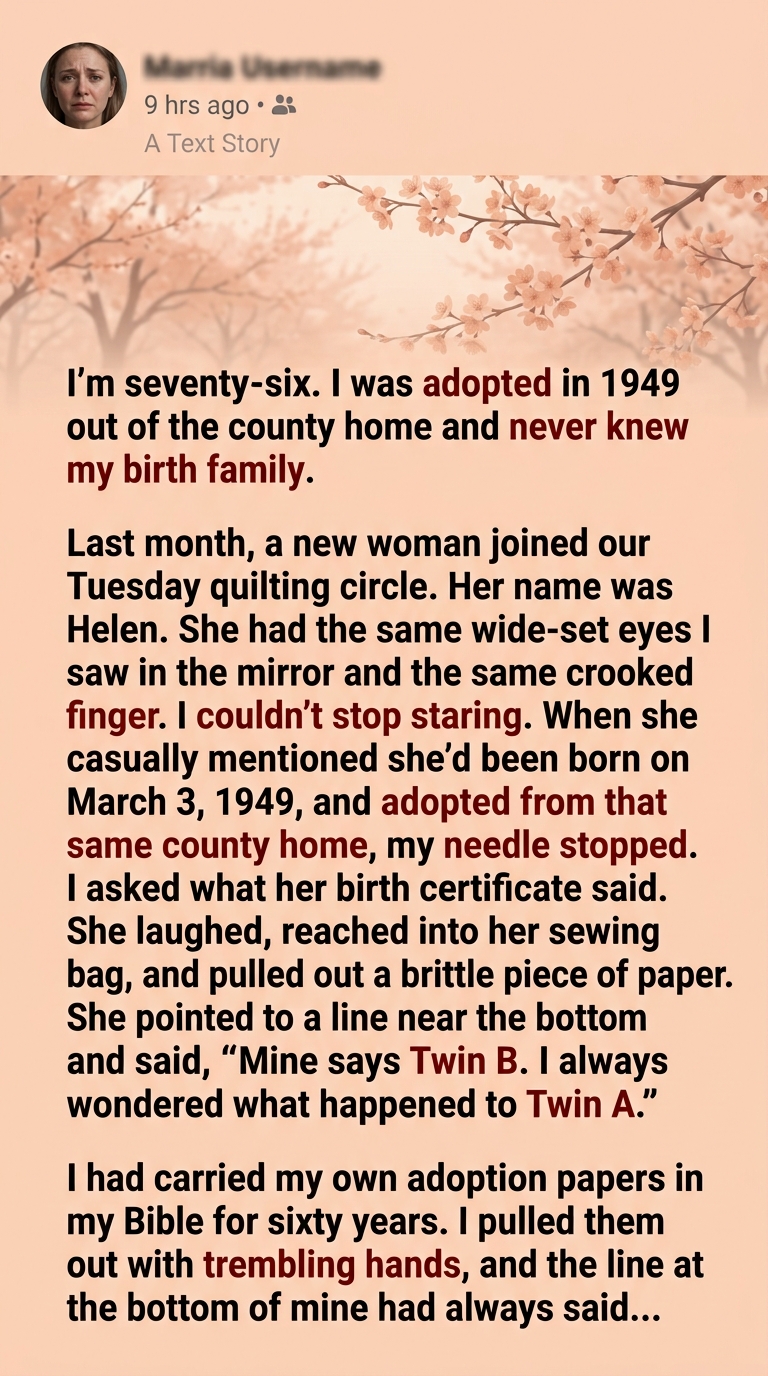
I’m seventy-six years old, and for most of my life, I believed I was an only child.
I was adopted in 1949 from the county home.
My adoptive parents were kind people, but they never knew much about where I came from.
Whenever I asked, my mother would say, “You were very little, sweetheart. That’s all they told us.”
So I learned to stop asking.
I built a life.
I married.
Raised two children.
Became a grandmother.
And eventually, I made peace with the blank spaces in my history.
Then Helen joined our Tuesday quilting circle.
She was new.
Quiet.
Funny.
She sat beside me and struggled with a particularly complicated quilt pattern.
“I’m hopeless at this,” she laughed.
“You’re holding it upside down,” I told her.
She laughed.
And that’s when I really looked at her.
Her eyes.
Wide-set.
Just like mine.
Then I noticed her hands.
Her little finger on the left hand curved slightly inward.
Mine did too.
I stared at her so long that she finally asked:
“Do I have something on my face?”
I laughed nervously.
“No. You just look familiar.”
She smiled.
“I get that sometimes.”
Then, almost casually, she mentioned her birthday.
March 3, 1949.
My needle stopped.
“Where were you born?”
She named the same county.
My heart began pounding.
“Were you adopted?”
She nodded.
“From the county home.”
The room seemed to disappear.
I asked, “Do you know anything about your birth records?”
Helen shrugged.
“Not much.”
Then she reached into her sewing bag.
“I actually brought the old papers today.”
She pulled out a brittle document folded nearly to pieces.
She pointed toward the bottom.
“Mine says Twin B.”
She laughed nervously.
“I always wondered what happened to Twin A.”
My hands began shaking.
I reached into my purse.
Inside my Bible was the adoption document I had carried for nearly sixty years.
I opened it.
Helen leaned closer.
I pointed to the bottom.
The line read:
“Twin A — transferred to county care.”
I looked at Helen.
She looked at me.
Neither of us spoke.
Then Helen whispered:
“That’s you.”
We didn’t hug immediately.
We simply stared at each other.
Two seventy-six-year-old women sitting at a quilting table, surrounded by scraps of fabric and half-finished blankets, realizing that we’d spent our entire lives searching for the same person.
Each other.
Helen began crying.
“I thought I was alone.”
“So did I.”
She reached across the table.
Her crooked little finger touched mine.
It fit perfectly beside it.
We spent the next several weeks trying to reconstruct what had happened.
The county records were incomplete.
1949 was a long time ago.
But Helen had one advantage.
Her adoption papers contained a name.
Not our mother’s full name.
Just an initial.
M. Carter.
Mine had the same initial.
We contacted the county archive.
Then the state records office.
Then a genealogist.
Piece by piece, the story emerged.
Our mother was a young woman who had been unmarried and struggling financially.
She had given birth to twins.
She had asked the county home to keep us together.
But there was a shortage of foster families willing to take two infants.
So we were separated.
Helen was adopted first.
I was adopted two weeks later.
Our mother was told we had been placed.
She was never given our adoptive names.
And then she disappeared from the records.
For decades, Helen and I wondered why she hadn’t come looking.
Eventually, we discovered why.
She had died in 1961.
She was only thirty-four.
There was no dramatic reunion waiting for us.
No mother suddenly walking through a doorway.
No chance to ask why she left.
But there was something else.
A letter.
It had been stored in an old county file.
The archivist warned us that the handwriting was difficult to read.
We opened it together.
It was dated March 20, 1949.
Seventeen days after our birth.
Our mother had written:
“Please tell my girls that I loved them. I did not give them away because I didn’t want them. I gave them away because I wanted them to have what I could not give them.”
Helen covered her mouth.
I couldn’t breathe.
The letter continued.
“If they ever find each other, tell them they were never alone. They had each other from the very beginning.”
We sat there holding hands.
For seventy-six years, I had wondered whether my mother had loved me.
Now I knew.
She had.
She simply hadn’t been allowed to keep me.
Helen eventually came to my house.
We spent an entire afternoon looking through my old photographs.
She laughed at my terrible haircut from 1967.
I laughed at her wedding dress.
Then we discovered something astonishing.
We had both chosen the same color for our kitchens.
We both hated black licorice.
We both hummed when we cooked.
And both of us had kept old buttons in glass jars because we couldn’t stand throwing them away.
Helen shook her head.
“Do you think that’s genetic?”
“Probably.”
“What about the quilting?”
I smiled.
“Definitely.”
She laughed.
Then she grew quiet.
“Do you ever feel angry?”
I knew what she meant.
“Yes.”
“At our mother?”
I shook my head.
“No.”
“At the county?”
“Sometimes.”
“At the people who decided two babies could simply be separated?”
I looked at her.
“Yes.”
Then she squeezed my hand.
“But we found each other.”
“Yes.”
“That has to count for something.”
“It counts for everything.”
A month later, Helen and I returned to our quilting circle.
Everyone knew our story by then.
The women had prepared something for us.
Two quilts.
Matching quilts.
One had TWIN A stitched into the corner.
The other said TWIN B.
We laughed.
Then cried.
Then laughed again.
Helen looked around the room.
“You know what I think?”
“What?”
“I spent seventy-six years thinking my life began when I was adopted.”
She looked at me.
“But it didn’t.”
She reached for my hand.
“It began three days before that.”
I knew exactly what she meant.
Our lives had begun together.
And somehow, after seventy-six years apart, they had found their way back to each other.
That evening, I took my adoption papers out of my Bible for the first time in sixty years.
I didn’t put them back.
Instead, I framed them.
Not as a reminder of what had been taken from me.
But as proof that the truth can survive almost anything.
At the bottom of my adoption papers, one little line had changed the story of my entire life.
I had spent decades thinking it meant I was alone.
It turned out it meant something else.
I wasn’t abandoned. I was separated.
And somewhere in the world, my other half had been carrying the same question all along.
What happened to Twin A?
Now she knows.
And so do I.
Sometimes the family you spend a lifetime searching for isn’t waiting somewhere in your past. They’re waiting for you to finally find the missing piece—and realize it was looking for you, too.