MY FATHER SAID I WASN’T WORTH INVESTING IN—FOUR YEARS LATER, MY NAME ECHOED ACROSS THE STADIUM
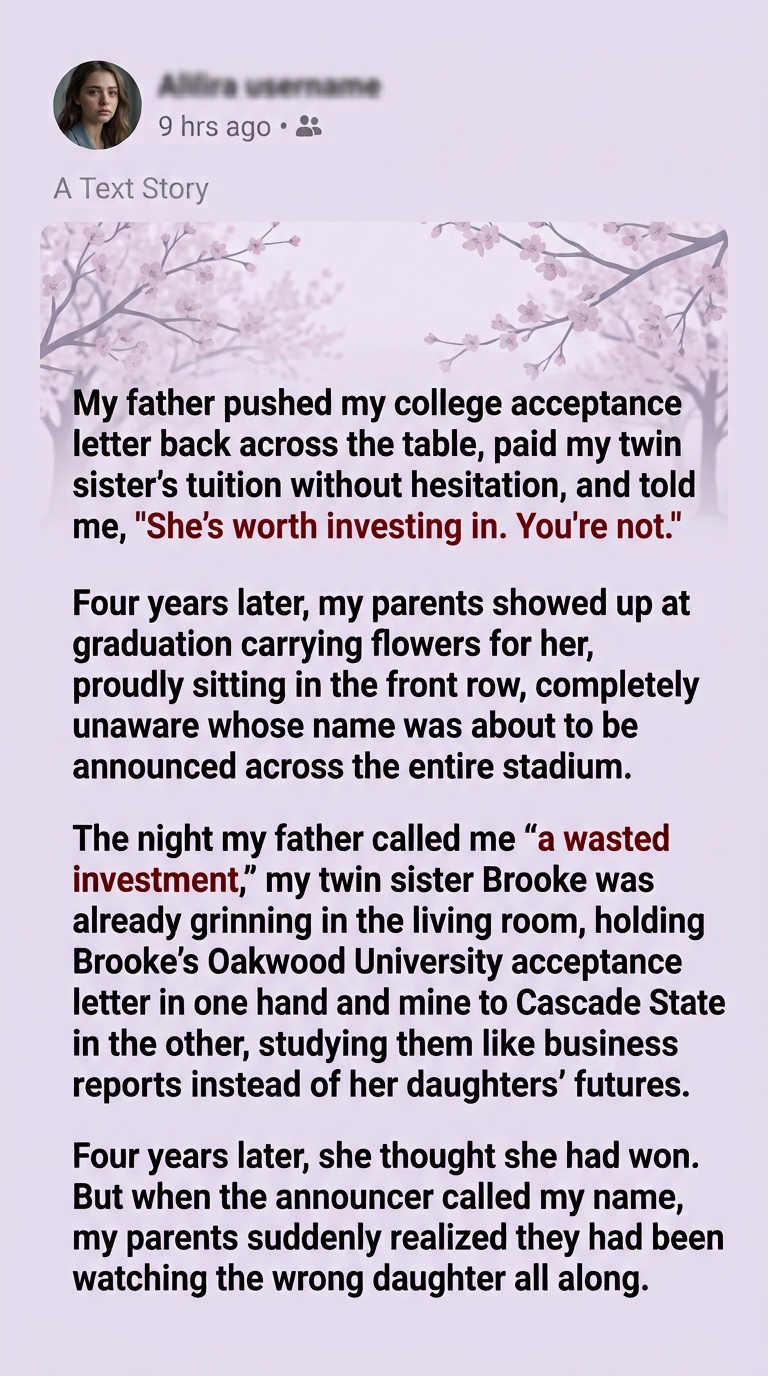
My father pushed my college acceptance letter back across the table.
He didn’t even bother reading it again.
“You got into Cascade State,” he said flatly.
I nodded.
“I did.”
Then he looked at my twin sister, Brooke.
She had been accepted into Oakwood University.
My father smiled.
“I’ll pay every dollar of Brooke’s tuition.”
I stared at him.
“What about mine?”
He didn’t hesitate.
“She’s worth investing in.”
Then he looked directly at me.
“You’re not.”
The room went silent.
My mother didn’t defend me.
She simply looked down at the two acceptance letters lying on the table.
Brooke was already smiling.
That night, she sat in the living room holding both letters in her hands, studying them like business reports instead of her daughters’ futures.
Oakwood University.
Cascade State.
She looked at me and said, “I guess Dad knows what he’s doing.”
I didn’t answer.
I simply picked up my acceptance letter and went upstairs.
I cried that night.
Not because I thought Cascade State was beneath me.
But because the people who were supposed to believe in me had decided I wasn’t worth believing in.
The next morning, I walked into my father’s office.
“I’ll figure out the tuition myself.”
He barely looked up from his computer.
“Good.”
That one word changed my life.
I applied for every scholarship I could find.
I worked mornings before class.
I worked weekends.
I became a resident assistant to cover housing.
There were nights when I ate instant noodles for dinner because I couldn’t afford anything else.
Meanwhile, Brooke lived comfortably.
My parents paid for her tuition, apartment, meals, vacations, and even a new car.
Whenever I came home, my father would ask how much debt I had accumulated.
Whenever Brooke came home, he asked about her grades.
The difference was obvious.
And painful.
But something strange happened during my second year.
A professor noticed my research.
He encouraged me to apply for a competitive national fellowship.
I did.
I won.
That fellowship led to an internship.
The internship led to a job offer.
And that job changed everything.
By my senior year, I was leading a research team and had already been offered a position with one of the fastest-growing companies in my field.
I didn’t tell my parents.
Not because I wanted revenge.
I simply stopped needing their approval.
Then graduation day arrived.
My parents came.
But not for me.
They arrived carrying flowers for Brooke.
They proudly walked into the stadium and took their seats in the front row.
My mother waved at Brooke.
My father took pictures.
I sat several rows behind them.
They never even noticed.
Brooke was graduating with honors.
My parents were convinced she had proven them right.
Then the ceremony began.
Names were called one after another.
Bachelor’s degrees.
Awards.
Scholarships.
Department honors.
Then the university president stepped to the microphone.
“And now, we recognize this year’s recipient of the Cascade State Chancellor’s Medal for outstanding academic achievement, leadership, and service.”
My father barely looked up.
The president continued.
“This year’s recipient has also been selected to deliver the student commencement address.”
Then he said my name.
The entire stadium erupted in applause.
For a second, my parents didn’t move.
My mother turned around.
She saw me walking toward the stage.
Her mouth fell open.
My father stood frozen.
Brooke slowly lowered the flowers from her lap.
I walked across the stage and accepted the medal.
Then I stepped behind the microphone.
I looked out at thousands of people.
And for the first time, I saw my father looking at me—not as the daughter who wasn’t worth investing in, but as someone he had completely underestimated.
I didn’t mention him.
I didn’t mention Brooke.
I simply told the graduates about the scholarship applications, the late nights, the jobs, the failures, and the moments when I wanted to quit.
Then I said:
“Sometimes the person who believes in you isn’t the person you expected. And sometimes, when nobody believes in you, you have to become the first person who does.”
The stadium erupted in applause.
After the ceremony, my father found me outside.
He was holding the flowers that had originally been meant for Brooke.
“I didn’t know,” he said quietly.
I looked at him.
“You never asked.”
He swallowed.
“I was wrong about you.”
I nodded.
“You were.”
My mother started crying.
“We’re proud of you.”
I looked at both of them.
“I appreciate that.”
My father handed me the flowers.
Then he said something I never expected.
“I wish I had invested in you.”
I smiled sadly.
“You did.”
He looked confused.
I continued.
“You taught me exactly how much I could accomplish without you.”
I hugged my mother.
I shook my father’s hand.
Then I walked away.
That night, I received an email confirming my first full-time position.
The salary was more than my father had ever paid toward Brooke’s education.
But the money wasn’t what mattered.
For four years, my father had believed he was investing in the daughter who would make him proud.
He never realized that the daughter he called a wasted investment was quietly building a life that didn’t require his approval.
And when my name echoed across that stadium, he finally understood something I had learned years earlier:
Sometimes being underestimated isn’t the end of your story. It’s the beginning of proving yourself to yourself.