MY FATHER SAID THE FAMILY HARDWARE STORE NEEDED A SON—THEN HIS LAWYER READ THE LAST CLAUSE OF THE WILL
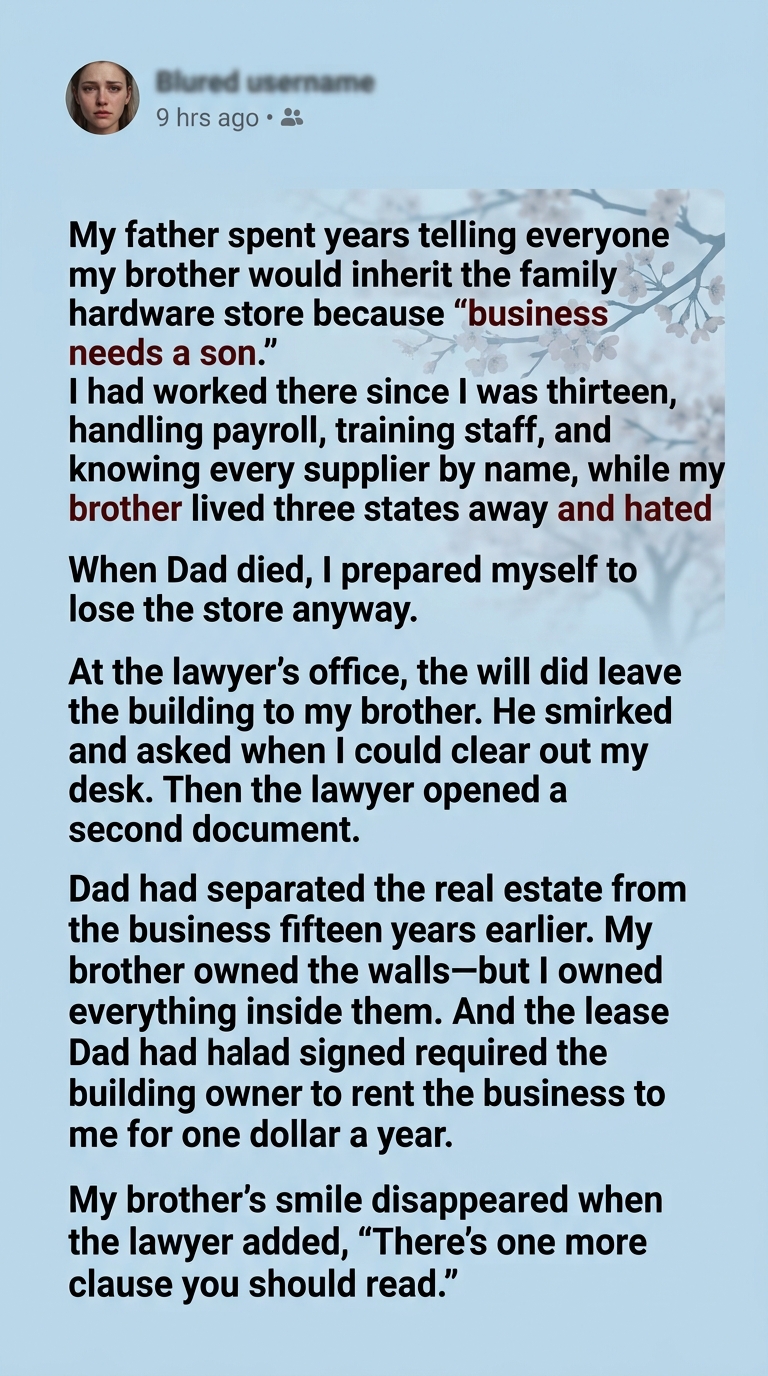
My father spent years telling everyone my brother would inherit the family hardware store.
“Business needs a son,” he always said.
I heard it so many times that eventually, I stopped arguing.
What he never mentioned was how much of that “business” I had actually built.
I started working at the store when I was thirteen.
At first, I swept floors and stocked shelves.
By sixteen, I was handling inventory.
By twenty, I was managing payroll.
Eventually, I trained every new employee, negotiated with suppliers, handled the accounts, and knew exactly which contractor wanted which brand of tools.
I could tell you where almost every item was without looking at a computer.
My brother, meanwhile, lived three states away.
He hated retail.
He hated the smell of the store.
And whenever Dad asked him to help, he’d say, “That’s your thing.”
Yet Dad always insisted:
“One day, this will all belong to him.”
Then Dad died.
The store became strangely quiet.
For the first time in decades, there was no voice calling from the back office.
No keys jingling at the front counter.
No Dad telling me I was doing something wrong.
I expected the worst.
But I wasn’t prepared for how it felt to sit in the lawyer’s office and hear the words out loud.
“The building and property are being left to your brother.”
My brother leaned back in his chair.
He looked at me and smiled.
I already knew what was coming.
“You should probably start clearing out your desk.”
I stared at him.
The lawyer didn’t react.
Instead, he opened another folder.
“There is a separate business agreement your father executed fifteen years ago.”
My brother’s smile disappeared slightly.
The lawyer continued.
“Your father separated ownership of the real estate from ownership of the business.”
I frowned.
“What does that mean?”
“It means your brother owns the building.”
My brother smiled again.
“And I suppose I own the store too.”
The lawyer shook his head.
“No.”
He turned toward me.
“You own the business.”
My brother’s expression changed completely.
“What?”
The lawyer slid another document across the table.
“Your father transferred the hardware business into a separate company fifteen years ago. Your father was the owner until his death, and according to his business succession documents, the company transfers to you.”
My brother stared at the paperwork.
“That can’t be right.”
“It is.”
He looked at me.
“You knew about this?”
“I didn’t.”
The lawyer continued.
“There’s more.”
He pulled out another document.
“Your father also signed a long-term lease with the property owner.”
My brother suddenly realized where this was going.
“How long?”
“Thirty years.”
He swallowed.
“And the rent?”
The lawyer looked at me.
“One dollar per year.”
My brother stood up.
“You’re telling me I own the building, but she gets to operate the store inside it for practically nothing?”
The lawyer nodded.
“That’s correct.”
My brother’s face turned red.
“That makes no sense!”
The lawyer calmly replied:
“Your father was very deliberate.”
Then he reached into the folder again.
“And there’s one more clause you should read.”
He handed the document to my brother.
His eyes moved across the page.
Then stopped.
His face went completely blank.
I looked at the lawyer.
“What does it say?”
He answered:
“Under the terms of the lease, the building owner cannot terminate the agreement, raise the rent, or sell the property without first offering it to the business owner.”
My brother looked at me.
“You have the right of first refusal.”
I nodded slowly.
The lawyer added:
“And there’s an additional provision.”
My brother’s jaw tightened.
“What provision?”
“If the building is ever sold, the business owner has the right to purchase it at the independently appraised market value.”
My brother sat back down.
For the first time since Dad died, he wasn’t smiling.
I looked at the documents.
Then I understood.
Dad hadn’t simply left me the business.
He had protected it.
He knew my brother didn’t want it.
He knew I had spent my entire life keeping it alive.
And instead of arguing with the family tradition he had repeated for years, Dad had quietly created a structure that allowed the person actually running the business to keep running it.
I asked the lawyer one question.
“Why didn’t Dad ever tell me?”
The lawyer smiled sadly.
“He told me something once.”
“What?”
He looked at me.
“He said, ‘She doesn’t need to be told she’s capable. She needs to be given the chance to prove it.’”
I couldn’t speak.
My brother stood.
“So what am I supposed to do?”
I looked at him.
“You own the building.”
He stared at me.
“And I own the business.”
Neither of us said anything.
Finally, he sighed.
“Dad really planned everything.”
The lawyer smiled.
“He did.”
Months later, I kept the store exactly where it had always been.
I kept the employees.
I kept our suppliers.
I kept Dad’s old desk.
And I hung a new sign behind the counter.
Not my father’s name.
Not my brother’s.
Mine.
My brother eventually decided to keep the building as an investment and continued honoring the lease.
We didn’t become best friends overnight.
But something changed between us.
He stopped calling it “Dad’s store.”
And I stopped waiting for my father to acknowledge that I belonged there.
Because years earlier, he had already made his decision.
He just hadn’t announced it.
And the greatest inheritance my father left me wasn’t the inventory, the accounts, or the building.
It was the proof that after spending my whole life being told the business needed a son…
my father had finally made sure it belonged to the person who had actually built it.