MY BROTHER ARRIVED LATE TO MOM’S FUNERAL AND CLAIMED HE’D CARED FOR HER FOR YEARS—THEN HER LAWYER PLAYED ONE RECORDING
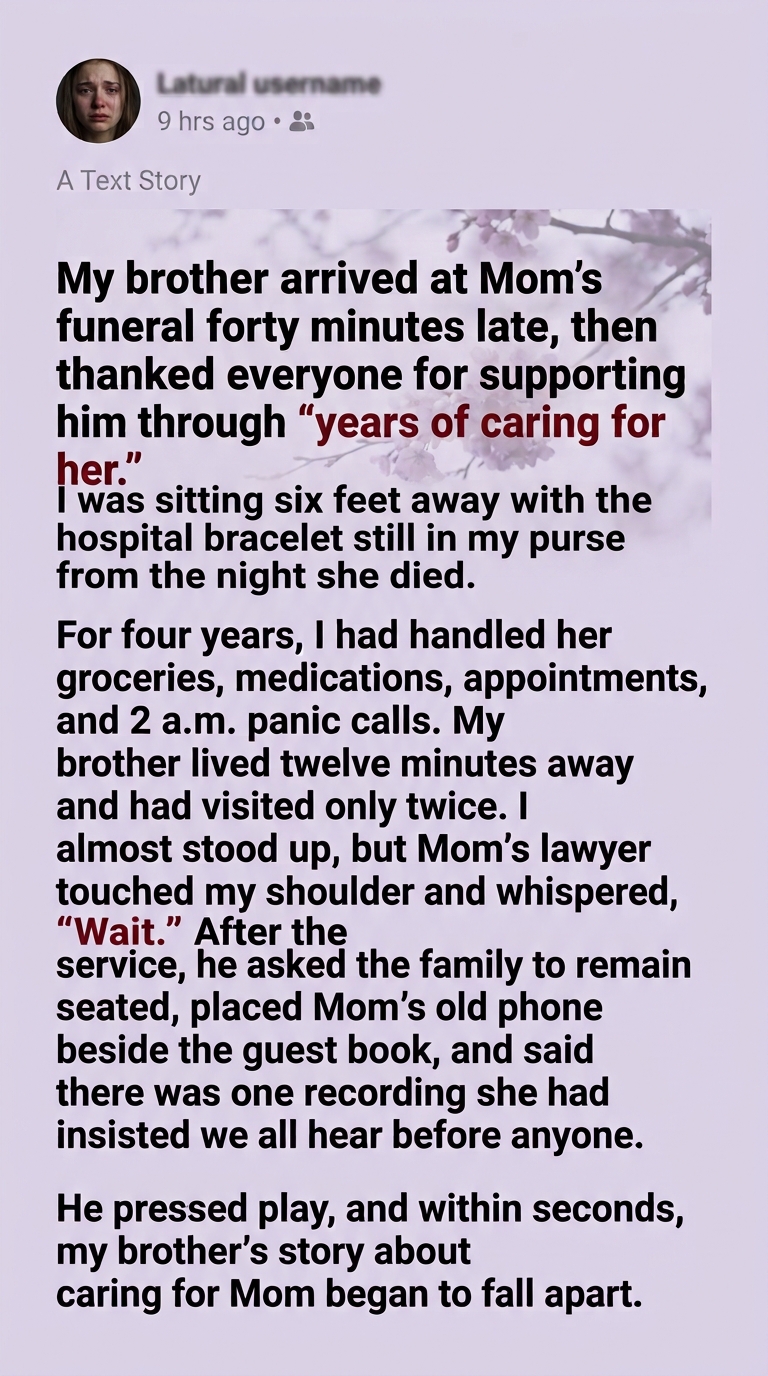
My brother arrived at Mom’s funeral forty minutes late.
He walked through the doors wearing an expensive suit, carrying flowers, and looking exhausted.
Then he hugged several relatives.
“Thank you all for supporting me,” he said.
“I spent years taking care of Mom.”
I almost laughed.
Not because it was funny.
Because it was so completely untrue.
I was sitting six feet away.
In my purse was the hospital bracelet Mom had been wearing the night she died.
For four years, I had handled everything.
Groceries.
Medications.
Doctor’s appointments.
Insurance paperwork.
Laundry.
Bills.
And those terrifying 2 a.m. phone calls when Mom woke up scared and couldn’t breathe.
My brother lived twelve minutes away.
He had visited twice.
Once for Christmas.
Once on Mom’s birthday.
That was it.
But there he stood, accepting condolences as though he had spent every night beside her.
I was about to stand up.
Then I felt a hand on my shoulder.
Mom’s lawyer leaned toward me.
“Wait.”
I looked at him.
“Wait for what?”
He didn’t answer.
The funeral continued.
My brother gave a speech about how difficult the past few years had been.
He talked about sacrifice.
He talked about sleepless nights.
He talked about “being there every step of the way.”
I stared at the floor.
I wanted to scream.
But I remembered the lawyer’s words.
Wait.
After the service, everyone began to leave.
Then Mom’s lawyer stood.
“Before anyone goes, I’d like the family to remain seated.”
My brother looked irritated.
“Why?”
The lawyer didn’t answer.
Instead, he walked to a small table near the guest book.
Then he placed Mom’s old phone on top of it.
My stomach tightened.
He looked at all of us.
“Your mother left specific instructions.”
My brother crossed his arms.
“Instructions about what?”
“About this.”
The lawyer picked up the phone.
“She insisted that one recording be played before anyone discussed her estate.”
My brother’s face changed.
“What recording?”
The lawyer pressed play.
Mom’s voice filled the room.
Her voice was weak.
But unmistakable.
“If you’re hearing this, I’m gone.”
Everyone became silent.
Mom continued.
“I know there may be questions about who took care of me during the last few years.”
My brother shifted in his seat.
Mom continued.
“So I want the truth to come from me.”
There was a pause.
Then she said:
“My daughter was the one who took care of me.”
I felt tears fill my eyes.
“She came to my house every week. She managed my medications. She took me to every appointment. She answered my calls in the middle of the night.”
My brother looked around the room.
Mom’s voice continued.
“My son visited twice.”
Someone in the back gasped.
“He was kind when he came. But he was not my caregiver.”
My brother stood up.
“This is ridiculous.”
The lawyer raised a hand.
“Please sit down.”
The recording continued.
“I know my son may tell people he cared for me.”
Mom’s voice became softer.
“Please don’t argue with him about it.”
My brother froze.
“Because I don’t want my final days remembered for fighting.”
Then Mom said something that made my brother sit back down.
“But I do want the truth recorded.”
The room was completely silent.
Then she continued.
“My daughter never asked me for anything.”
“She never complained.”
“She simply showed up.”
The recording ended.
Nobody moved.
My brother stared at the floor.
Then he whispered:
“I was going to help.”
I looked at him.
“You could have.”
He didn’t answer.
The lawyer opened a folder.
“There is one more matter.”
My brother looked up.
“The estate.”
He took out Mom’s will.
“My mother left the house to my brother,” I thought.
But the lawyer shook his head.
“She left the house to her daughter.”
My brother’s eyes widened.
“What?”
The lawyer continued.
“She also established a trust for her grandchildren and left a smaller personal inheritance to her son.”
My brother stood again.
“That’s not fair.”
The lawyer looked at him.
“She made her wishes very clear.”
My brother turned toward me.
“So you get everything because you played nurse?”
I didn’t respond.
The lawyer did.
“She didn’t leave you the house because you were a better child.”
He paused.
“She left it to the person who was actually caring for her because she wanted that person to have security after she was gone.”
My brother looked away.
For a moment, I thought he would argue again.
Instead, he sat down.
After everyone left, I stayed behind.
I picked up Mom’s phone.
I played the recording one more time.
At the very end, there was something I hadn’t noticed before.
Mom’s voice was barely a whisper.
“If you’re my daughter and you’re listening to this…”
A pause.
“Thank you for coming back every time I called.”
I covered my mouth.
Then she added:
“I hope you finally understand that I noticed.”
That was the moment I broke down.
Not because of the house.
Not because of the inheritance.
Because for four years, I had wondered whether Mom understood how much I was doing.
She did.
She had noticed every grocery bag.
Every doctor’s appointment.
Every sleepless night.
Every time I showed up when it would have been easier not to.
And somehow, knowing that was worth more than anything she had left behind.
My brother never apologized that day.
But several months later, he called me.
His voice was quiet.
“I’ve been thinking about what Mom said.”
I waited.
“I should have been there.”
I didn’t know what to say.
So I simply answered:
“You should have.”
He was silent for a long time.
Then he said:
“I can’t change it.”
“No,” I said.
“You can’t.”
And we hung up.
I never needed Mom’s recording to prove what I had done.
But I was grateful she left it behind.
Because sometimes the person who tells the truth isn’t the one standing at the funeral giving the speech.
Sometimes…
it’s the person who knew the truth was worth leaving behind after they’re gone.