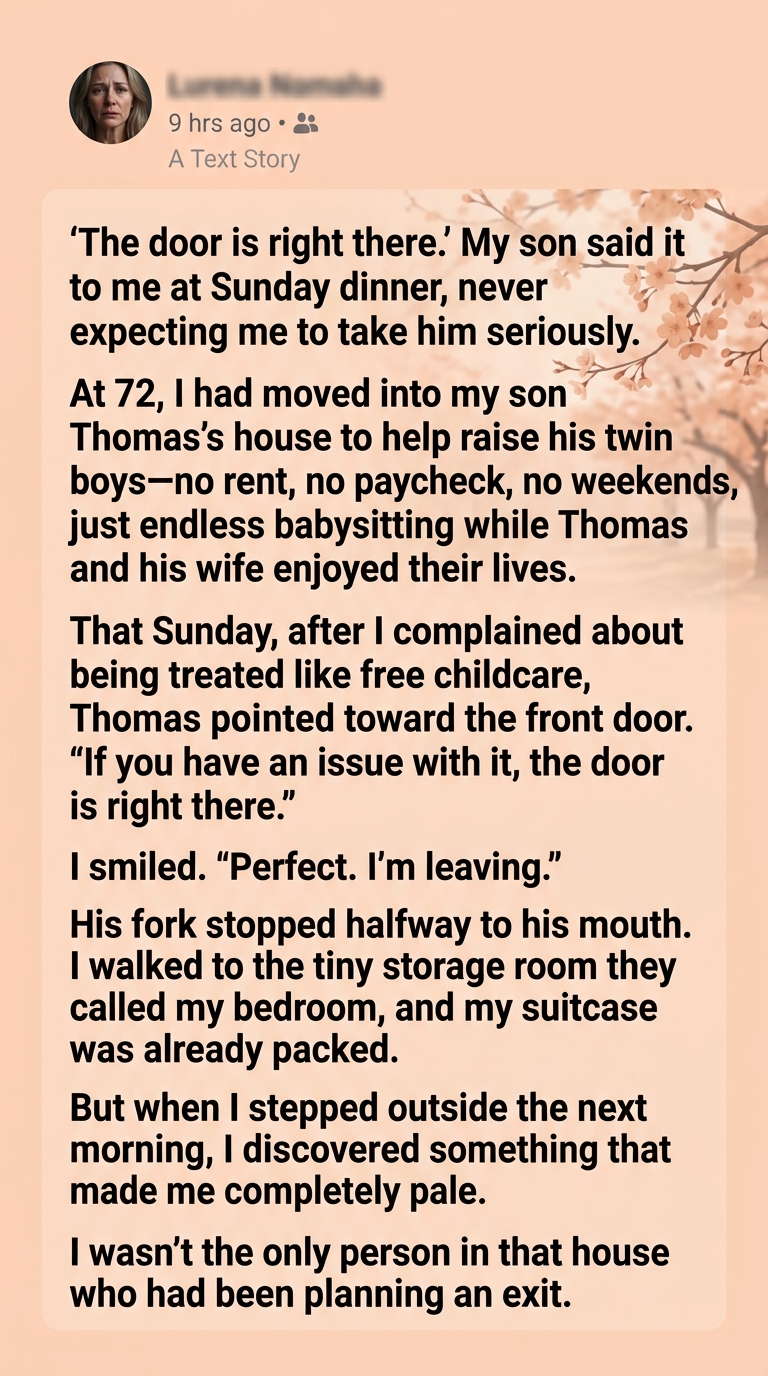
“THE DOOR IS RIGHT THERE,” MY SON TOLD ME—SO I LEFT. THE NEXT MORNING, I DISCOVERED I WASN’T THE ONLY ONE LEAVING.
“The door is right there.”
My son Thomas said it during Sunday dinner.
He pointed toward the front door as casually as if he were telling me where the bathroom was.
“If you have a problem with how things are, Mom, the door is right there.”
I stared at him.
Then I smiled.
“Perfect.”
His fork stopped halfway to his mouth.
“I’m leaving.”
Thomas blinked.
“What?”
“You told me where the door was.”
His wife looked at him.
“Thomas…”
But I was already standing.
I was seventy-two years old.
For almost two years, I had lived in their house helping raise their twin boys.
No rent.
No paycheck.
No weekends.
No vacations.
Just endless babysitting.
I cooked.
I cleaned.
I packed lunches.
I took the boys to school.
I helped with homework.
I stayed home when they were sick.
I woke up when they had nightmares.
Meanwhile, Thomas and his wife went to dinners, weekend trips, concerts, and parties.
Whenever I complained, they called it “helping the family.”
That Sunday, I finally said:
“I don’t mind helping. But I don’t want to be treated like free childcare.”
Thomas sighed.
“You’re retired. What else are you doing?”
I looked at him.
“I was hoping to enjoy the rest of my life.”
He pointed at the door.
“If you don’t like it, leave.”
So I did.
I walked to the tiny storage room they called my bedroom.
My suitcase was already packed.
I had started preparing weeks earlier.
I folded my clothes.
Put my medication in my purse.
Collected my important documents.
And waited.
Now I finally had permission to leave.
I went to bed that night knowing I wouldn’t wake up in that house again.
The next morning, I carried my suitcase downstairs.
The house was strangely quiet.
Too quiet.
I opened the front door.
Then I saw something that made me completely pale.
There were two suitcases sitting outside.
Small ones.
The twins’ suitcases.
I looked back into the house.
“Thomas?”
No answer.
Then I heard whispering upstairs.
I quietly walked back inside.
The twins were standing at the top of the stairs.
Both were crying.
“What happened?”
My oldest grandson looked at me.
“Grandma, are you really leaving?”
“Yes, sweetheart.”
He wiped his face.
“Then we’re leaving too.”
I froze.
“What?”
He pointed toward their bedroom.
“Mom said we’re going to boarding school.”
I felt my stomach drop.
“When?”
“Tomorrow.”
His brother began crying.
“She said because you’re leaving, there’s nobody to take care of us.”
I couldn’t believe it.
I went downstairs.
Thomas was standing in the kitchen.
“What did you do?”
He looked at me.
“Mom…”
“You’re sending your children away because I won’t babysit anymore?”
His wife started crying.
“It isn’t like that.”
“Then what is it like?”
Thomas finally admitted the truth.
They couldn’t afford their lifestyle without me.
The mortgage.
The car payments.
The private school.
The vacations.
Everything had depended on my unpaid work.
When I said I was leaving, their entire arrangement collapsed.
The boarding school wasn’t something they had planned for months.
It was their desperate solution.
I looked at Thomas.
“You told me the door was right there.”
He lowered his eyes.
“I didn’t mean it.”
“You did.”
He looked at his sons.
“I was angry.”
I shook my head.
“No. You were comfortable.”
His wife began apologizing.
She said they had taken me for granted.
She said they thought I would always be there.
And that was the part that hurt the most.
They hadn’t thought about whether I wanted to stay.
They had simply assumed I would.
I took the twins’ suitcases upstairs.
“Come on.”
Thomas looked confused.
“Where are you going?”
“I’m taking them to breakfast.”
He stared at me.
“Mom, please.”
I turned around.
“I am not taking responsibility for your children anymore.”
His face fell.
“But they’re my grandsons.”
“And you’re their father.”
The room went silent.
I didn’t take the boys with me permanently.
I didn’t want to become the person who solved every problem they refused to solve themselves.
Instead, I called my daughter-in-law’s mother.
Then I called a family counselor.
Within a few days, the family had a serious conversation about childcare, finances, and responsibilities.
Thomas and his wife had to change their lifestyle.
They sold one of their cars.
Canceled several subscriptions.
Stopped taking expensive vacations.
And hired part-time childcare they could actually afford.
The twins stayed home.
But things changed.
So did I.
I moved into my own small apartment.
It wasn’t large.
It wasn’t luxurious.
But the first night I slept there, I woke up naturally.
No alarm.
No children screaming.
No lunchboxes to pack.
No one asking where their socks were.
I made coffee.
Sat by the window.
And realized how peaceful my life could be.
A week later, Thomas came to visit.
He stood outside my apartment holding flowers.
“I owe you an apology.”
I let him in.
He sat down.
“I thought you would always be there.”
“I know.”
“I didn’t understand how much you were doing.”
“You weren’t supposed to.”
He looked confused.
“Why?”
“Because they’re your children.”
He nodded slowly.
Then he said:
“I miss having you there.”
I smiled.
“I miss having me too.”
He laughed sadly.
Then he hugged me.
Before he left, he said:
“Can we start over?”
I nodded.
“Yes.”
“But this time, I’m your mother.”
He smiled.
“And you’re not our nanny.”
“Exactly.”
He left.
I closed the door.
Then I looked around my apartment.
For seventy-two years, I had spent my life taking care of other people.
My husband.
My children.
My grandchildren.
And somewhere along the way, I had forgotten that I was allowed to take care of myself too.
Thomas had pointed toward the door thinking it was a threat.
He didn’t realize he was giving me permission.
And when I walked through it, I discovered something neither of us expected:
I wasn’t abandoning my family. I was finally leaving the role they had mistaken for my entire identity.