MY SON UNINVITED ME FROM HIS CRUISE—EIGHT DAYS LATER, HE CAME HOME TO A NEW LOCK AND A NOTICE
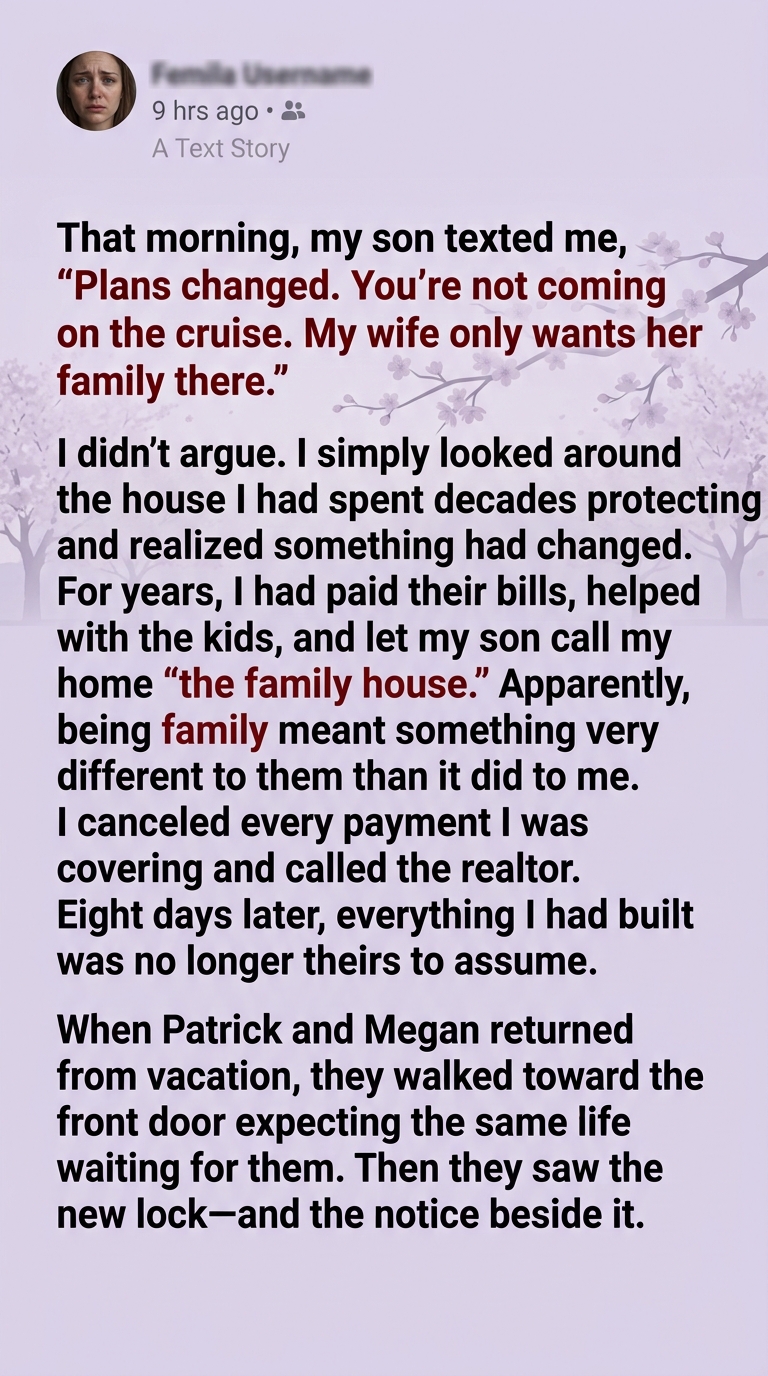
That morning, my son texted me.
Plans changed. You’re not coming on the cruise. Megan only wants her family there.
I read the message twice.
Then I put my phone down.
I didn’t argue.
I didn’t ask why.
I simply looked around my house.
The house I had spent decades protecting.
The house where my son had grown up.
The house he now casually called “the family house.”
For years, I had paid their bills.
I helped with their children.
I covered emergencies.
When Patrick’s car broke down, I paid the repair bill.
When Megan needed help with a medical expense, I paid it.
When they struggled with their mortgage, I helped.
And every time I did, Patrick said the same thing.
“Don’t worry, Mom. It’s all staying in the family.”
Apparently, “family” meant something very different to him than it did to me.
I opened my bank account.
I canceled every automatic payment I was covering for them.
Then I called a realtor.
“I want to sell my house.”
There was a pause.
“Are you sure?”
“Yes.”
That afternoon, I met with an attorney.
We reviewed the title.
My name was the only name on it.
Patrick and Megan had never been owners.
They had simply lived there with my permission.
The next day, I gave them written notice.
They were shocked.
Patrick called.
“Mom, what are you doing?”
“Selling my house.”
“You can’t.”
“It’s mine.”
“But this is our home.”
“No.”
I corrected him.
“It was my home. I allowed you to live there.”
“You’re seriously throwing us out because we didn’t take you on a cruise?”
I laughed quietly.
“No.”
“Then why?”
“Because your text finally made something clear.”
“What?”
“You don’t see me as family.”
Silence.
Then Megan got on the phone.
“This is ridiculous.”
I answered calmly.
“Maybe.”
“But the decision is made.”
Eight days later, the house had been emptied.
My belongings were moved into a smaller place I had chosen for myself.
The locks were changed.
The sale paperwork was ready.
Then Patrick and Megan returned from their vacation.
They pulled into the driveway expecting everything to be exactly as they’d left it.
Patrick walked toward the front door.
He tried his key.
It didn’t work.
He tried again.
Then he saw the new lock.
Beside it was a notice.
He pulled it down.
His face went pale.
Megan walked over.
“What is it?”
Patrick handed her the paper.
She read it.
Then looked at him.
“She’s selling the house?”
He nodded.
She immediately called me.
I answered.
“You changed the locks?”
“Yes.”
“You can’t do this!”
“I already did.”
“But our things are inside!”
“No. Your things were removed.”
Patrick’s voice rose.
“You’re my mother!”
I took a breath.
“I know.”
“Then how can you do this to me?”
I answered:
“How could you send me that message?”
He went silent.
I continued.
“You didn’t say, ‘Mom, we’re sorry, but we have limited space.’”
“You said your wife only wanted her family there.”
“She wasn’t talking about family.”
“She was talking about me.”
Megan interrupted.
“That isn’t fair.”
I replied:
“You were both perfectly comfortable accepting my money when it benefited you.”
“But when there was a choice about who belonged on the cruise, you made yours.”
There was silence.
Then Patrick said:
“I didn’t think you’d take it seriously.”
I closed my eyes.
“That was the problem.”
He had never considered that I might actually believe his words.
Because for years, he had assumed my love meant unlimited access.
My house.
My money.
My time.
My help.
My forgiveness.
But love doesn’t mean ownership.
A few weeks later, the house sold.
Patrick and Megan found their own apartment.
They had to take responsibility for their bills.
Their children were fine.
And I finally had a home that didn’t feel like a waiting room for everyone else’s emergencies.
Patrick eventually came to see me.
He stood outside my door.
“I miss you.”
I looked at him.
“I miss you too.”
“Can we fix this?”
“Maybe.”
He looked hopeful.
“What do I need to do?”
I smiled.
“Start treating me like your mother instead of your safety net.”
He nodded.
“I understand.”
I hope he did.
Because I hadn’t sold the house to punish him.
I sold it because I realized that protecting something for decades doesn’t mean other people are entitled to inherit it simply because they expect you to keep sacrificing.
My son thought canceling my cruise invitation would cost him nothing.
He was wrong.
It cost him the one thing he had quietly assumed would always be his:
access to the life I had spent decades building.