THE OTHER ACCOUNT MY DAUGHTER-IN-LAW DIDN’T WANT ME TO KNOW ABOUT
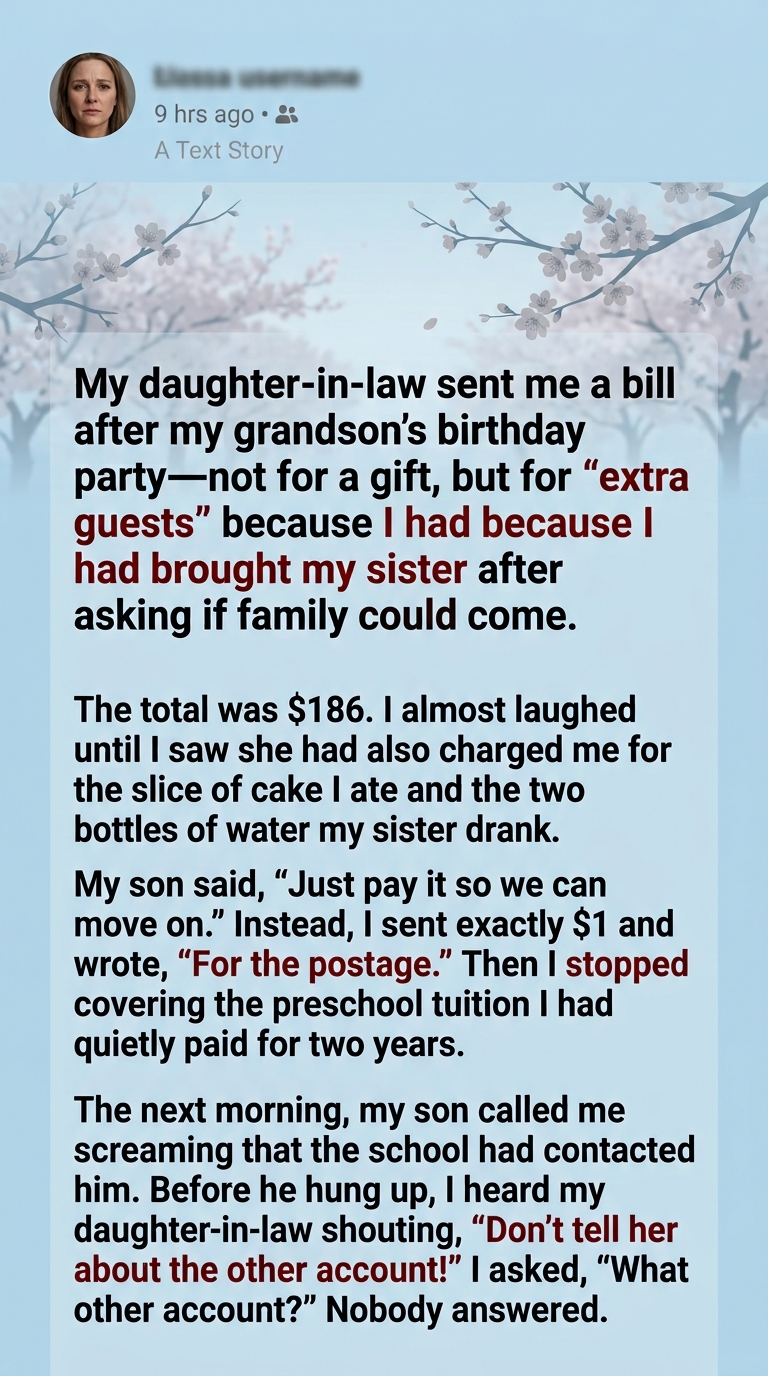
My daughter-in-law sent me a bill after my grandson’s birthday party.
Not for a gift.
Not for the food I had brought.
For “extra guests.”
The total was $186.
I stared at the invoice on my phone.
Additional guest fee: $75.
Additional food: $40.
Cake consumption: $12.
Beverage consumption: $9.
Facility surcharge: $50.
I almost laughed.
Then I saw the line at the bottom.
Guest: Carol’s sister.
I had brought my sister because I had specifically asked my daughter-in-law beforehand.
“Is it okay if my sister comes? She’d love to see Noah.”
She had smiled.
“Of course.”
Now she was charging me for her presence.
I called my son.
“Ethan, did you know Jenna sent me a bill for Noah’s birthday?”
He sighed.
“Mom, just pay it.”
“She charged me for a slice of cake.”
“I know.”
“And two bottles of water my sister drank.”
“Mom.”
“Ethan, this is ridiculous.”
“Just pay it so we can move on.”
I looked at the invoice again.
Something inside me went quiet.
“Okay.”
I sent exactly $1.
In the payment note, I wrote:
For the postage.
Then I stopped doing something else.
For two years, I had quietly paid Noah’s preschool tuition.
Every month.
$780.
I had never mentioned it.
Not because I expected gratitude.
Because I wanted to help my grandson.
I had set up automatic payments through a separate account so Ethan and Jenna wouldn’t feel embarrassed.
But after that invoice, I canceled the arrangement.
I didn’t tell anyone.
The next morning, my phone rang.
It was Ethan.
He was furious.
“Mom! What did you do?”
“Good morning to you too.”
“The school called us!”
“About what?”
“They said Noah’s tuition hasn’t been paid!”
I paused.
“That’s strange.”
“Don’t play games with me!”
“I haven’t.”
“You canceled the payments!”
“Yes.”
“You can’t just do that!”
I sat down.
“I can, actually. It’s my money.”
“You’ve been paying his tuition?”
“For two years.”
There was silence.
Then I heard Jenna screaming in the background.
“Don’t tell her about the other account!”
My stomach tightened.
Ethan immediately said,
“I have to go.”
“Wait.”
He hung up.
I stared at my phone.
The other account?
I called back.
No answer.
I called Jenna.
Straight to voicemail.
That afternoon, I drove to the preschool.
The director knew me because I had arranged the original tuition payments.
I asked her a simple question.
“Are there any other accounts connected to my grandson’s tuition?”
She looked uncomfortable.
“I probably shouldn’t discuss your son’s financial arrangements.”
“I’m not asking about his finances.”
I handed her the payment records.
“These are my payments.”
She nodded.
“Yes.”
“Then why did someone tell you there was another account?”
She hesitated.
Finally, she said,
“Because there is an account listed as an emergency payment source.”
“Whose?”
She looked at the screen.
“Jenna’s.”
I frowned.
“Is it active?”
“Yes.”
“For what?”
The director looked at me.
“Private tuition assistance.”
I felt something was wrong.
“What’s that?”
She lowered her voice.
“Mrs. Bennett, your son and daughter-in-law submitted paperwork saying their household income qualified them for financial assistance.”
I stared at her.
“What?”
“They’ve been receiving a tuition discount for almost two years.”
“How much?”
She looked at the records.
“Approximately $520 a month.”
My mouth went dry.
“So I was paying $780 every month…”
“Yes.”
“And they were also receiving a $520 discount?”
She nodded.
I did the math in my head.
For two years, that was more than $12,000 in tuition assistance.
Money they had apparently claimed they needed.
Money they hadn’t told me about.
I thanked her and walked back to my car.
Then I called Ethan.
He answered.
“Mom, I’m sorry about yesterday.”
“What’s the other account?”
Silence.
“Ethan.”
“What account?”
“The one Jenna told you not to tell me about.”
He didn’t respond.
“I went to Noah’s school.”
His breathing changed.
“What did they tell you?”
“That you and Jenna have been receiving financial assistance.”
He was silent.
“Why?”
“We needed it.”
“Then why didn’t you tell me?”
“We didn’t want you to feel like you had to keep paying.”
I almost laughed.
“You let me pay $780 a month for two years while you received another $520 in assistance?”
“It wasn’t like that.”
“How was it?”
“We were struggling.”
“Then why did Jenna send me a $186 bill for two bottles of water?”
He had no answer.
I hung up.
That evening, Ethan came to my house.
Alone.
He looked exhausted.
“Mom.”
“Come in.”
He sat down.
“Jenna is angry.”
“I imagine she is.”
“She says you embarrassed us.”
“I didn’t.”
“She says the school shouldn’t have told you.”
“They didn’t tell me anything you didn’t have to disclose when you listed my payments.”
He looked down.
Then he finally admitted it.
Jenna had discovered the preschool’s financial-assistance program shortly after Noah enrolled.
She applied.
She was denied at first.
Then she submitted additional documentation claiming that Ethan had inconsistent income and that their monthly expenses exceeded their household income.
The school approved the discount.
But there was one problem.
My payments weren’t included as income.
They had described themselves as financially struggling while privately allowing me to cover most of Noah’s tuition.
“How much money did you save?” I asked.
Ethan rubbed his hands together.
“About twelve thousand.”
“And what did you do with it?”
He hesitated.
“Some went toward bills.”
“Some?”
He looked away.
“Jenna has a savings account.”
“What kind?”
“Just a regular account.”
“Whose name is on it?”
“Jenna’s.”
I looked at him.
“That’s the other account.”
He nodded.
I suddenly understood why Jenna had panicked.
It wasn’t simply that I had discovered the tuition assistance.
It was that I might ask where the money had gone.
And I did.
“Why did she need to hide that from me?”
Ethan didn’t answer.
I knew then that there was more.
A week later, Ethan came back.
He looked embarrassed.
He put a folder on my kitchen table.
“I found these.”
Inside were bank statements.
Jenna had been transferring the money saved from the tuition discount into a separate account.
Over two years, the balance had grown to nearly $14,000.
I looked at him.
“What was it for?”
He shook his head.
“I don’t know.”
Then he found an email.
It was from Jenna to her sister.
The subject line was:
“Mom’s money.”
The email said she was building a private emergency fund because she believed that one day I would stop helping them.
She wrote:
“As long as Carol thinks she’s just helping with preschool, she’ll keep paying. We can use the extra money to build our own cushion.”
I read it twice.
That sentence hurt more than the birthday bill.
Not because of the money.
Because I had thought I was helping my family.
She had treated my generosity like a financial strategy.
The $186 invoice suddenly looked different.
It wasn’t about cake.
It wasn’t about water.
It wasn’t even about $186.
It was about control.
Jenna wanted every dollar accounted for when it came out of my pocket while keeping every dollar she could hide from me.
Ethan eventually asked me,
“Can you forgive us?”
I looked at him.
“I can forgive you for being afraid to tell me the truth.”
He nodded.
“But I won’t continue paying for things while being treated like a customer.”
He swallowed.
“I understand.”
“And I won’t pay another dollar unless I know exactly where it’s going.”
“I understand.”
The next month, I opened a college savings account for Noah.
In his name.
Not his parents’.
I deposited the amount I had originally planned to spend on preschool.
Then I told Ethan:
“If I help my grandson, I want it to benefit him directly.”
He nodded.
Jenna didn’t speak to me for almost six months.
Then, unexpectedly, she showed up at my door.
She didn’t bring an invoice.
She brought an apology.
“I was embarrassed,” she said.
I listened.
“I thought if I admitted we needed help, you’d think we couldn’t provide for Noah.”
I said nothing.
“So I turned everything into transactions.”
I looked at her.
“You charged me for cake.”
She started crying.
“I know.”
“And water.”
“I know.”
“And my sister’s presence.”
“I know.”
I let the silence sit between us.
Finally, she said,
“I was wrong.”
I nodded.
“You were.”
She wiped her eyes.
“Can we start over?”
I thought about it.
Then I opened the door wider.
“Come in.”
She stepped inside.
We didn’t magically become close.
Trust doesn’t return because someone says sorry.
But we started again.
And I kept one thing exactly the same.
Every time I helped my grandson after that, I did it directly for him.
No secret payments.
No hidden accounts.
No assumptions.
And certainly no invoices for cake.
Because sometimes a $186 bill isn’t really about $186.
Sometimes it’s the first crack in a wall someone built to keep you from seeing the truth.
And once that wall comes down, you might discover that the thing they were hiding wasn’t the money.
It was the way they had been using your love.