HE THOUGHT I WAS LEAVING WITH NOTHING
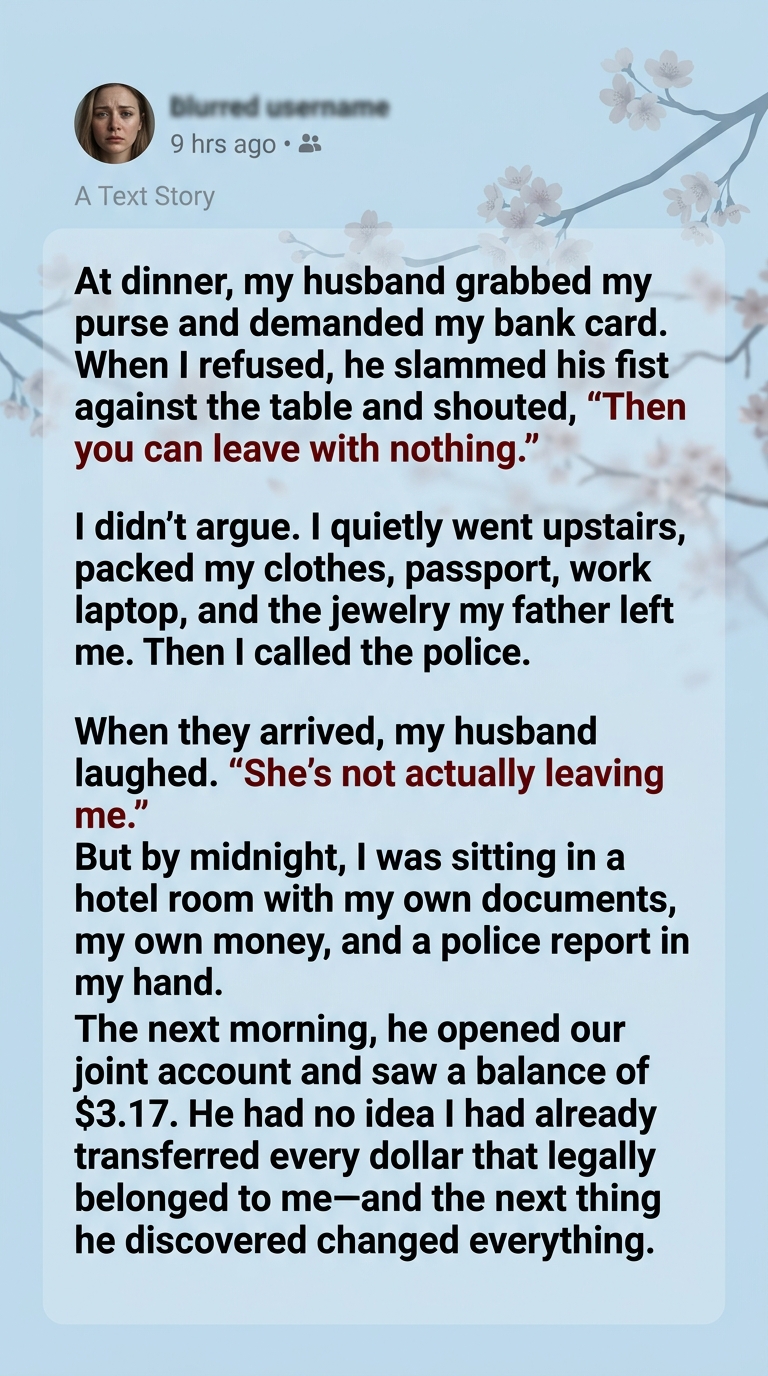
At dinner, my husband grabbed my purse and demanded my bank card.
“Give it to me.”
I stared at him.
“No.”
His face hardened.
“I wasn’t asking.”
He reached for the purse again.
I pulled it away.
“Don’t touch my things.”
He slammed his fist against the table.
The plates jumped.
“Then you can leave with nothing!”
The room went silent.
For a moment, I just looked at him.
This wasn’t the first time he’d yelled.
It wasn’t the first time he’d tried to control my money.
But something about those words was different.
Leave with nothing.
He said them like he had already decided what I was allowed to have.
I didn’t argue.
I didn’t cry.
I simply stood up.
“Fine.”
He laughed.
“Where are you going?”
“Upstairs.”
He rolled his eyes.
I walked into the bedroom and closed the door.
Then I opened my suitcase.
I packed clothes.
My passport.
My work laptop.
My father’s watch.
The small diamond earrings he’d given me before he died.
The necklace my grandmother had left me.
Anything that was unquestionably mine.
My hands were shaking, but I kept moving.
Then I called the police.
When they arrived, my husband was sitting in the living room.
He actually laughed when he saw them.
“She isn’t actually leaving me.”
One of the officers looked at him.
“Sir, step away from her.”
My husband shook his head.
“This is ridiculous.”
I handed the officer my statement.
“He grabbed my purse, demanded my bank card, and threatened me.”
My husband scoffed.
“She always exaggerates.”
The officer looked at me.
“Do you want to leave tonight?”
“Yes.”
My husband laughed again.
“She’ll be back tomorrow.”
I looked at him.
“No, I won’t.”
By midnight, I was sitting in a hotel room.
I had my passport.
My documents.
My personal belongings.
My own money.
And a police report in my hand.
For the first time in years, I could hear myself think.
The next morning, my phone started buzzing.
My husband.
Then again.
Then again.
I didn’t answer.
At 8:17 a.m., I received a message.
“What did you do?”
I stared at it.
Then another arrived.
“Where is the money?”
I knew exactly what he meant.
Our joint account.
For years, I had deposited my salary there.
So had he.
But I’d also kept meticulous records.
Every paycheck.
Every mortgage payment.
Every utility bill.
Every transfer.
Every contribution.
Three months earlier, I’d quietly started speaking with an attorney because I had realized something.
My husband had been moving money out of our joint account.
Small amounts at first.
Then larger ones.
He’d claimed they were business expenses.
They weren’t.
They were going into a separate account he had never told me about.
I had discovered nearly $38,000 missing.
I hadn’t confronted him.
I documented everything.
And after his threat the night before, I finally acted.
I transferred the amount my attorney confirmed I was legally entitled to withdraw from the joint account.
Not his money.
Not money I wasn’t entitled to.
Mine.
The account balance was now $3.17.
My husband had expected me to walk away empty-handed.
Instead, I had walked away with the money he thought he could control.
But that wasn’t the biggest problem waiting for him.
At 9:02 a.m., my attorney called.
“Did he contact you?”
“Yes.”
“Good.”
“Why?”
“Because the bank just notified him about the other account.”
I froze.
“What other account?”
“The one he opened using your information.”
My stomach dropped.
“What?”
My attorney continued.
“Your husband opened a line of credit using your personal information.”
I sat down.
“How much?”
“$62,000.”
I couldn’t breathe.
“He used my name?”
“Yes.”
“Without my permission?”
“Yes.”
“And the money?”
“That’s what we’re investigating.”
I suddenly remembered something.
The strange envelopes.
The bank statements I’d occasionally seen and assumed were business-related.
The times he’d told me not to worry about paperwork.
The passwords he’d changed.
He hadn’t simply been controlling my money.
He had been building a financial life behind my back.
And apparently, he’d been using my identity to do it.
My attorney sent me copies of the documents.
There was my name.
My Social Security number.
My address.
And a signature that looked like mine.
But wasn’t.
I stared at the screen.
Then I noticed the date.
The account had been opened six months earlier.
The same week my husband had insisted that I leave my passport and financial documents in his office “because we needed them for taxes.”
I felt sick.
He had been preparing.
That evening, he finally called.
I answered.
“What did you do?”
His voice was furious.
“You took all the money.”
“I took the money I was legally entitled to.”
“You emptied our account!”
“There was $3.17 left.”
“You can’t do this to me!”
I almost laughed.
“You told me I would leave with nothing.”
Silence.
Then he lowered his voice.
“You’re my wife.”
“And you’re my husband.”
“So act like it.”
“I did.”
“What does that mean?”
“It means I trusted you.”
He didn’t respond.
I continued.
“You were the one who broke that trust.”
Then I asked,
“Why did you open a credit account in my name?”
Silence.
That silence told me everything.
“You don’t understand,” he finally said.
“Then explain it.”
“I was going to pay it back.”
“With what?”
“Money from the business.”
“What business?”
He stopped.
And that’s when I realized there was another layer.
My husband hadn’t been using the money for himself.
He had been hiding debts.
Massive ones.
His business had been failing for almost a year.
He had borrowed money from multiple lenders.
He had missed payments.
And he had started using our joint finances to keep everything afloat.
Then he’d used my identity to obtain additional credit.
He wasn’t trying to leave me with nothing because he was angry.
He was trying to make sure I had nothing because he needed everything.
My attorney filed the necessary fraud reports.
The bank froze the unauthorized account.
The police investigation expanded.
And then came the discovery that finally ended any possibility of reconciliation.
My husband had transferred the title of our house into his company’s name three weeks earlier.
Without telling me.
He had planned to use the house as collateral.
Our home.
The one I had helped pay for.
The one he had told me was “ours.”
He had been preparing to put it at risk while telling me I was the one who might leave with nothing.
When I confronted him through our attorneys, he finally admitted everything.
“I thought you would stay.”
I stared at him.
“That was your plan?”
“Yes.”
“You thought I’d stay while you emptied our accounts, used my identity, and risked our home?”
“I thought you’d forgive me.”
I shook my head.
“You didn’t need forgiveness.”
He looked confused.
“You needed permission.”
“For what?”
“To keep doing it.”
The divorce took months.
The house was eventually protected from his creditors.
The fraudulent credit account was closed.
The money he had transferred without authorization was traced.
Some of it was recovered.
And the financial records became evidence in the case.
My husband eventually faced criminal charges related to the fraudulent accounts and unauthorized transfers.
But the most important moment came much earlier.
A week after I left, I returned to the house with an officer to collect the rest of my belongings.
My husband was sitting at the kitchen table.
The same table where he had slammed his fist.
He looked exhausted.
“You really aren’t coming back?”
I looked around the room.
At the walls.
The photographs.
The life I had spent years building.
Then I looked at him.
“No.”
He looked down.
“I never thought you’d actually leave.”
“I know.”
“You always stayed.”
“I did.”
“Why this time?”
I took a breath.
“Because you finally told me what you thought I was worth.”
He looked at me.
“You said I’d leave with nothing.”
I picked up my father’s watch from the counter.
“You were wrong.”
Then I walked out.
I didn’t leave with everything.
I left with the things that mattered.
My documents.
My work.
My father’s watch.
My own money.
My freedom.
And something I hadn’t realized I had lost somewhere along the way:
the belief that I was allowed to say no.
My husband thought the $3.17 in our joint account meant he had won.
He didn’t understand.
That number wasn’t the end of my life.
It was the beginning of one he could no longer control.
And the next thing he discovered wasn’t about money at all.
It was the police report.
Because for the first time, everything he had done was no longer hidden inside our marriage.
It was on paper.
And this time, he couldn’t tell me I was imagining it.