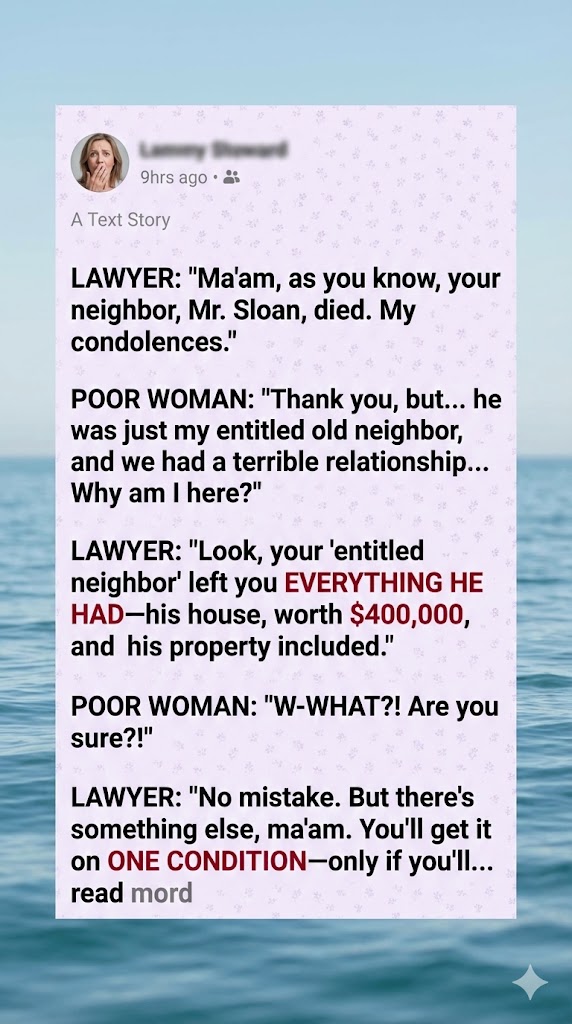
“…move into the house and live there for one full year.”
The woman blinked. “That’s it?”
The lawyer nodded. “You must personally reside in the property for twelve consecutive months. You cannot rent it out during that time. If you leave before the year is up, the estate will be donated to a local foundation.”
She sat back, stunned.
“But… we hated each other,” she said softly. “He complained about my kids’ noise. I complained about his trash cans. He called the city on me twice.”
The lawyer gave a small, knowing smile. “Yes. He mentioned that in his letter.”
“Letter?”
He handed her a sealed envelope.
With trembling fingers, she opened it.
Inside was a short handwritten note.
‘You annoyed me every single week. Your children were loud. Your dog dug near my fence. But you were also the only person who ever knocked on my door when my lights stayed off too long. You were the only one who brought soup when I got out of the hospital. You argued with me — but you never ignored me.’
Her vision blurred.
‘My own family hasn’t visited in years. But you checked in, even when we were fighting. I don’t need this house anymore. Maybe you and your kids will fill it with the noise I pretended to hate.’
Tears rolled down her cheeks.
The lawyer cleared his throat gently. “There’s one more clause.”
She looked up nervously.
“You must also care for his old golden retriever, Max. He insisted the dog stay with the house.”
She let out a shaky laugh through her tears. “Max used to bark at me every morning.”
“Yes,” the lawyer said. “He left a small trust to cover the dog’s expenses.”
She covered her mouth, overwhelmed.
One year.
That was the condition.
Three months later, she and her children moved into the house next door — now hers. The first night felt strange. Too quiet. Too big.
But the kids filled it quickly with laughter.
Max followed them everywhere.
Over time, she started seeing the house differently. The creaky floors. The garden he obsessively maintained. The little toolbox neatly organized in the garage.
He hadn’t been just an entitled old man.
He’d been lonely.
At the end of the year, she didn’t want to leave.
And she didn’t have to.
The house was officially hers.
Sometimes, when she watered the garden, she’d smile softly and whisper, “You grumpy old man… thank you.”