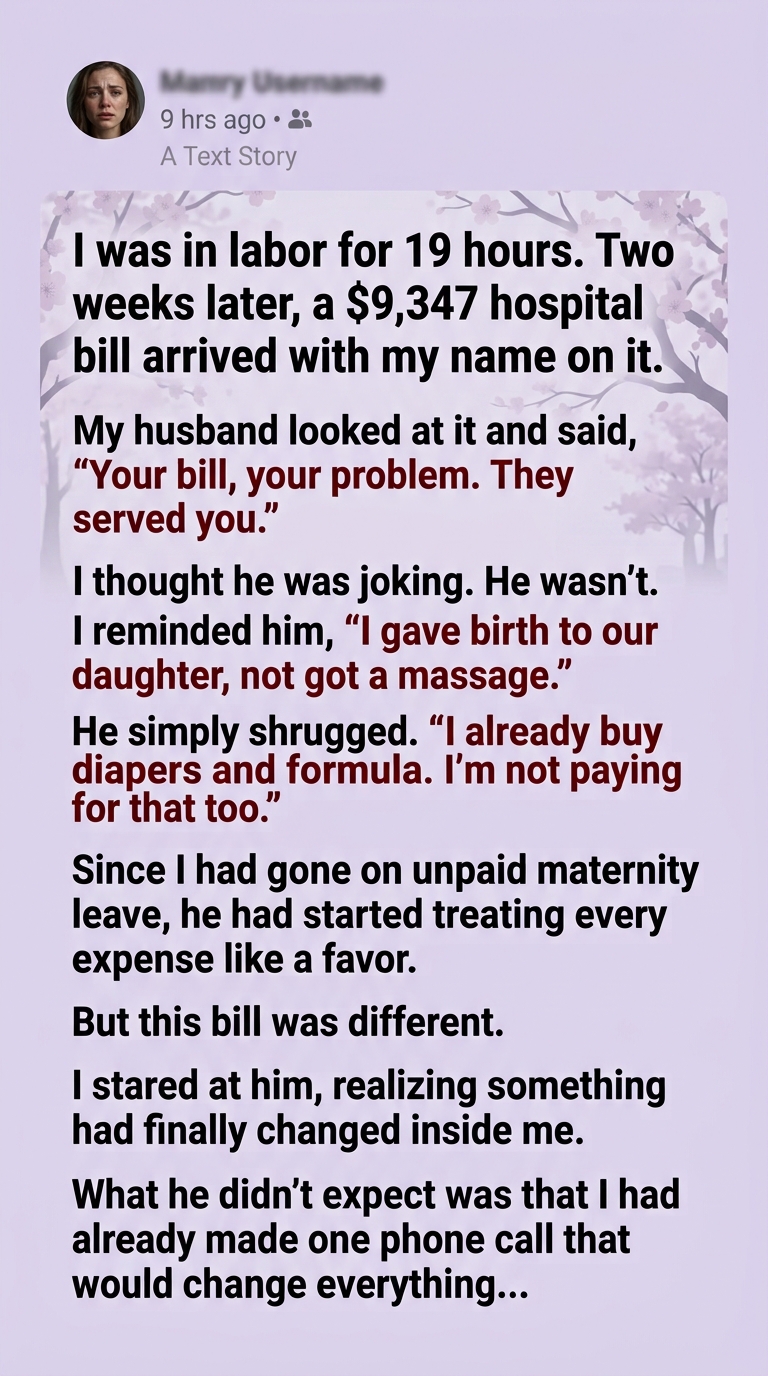
I was in labor for 19 hours.
Nineteen hours of contractions, exhaustion, IVs, monitors, and eventually an emergency procedure because our daughter wasn’t coming out safely.
Two weeks later, the hospital bill arrived.
$9,347.
My name was printed across the top.
I stared at it for almost a minute before taking it to my husband.
He looked at the bill.
Then he looked at me.
“Your bill, your problem.”
I actually laughed.
I thought he was joking.
He wasn’t.
“They served you,” he added.
I stared at him.
“I gave birth to our daughter, not got a massage.”
He shrugged.
“I already buy diapers and formula. I’m not paying for that too.”
Something inside me went completely still.
For months, I’d been telling myself he was stressed.
He had complained about money since I stopped working.
When I bought groceries, he asked why I couldn’t “make things stretch.”
When I needed prenatal vitamins, he called them unnecessary.
When our daughter was born, he complained about the hospital parking fee.
I’d gone on unpaid maternity leave, so I had no paycheck.
He knew that.
And somehow, he’d started treating every dollar spent on me like a personal favor.
But this bill wasn’t just about $9,347.
It was about the fact that he could look at the woman who had just spent 19 hours giving birth to his child and say:
Your problem.
That night, after he went to bed, I sat at the kitchen table.
Our daughter was sleeping upstairs.
I looked at the hospital bill again.
Then I picked up my phone.
I made one phone call.
“Hello,” I said.
“This is Maya Carter. I need to make an appointment with a family-law attorney.”
The next morning, I opened a separate bank account.
Then I called my old employer.
I had worked there for seven years before taking maternity leave.
I asked about returning earlier than planned.
My manager was surprised.
“You’re sure?”
I looked at my sleeping daughter.
“No,” I said. “But I’m doing it anyway.”
Then I made another call.
To the hospital.
I explained that I was struggling financially and asked whether there was a financial assistance program.
The billing representative paused.
“Actually, because of your household income and current circumstances, you may qualify.”
I submitted the paperwork.
Then I waited.
Three days later, I received a letter.
The hospital had approved a financial assistance reduction.
My $9,347 bill had been reduced to $1,860.
I could have cried.
Not because the bill was gone.
Because I’d just learned something important.
I wasn’t helpless.
My husband wanted me to believe every expense depended on his generosity.
He was wrong.
But I wasn’t finished.
At my appointment with the attorney, I brought everything.
Bank statements.
Bills.
Texts.
Every message where my husband complained about money I’d spent on our daughter.
The attorney read through them carefully.
Then she looked at me.
“Does he control the household finances?”
“Yes.”
“Do you have access to the joint account?”
“Technically.”
“What do you mean?”
“He monitors everything I spend.”
She nodded.
“Then we’ll make sure you understand your rights before you make any decisions.”
When I returned home, I didn’t tell my husband about the attorney.
Instead, I started preparing quietly.
I found a small apartment.
I arranged childcare.
I returned to work part-time.
And I stopped asking permission.
That was the part he noticed first.
One evening, he came home and found me packing a box.
“What are you doing?”
“Moving.”
He laughed.
“Moving what?”
“My things.”
His smile disappeared.
“You’re not leaving.”
“I am.”
“Over a hospital bill?”
I looked at him.
“No.”
He waited.
“I’m leaving because you showed me exactly how you see me.”
He shook his head.
“This is ridiculous.”
“You told me the birth of our daughter was my bill because the hospital ‘served me.’”
“You’re twisting my words.”
“No.”
I picked up another box.
“I’m finally listening to them.”
He became angry.
“You haven’t worked in months. You can’t afford to leave.”
I smiled.
“I already made arrangements.”
He stared at me.
Then his expression changed.
“You talked to someone.”
“Yes.”
“Who?”
“My attorney.”
The room went silent.
For the first time in months, he looked uncertain.
Then he said something I never expected.
“Fine. I’ll pay the hospital bill.”
I shook my head.
“It’s already handled.”
“What?”
“The hospital reduced it.”
He stared at me.
“I took care of it myself.”
He looked almost offended.
“You could have asked me.”
I couldn’t help laughing.
“I did.”
He went quiet.
“You told me it was my problem.”
That sentence ended the argument.
We separated shortly afterward.
The legal process wasn’t easy.
There were custody discussions, financial documents, childcare arrangements, and months of uncertainty.
But there was one thing I never questioned again.
Whether I deserved to be treated like a burden.
I didn’t.
A year later, I was working full-time again.
My daughter was healthy and happy.
The hospital bill had been completely paid.
And I had something I’d lost somewhere during my marriage.
My own voice.
One afternoon, my daughter was playing on the floor when my phone buzzed.
It was a message from my ex-husband.
“I wish you’d just talked to me instead of making everything so serious.”
I looked at my daughter.
Then I typed one sentence.
“I did talk to you. You just didn’t listen.”
I didn’t send anything else.
I put my phone down.
My daughter looked up at me.
“Mommy?”
“Yeah?”
“Can we have pancakes?”
I smiled.
“Absolutely.”
As I stood in the kitchen making pancakes, I realized something.
The $9,347 bill hadn’t destroyed my marriage.
It had simply put a price tag on something I had been refusing to see.
My husband didn’t think caring for me was part of marriage.
He thought it was a favor.
And the moment I stopped begging him to care was the moment my life finally began changing.
The phone call I’d made that night hadn’t been about the hospital bill.
It had been about finding a way out.
And it changed everything.