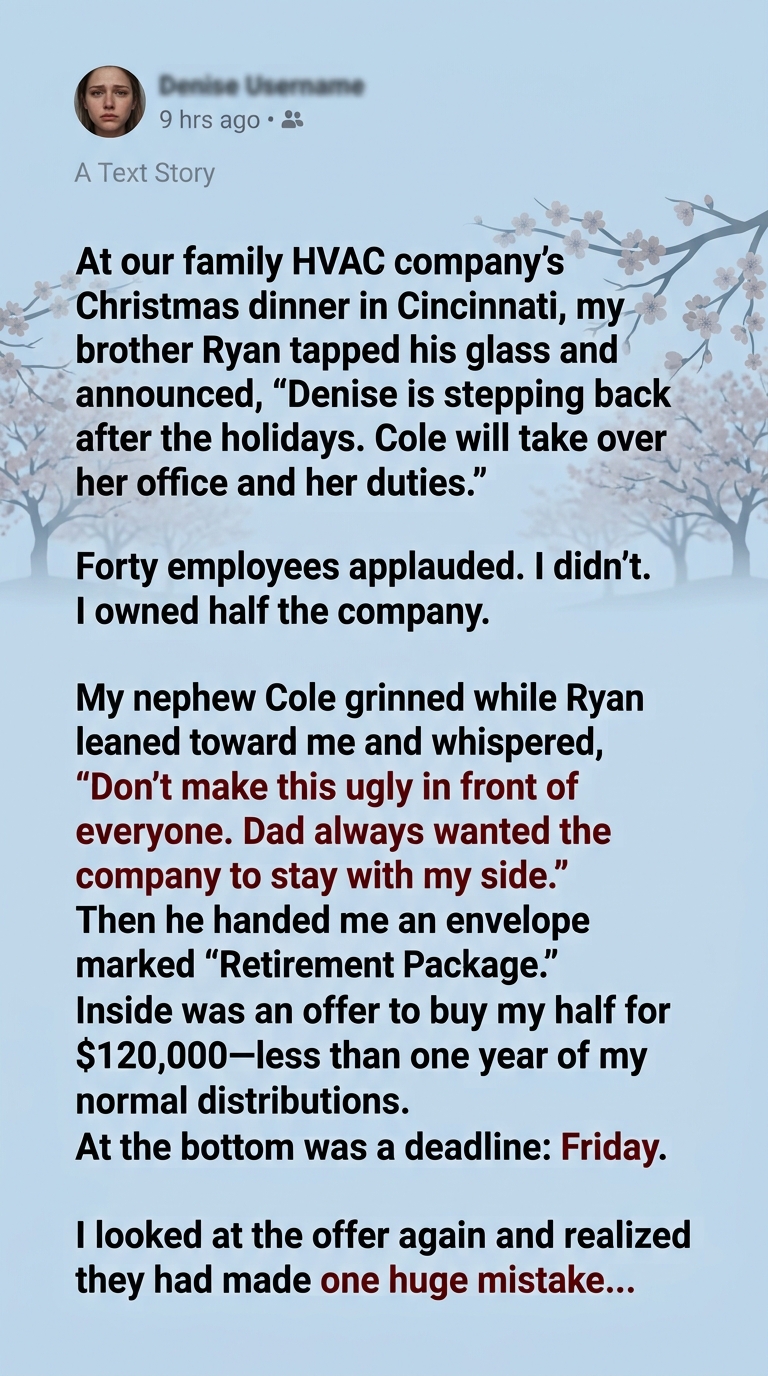
At our family HVAC company’s Christmas dinner in Cincinnati, my brother Ryan tapped his glass and announced, “Denise is stepping back after the holidays. Cole will take over her office and her duties.”
Forty employees applauded.
I didn’t.
I owned half the company.
My nephew Cole grinned from across the table like he had just been handed the keys to his future.
Ryan leaned toward me and whispered, “Don’t make this ugly in front of everyone. Dad always wanted the company to stay with my side.”
Then he handed me an envelope marked:
RETIREMENT PACKAGE
I opened it under the table.
Inside was an offer to buy my 50 percent ownership stake for $120,000.
I nearly laughed.
My normal annual distributions were more than that.
At the bottom of the document, in bold letters, was a deadline:
FRIDAY, 5:00 P.M.
I looked at Ryan.
He smiled.
“You’ll be taken care of,” he whispered. “You don’t need the headaches anymore.”
I folded the papers and slipped them back into the envelope.
“Of course,” I said.
Ryan looked relieved.
He thought I was surrendering.
He had no idea what I had found three weeks earlier.
Our father, Richard, had started Cincinnati Comfort Systems forty-two years ago with one truck, a toolbox, and a borrowed garage.
Ryan and I had grown up working there.
When Dad died, his will split the company equally between us.
Not between Ryan and his family.
Not between the grandchildren.
Between Ryan and me.
Fifty percent each.
I had spent the last twenty years managing the commercial accounts, payroll systems, insurance, and most of the company’s financial operations.
Ryan handled field operations.
We had built the company together.
At least, that’s what I thought.
Three weeks before the Christmas dinner, I had noticed something strange.
A vendor invoice had been approved for nearly $86,000.
The vendor’s name was familiar, but I couldn’t remember ever doing business with them.
I pulled the records.
The company had paid that vendor twelve times in eighteen months.
More than $700,000 total.
I dug deeper.
The vendor was an LLC registered to an address in Kentucky.
Then I found something that made my stomach tighten.
The registered agent was Ryan’s wife’s brother.
I didn’t confront Ryan.
Instead, I called our outside accountant.
She went silent when I showed her the invoices.
Then she said something I hadn’t expected.
“Denise, there’s another problem.”
She pulled up several older transactions.
Money had been transferred from the company into two investment accounts.
Both accounts were controlled by a holding company I had never heard of.
The holding company was owned by…
Cole.
My nephew.
I stared at the screen.
“How long?”
She hesitated.
“Almost four years.”
Four years.
While Ryan complained about rising costs.
While he told employees we had to freeze raises.
While he told me we couldn’t afford another service truck.
Money had been leaving the company.
And now they wanted to buy my half for $120,000.
I finally understood the plan.
They weren’t trying to retire me.
They were trying to remove me before I discovered everything.
But there was one thing Ryan didn’t know.
Six months earlier, Dad had asked me to update the company’s shareholder agreement after an unrelated dispute with another contractor.
During that process, our attorney had discovered an old clause in the original agreement.
A clause Dad had insisted on.
Neither shareholder could transfer, sell, or surrender their ownership without first offering the stake to the other shareholder at fair market value, as determined by an independent valuation.
And there was another clause.
If either shareholder attempted to remove the other shareholder from management through deception or fraudulent financial activity, the innocent shareholder could trigger an immediate forensic audit and buyout procedure.
Ryan had forgotten about it.
Or maybe he had never read it.
Either way, I knew exactly what I needed to do.
The next morning, I called our attorney.
“I need an independent valuation,” I said.
“And I need a forensic accountant.”
He didn’t ask why.
He simply said, “I’ll get started.”
By Thursday morning, the valuation came back.
The company wasn’t worth $240,000.
It was worth approximately $3.8 million.
My half was worth around $1.9 million.
The $120,000 offer was less than seven percent of what my stake was worth.
But that wasn’t even the biggest problem.
The forensic accountant had traced the missing money.
More than $1.4 million had been diverted through related companies.
Some of it had paid for Cole’s new truck.
Some had funded a down payment on a house.
Some had gone toward a private investment account.
And nearly $300,000 had been disguised as equipment expenses.
I had everything printed.
Every invoice.
Every transfer.
Every signature.
Every account.
On Friday morning, Ryan called me.
“You’ve signed the retirement papers, right?”
“No.”
There was a pause.
“Denise, don’t make this harder than it needs to be.”
“I agree.”
“You don’t understand what’s happening here.”
“I understand perfectly.”
He lowered his voice.
“Dad wanted Cole to eventually run this company.”
“Dad wanted his children to run it honestly.”
Silence.
Then Ryan said, “We can still handle this as a family.”
I looked at the stack of documents on my desk.
“You should have thought about that before you stole from the company.”
He hung up.
That afternoon, Ryan and Cole arrived at my office.
Cole looked nervous.
Ryan looked angry.
He shut the door behind them.
“You’re making a serious mistake,” Ryan said.
I slid the $120,000 offer across the desk.
“You made the mistake.”
He stared at me.
I placed the valuation beside it.
Then the forensic audit.
Then the shareholder agreement.
His face slowly changed.
Cole picked up the audit.
His hands began shaking.
“How did you get this?”
“I own half the company.”
Ryan looked at me.
“You can’t do this.”
“I already did.”
He opened his mouth, but no words came out.
I continued.
“Under Dad’s agreement, the company is now required to investigate the financial misconduct. Your voting rights regarding any transaction involving your own related companies are suspended until the investigation is complete.”
Ryan’s face went pale.
“And I’ve already notified the bank, our attorney, our accountant, and the board.”
“You wouldn’t.”
“I did.”
Cole sat down.
For the first time, he didn’t look like the future president of anything.
He looked like a kid who had finally realized that actions had consequences.
The investigation took several months.
Ryan eventually admitted that he had approved most of the transfers.
He claimed the money was compensation for “years of extra work.”
The auditors disagreed.
The company recovered a substantial portion of the money.
Ryan resigned.
Cole’s position was eliminated.
And the company changed its ownership and management structure so no one person could ever quietly control the finances again.
As for me?
I didn’t sell.
I stayed.
But I didn’t take Ryan’s job either.
Instead, I hired an experienced president from outside the family.
Someone with no last name connected to ours.
Someone who cared more about the company than inheritance.
Six months later, we held our annual employee meeting.
Forty employees sat in the same room where Ryan had announced my “retirement.”
I stood at the front.
I told them the company had survived something difficult.
I didn’t share every detail.
They didn’t need to know everything.
But I told them one thing.
“This company belongs to all of us who built it. Family can be part of a business, but family doesn’t get to replace honesty.”
People applauded.
Not because I had won.
But because their jobs were safe.
The company was stable.
And for the first time in years, everyone knew exactly where we stood.
Later that evening, I went through Dad’s old desk.
At the bottom of the drawer, I found a handwritten note.
It was dated years before he died.
It said:
“Never confuse keeping the family together with keeping the family business together. If one requires sacrificing the other, protect the people who earned it.”
I sat there for a long time.
Then I smiled.
Ryan had spent Christmas believing he was taking my company away from me.
He didn’t realize the company had never been his to give away.
And that $120,000 retirement package?
I kept it.
Not because I wanted the money.
I framed it.
It now hangs in my office.
Underneath it is a small plaque that reads:
“Know what you own.”