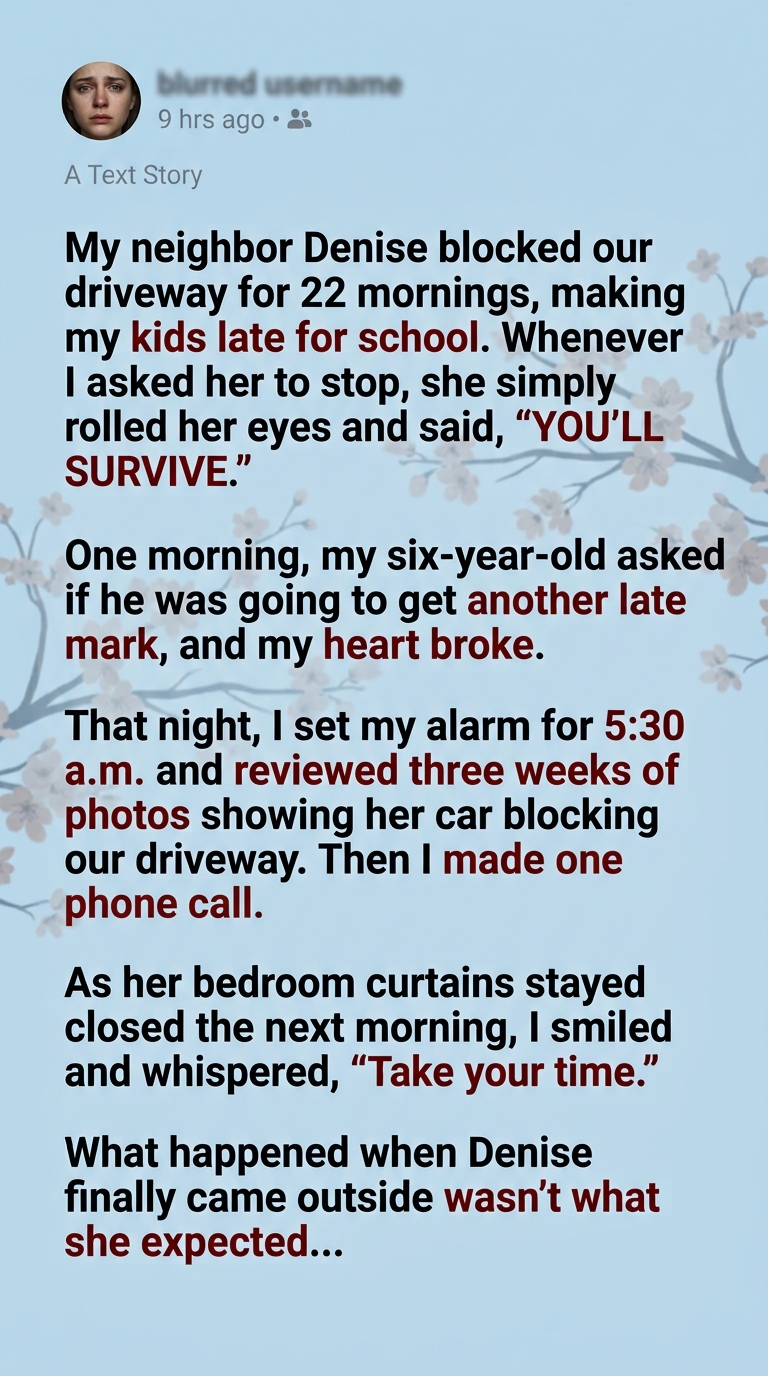
My neighbor Denise had blocked our driveway for 22 mornings.
Twenty-two mornings of the same thing.
I’d wake up, get the kids dressed, pack their lunches, and walk outside only to find her SUV parked directly across our driveway.
The first few times, I assumed it was temporary.
I knocked on her door.
“Denise, could you move your car? My kids need to get to school.”
She barely looked at me.
“You’ll survive.”
I tried being polite.
The next morning, she did it again.
Then again.
Sometimes she moved the car after ten minutes.
Other mornings, she didn’t move it until we were already late.
I started leaving earlier.
It didn’t help.
She simply parked earlier.
One morning, my six-year-old climbed into the back seat and asked:
“Mom, am I going to get another late mark?”
I looked at him through the rearview mirror.
His little face was worried.
And something inside me broke.
That evening, I stopped arguing.
I opened my phone.
For three weeks, I’d taken photographs every morning.
The date.
The time.
Her license plate.
The entire driveway blocked.
I had twenty-two photographs.
Twenty-two mornings.
I put them all into a folder.
Then I set my alarm for 5:30 a.m.
And made one phone call.
The next morning, I woke up before sunrise.
I looked outside.
Denise’s SUV was exactly where it always was.
Blocking the entire driveway.
I smiled.
“Take your time.”
Then I made breakfast.
Packed the kids’ lunches.
And waited.
At 7:18, I heard Denise’s front door open.
Her curtains moved.
A few minutes later, she walked toward her SUV holding her coffee.
Then she stopped.
A city parking enforcement officer was standing beside it.
A police officer stood a few feet away.
And behind them was a tow truck.
Denise’s mouth fell open.
“What is this?”
The parking officer pointed toward her SUV.
“Ma’am, your vehicle is blocking a residential driveway.”
“I’ll move it!”
“You’re welcome to move it.”
She reached for her keys.
Then the officer continued.
“But you’ve received multiple complaints about this location.”
Denise froze.
“How many?”
I stepped onto my porch.
“Twenty-two.”
She looked at me.
“You called them?”
“I documented it.”
She marched toward me.
“You could have just talked to me!”
I stared at her.
“I did.”
“You never talked to me twenty-two times!”
“I didn’t need to.”
I held up my phone.
“Twenty-two photographs did.”
She looked at the screen.
Every photograph showed the same thing.
Her SUV.
Our driveway.
The date.
The time.
Her face went red.
Then the officer handed her a citation.
She looked at the amount.
“What?”
He explained the violation.
Then the tow truck driver started connecting the vehicle.
Denise suddenly panicked.
“Wait! You can’t tow my car!”
The officer calmly explained that she could move it before the tow was completed.
She looked at me.
Then at the driveway.
Then at the tow truck.
For the first time, she wasn’t laughing.
She wasn’t rolling her eyes.
She wasn’t saying, “You’ll survive.”
She was realizing that other people had rules too.
I thought that was the end.
It wasn’t.
That afternoon, Denise knocked on my door.
I almost didn’t answer.
But I did.
She stood there without her usual attitude.
“I owe you an apology.”
I waited.
“I’ve been awful.”
“Yes.”
She sighed.
“My husband died last year.”
I hadn’t known.
“I’ve been angry,” she continued. “At everyone. At everything.”
I nodded.
“I’m sorry.”
She looked at me.
“I thought people were just trying to control me.”
“And now?”
“Now I realize I was making everyone else miserable.”
I didn’t know what to say.
So I said the only thing that felt honest.
“I’m sorry you lost your husband.”
Her eyes filled with tears.
“Thank you.”
She took a breath.
“I’ll never block your driveway again.”
“Good.”
She almost smiled.
“Can we start over?”
I looked at her.
“As neighbors?”
“As neighbors.”
I held out my hand.
She shook it.
The next morning, something strange happened.
I walked outside.
The driveway was completely clear.
No SUV.
No argument.
No waiting.
Just an empty driveway.
There was a small note tucked under my windshield wiper.
I opened it.
“Your kids shouldn’t have to be late because of me. I’m sorry.”
Underneath were two muffins.
My six-year-old read the note.
“Is Denise nice now?”
I smiled.
“I think she’s trying.”
He looked at the empty driveway.
“Good.”
Then he climbed into the car.
We left on time.
For the first time in weeks.
Denise thought I would keep asking her.
She thought I would keep waiting.
She thought I’d simply have to “survive.”
Instead, I stopped arguing and started documenting.
And when she finally came outside that morning, she discovered something she hadn’t expected:
The problem wasn’t that I had finally gotten angry.
The problem was that I had finally stopped asking her to do the right thing—and let the consequences do the talking.