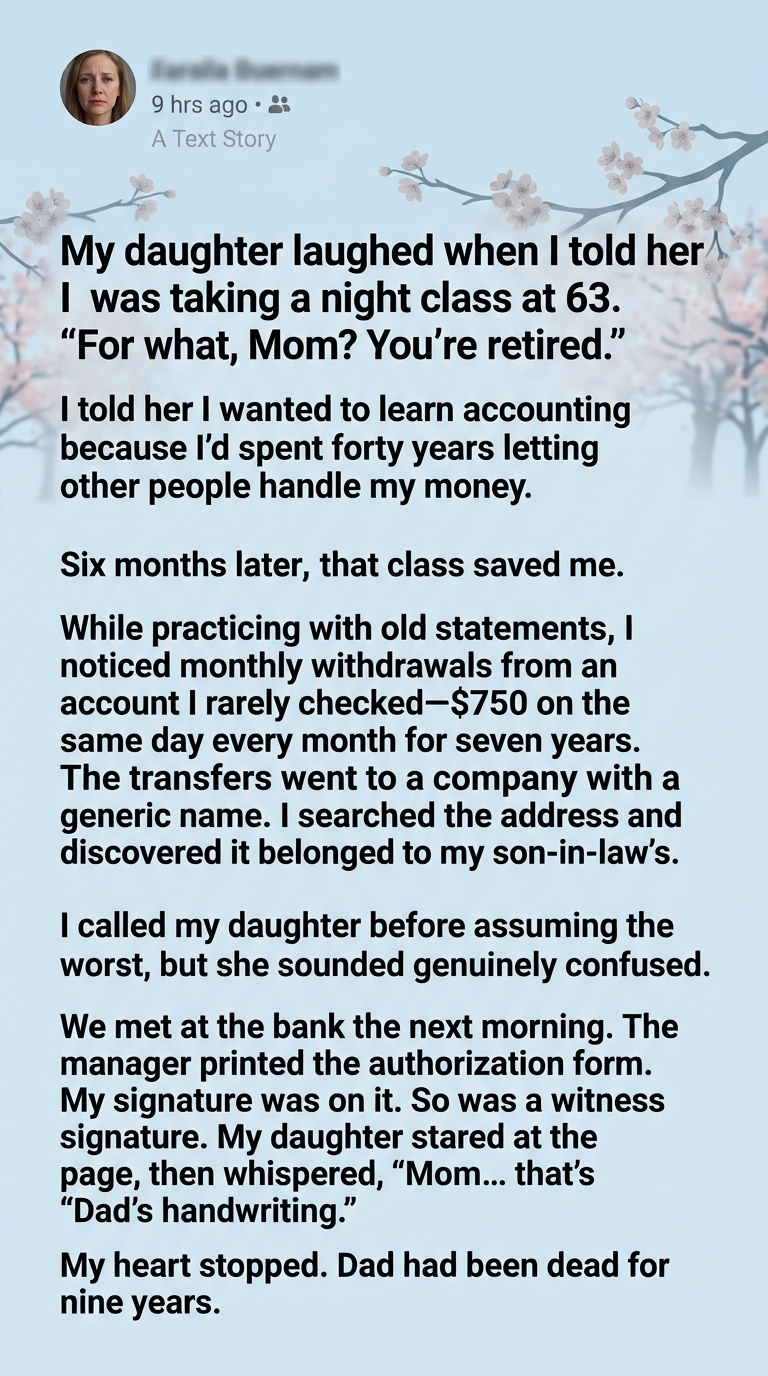
My daughter laughed when I told her I was taking a night class at sixty-three.
“For what, Mom? You’re retired.”
I smiled.
“That’s exactly why.”
She shook her head.
“You’re going to school now?”
“Accounting.”
She laughed again.
“Why?”
I looked at her.
“Because I’ve spent forty years letting other people handle my money.”
That ended the conversation.
My husband had always managed our finances.
After he died, my daughter helped me with the complicated parts.
Bills.
Taxes.
Investments.
Bank accounts.
I trusted them.
Why wouldn’t I?
They were my family.
But something about turning sixty-three made me want to understand my own finances.
So twice a week, I went to night class.
At first, I struggled.
Debits.
Credits.
Ledgers.
Reconciliations.
I almost quit three times.
Then one evening, our instructor gave us old bank statements to practice with.
I decided to use my own.
I pulled statements from an account I rarely checked.
I started comparing the numbers.
At first, everything looked normal.
Then I noticed something.
$750.
Every month.
Same day.
Same amount.
Same account.
I went back seven years.
The withdrawals were there.
Every single month.
84 payments.
$63,000 total.
I stared at the number.
I had no idea what it was.
The company receiving the money had a generic name:
Northfield Administrative Services.
I searched the address.
My stomach tightened.
The address belonged to my son-in-law’s office.
I immediately called my daughter.
“Can you come over?”
“Why?”
“I need to ask you something.”
She came over that evening.
I showed her the statements.
She looked confused.
“I don’t know what this is.”
“Are you sure?”
“Yes.”
“What about your husband?”
She shook her head.
“I’ll ask him.”
“No.”
I stopped her.
“Let’s go to the bank first.”
The next morning, we met with the bank manager.
I explained everything.
He pulled up the account records.
Then he printed the authorization form connected to the recurring transfers.
I looked at the page.
My name was there.
Account holder: Margaret Reynolds.
Under authorization:
Margaret Reynolds.
And beneath it was a witness signature.
I stared at it.
My daughter leaned closer.
Then she stopped breathing.
“Mom…”
“What?”
She pointed at the witness signature.
“That’s Dad’s handwriting.”
I looked at it again.
My heart stopped.
My husband had been dead for nine years.
The bank manager looked uncomfortable.
“Is there a problem?”
I whispered:
“My husband died nine years ago.”
The manager stared at the document.
Then at me.
He immediately called someone from the bank’s fraud department.
They examined the original authorization.
Then they told us something even more disturbing.
The authorization had been created eleven months after my husband died.
I felt the room spinning.
“That’s impossible.”
The manager nodded.
“It appears someone submitted this document after his death.”
My daughter covered her mouth.
“Mom…”
I couldn’t speak.
The bank froze the remaining funds.
Then they asked me whether I had ever authorized anyone to manage this account.
I said no.
But then I remembered something.
After my husband died, my son-in-law had offered to help me organize my finances.
He had said:
“You shouldn’t have to deal with this stuff alone.”
I trusted him.
He had helped me consolidate several accounts.
He had prepared tax documents.
He had even driven me to the bank.
I suddenly felt sick.
“Could he have had access?”
The manager checked.
“Yes.”
My daughter started crying.
“No.”
I looked at her.
“I’m sorry.”
“No.”
She shook her head.
“My husband wouldn’t do this.”
The bank manager looked at us.
“We don’t know who initiated the transfers yet.”
That distinction mattered.
So we didn’t accuse anyone.
We requested a full investigation.
The bank traced the original instructions.
The company receiving the money wasn’t actually a normal business.
It was an LLC registered three months before the first withdrawal.
And its only listed manager was…
My son-in-law.
My daughter looked like she had been punched.
“No.”
I reached for her hand.
“We need to know why.”
The bank eventually found the original account-opening records.
My son-in-law had created the company.
But there was another name attached to the documents.
My husband’s name.
Except my husband had never signed them.
Someone had copied his signature.
My daughter was furious.
She called her husband.
He arrived at the bank an hour later.
When he saw the documents, his face went pale.
“What is this?”
I asked.
He didn’t answer.
My daughter stepped forward.
“Did you take Mom’s money?”
He looked at her.
Then at me.
Finally, he sat down.
“Yes.”
My daughter started crying.
“Why?”
He rubbed his face.
“I was going to pay it back.”
“For seven years?”
“I had a business.”
“And you took $63,000 from my mother?”
“I didn’t steal it.”
I stared at him.
“What would you call it?”
He looked down.
“I thought your mom would never notice.”
Those words hurt more than the money.
I had spent years trusting him.
My daughter asked:
“Why Dad’s signature?”
He was silent.
Then he finally explained.
When my husband died, he had left behind several unfinished financial documents.
My son-in-law had discovered that my husband had once authorized him to help with business paperwork.
He used an old document as a template.
Then created a fake authorization.
He believed that because he had been helping the family financially, he was entitled to “borrow” from an account I barely touched.
The $750 transfers had initially been used to cover a business loan.
When the business improved, he kept taking the money.
Every month.
For seven years.
My daughter was devastated.
She looked at me.
“I had no idea.”
“I know.”
“Mom, I’m so sorry.”
I hugged her.
“This isn’t your fault.”
The bank recovered a significant portion of the remaining money.
The rest became part of a legal repayment process.
My son-in-law eventually admitted what he had done.
He also admitted that he had deliberately used my lack of financial knowledge against me.
That sentence stayed with me.
Because it was true.
I had spent decades believing money was something other people understood.
My husband handled it.
Then my daughter helped.
Then my son-in-law.
I trusted everyone.
But I never learned enough to protect myself.
Until I went to that night class.
Several months later, I sat in the same classroom.
Our instructor asked everyone to share something they had learned.
When it was my turn, I said:
“I learned that understanding your own money isn’t about becoming wealthy.”
I paused.
“It’s about becoming impossible to deceive.”
The room went quiet.
I smiled.
“I wish I’d learned that forty years ago.”
After class, my daughter was waiting outside.
She hugged me.
“I’m glad you took that class.”
“So am I.”
She smiled.
Then she asked:
“Are you still taking accounting next semester?”
I laughed.
“Absolutely.”
“What are you going to study?”
I looked at her.
“Investments.”
She laughed.
“I should have known.”
We walked to the car together.
I thought about my husband’s signature.
For years, I had believed seeing his handwriting again would feel like finding a piece of him.
Instead, it had been the clue that exposed the biggest financial betrayal of my life.
But in the end, that forged signature gave me something my husband never could.
A reason to finally take control of my own life.
I didn’t lose $63,000.
I lost the illusion that trust meant never asking questions.
And that lesson was worth far more than any accounting class.
At sixty-three, I didn’t go back to school because I was too old to learn.
I went because I finally realized I was too old to let someone else make every decision for me.