- I had spent years making sure my family never had to worry about money.
Apparently, that had made them forget who was paying the bills.
My name is Daniel.
I was thirty-seven when I finally learned that being generous and being appreciated were two completely different things.
It happened on my birthday.
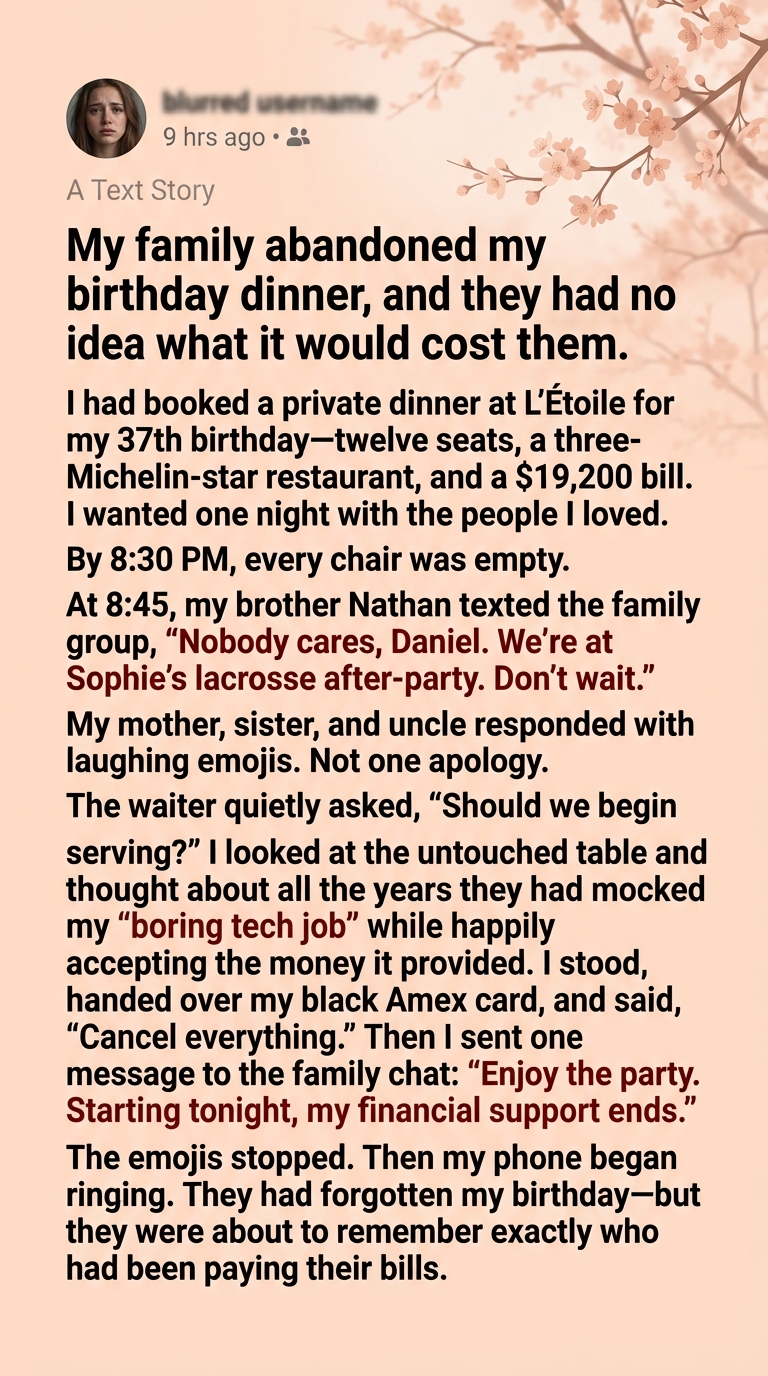
I had booked a private dinner at L’Étoile.
Twelve seats.
Three Michelin stars.
A tasting menu I’d been looking forward to for months.
The total was $19,200.
It was ridiculous.
It was extravagant.
And for once, I didn’t care.
I wasn’t trying to impress anyone.
I wanted one night with the people I loved.
My mother.
My younger brother Nathan.
My sister Rachel.
My uncle Martin.
Their spouses.
Their children.
Twelve people.
I sent the invitations six weeks ahead.
Everyone said yes.
My mother even called me.
“Thirty-seven,” she joked. “You’re getting old.”
I laughed.
“Come anyway.”
“Oh, we will.”
I spent the next month planning everything.
I paid the deposit.
I arranged a private dining room.
I selected the wine.
I even ordered a special dessert with a message written in chocolate:
Happy Birthday, Daniel.
I thought it would be a night I’d remember forever.
I was right.
Just not for the reason I expected.
At 7:00 PM, I arrived.
The restaurant was beautiful.
Soft lighting.
White tablecloths.
A dozen place settings.
Twelve chairs.
I sat down at the head of the table.
At 7:10, no one had arrived.
I checked my phone.
Nothing.
At 7:20, I texted the family group.
“Everything okay? I’m here.”
No response.
At 7:35, my sister Rachel finally replied.
“Running late.”
I smiled.
Fine.
People get delayed.
At 7:50, still nobody.
At 8:00, I called my mother.
No answer.
I called Nathan.
Nothing.
My uncle.
Voicemail.
At 8:15, the restaurant manager came over.
“Mr. Daniel?”
“Yes?”
“Would you like us to hold service?”
“Yes.”
I looked at the empty chairs.
“They’re coming.”
I believed it.
At 8:30, I stopped believing it.
Twelve empty chairs.
Twelve untouched menus.
Twelve glasses waiting to be filled.
Then my phone buzzed.
It was Nathan.
Not a private message.
The family group.
Nathan: “Nobody cares, Daniel. We’re at Sophie’s lacrosse after-party. Don’t wait.”
I stared at the screen.
For a few seconds, I couldn’t process it.
Sophie’s lacrosse after-party.
My niece had a game earlier that afternoon.
I’d actually sent her $400 for the team fundraiser.
I’d told her to have fun.
I hadn’t expected them to choose her after-party over my birthday dinner.
But what hurt wasn’t the choice.
It was the way Nathan said it.
Nobody cares, Daniel.
Then my mother reacted with a laughing emoji.
My sister added one.
My uncle added two.
No apology.
No explanation.
Just laughter.
I put my phone face down.
The waiter approached quietly.
“Should we begin serving?”
I looked at the table.
All twelve chairs were empty.
“Cancel everything.”
He hesitated.
“Are you sure?”
“Yes.”
“Would you like us to prepare something for you?”
I looked at the menu.
Then at the empty chairs.
“No.”
I stood.
I handed the black Amex to the manager.
“Charge whatever cancellation fee is necessary.”
He looked surprised.
“I’m sorry.”
“Don’t be.”
I took one last look at the table.
Then I walked out.
In the elevator, I opened my banking app.
I looked at the monthly transfers.
Mom’s mortgage.
Rachel’s car payment.
Nathan’s student loan.
Sophie’s private school tuition.
Uncle Martin’s medical insurance.
Rachel’s credit card.
Nathan’s rent.
I had been paying all of it.
Quietly.
For years.
Nobody had ever asked me to.
At least, not directly.
It started with my mother.
After my father died, she couldn’t afford the mortgage alone.
So I helped.
Then Nathan lost his job.
I covered his rent.
Rachel’s husband started a business that failed.
I helped them recover.
Sophie’s school tuition increased.
I paid the difference.
Uncle Martin had a medical issue.
I handled the insurance premiums.
Every time someone needed help, I stepped in.
And every time I did, they joked about my job.
“Daniel and his computer money.”
“Must be nice sitting behind a screen all day.”
“You don’t have a real job.”
“You’ll understand when you have an actual family.”
I laughed along.
Because I didn’t want money to become a weapon.
But that night, sitting alone in the back of a car, I finally understood something.
They didn’t respect me.
They respected what my money could do for them.
So I sent one message.
Daniel: “Enjoy the party. Starting tonight, my financial support ends.”
I put my phone away.
Thirty seconds later, it rang.
Mom.
I ignored it.
Then Nathan.
Ignored.
Rachel.
Ignored.
Uncle Martin.
Ignored.
The phone wouldn’t stop.
By midnight, I had forty-three missed calls.
The next morning, I woke up to 118 messages.
Most weren’t apologies.
They were questions.
“What does this mean?”
“Daniel, call me.”
“You can’t just do this.”
“Mom needs you.”
“Nathan’s rent is due.”
“Sophie’s tuition is due next week.”
Not one person said:
I’m sorry we abandoned you.
Not one.
I didn’t answer.
Instead, I called my financial advisor.
“I want every recurring family payment stopped.”
He was silent.
“Are you sure?”
“Yes.”
“All of them?”
“All.”
Then I called my attorney.
“I want to update my estate plan.”
That got everyone’s attention.
By lunchtime, my mother showed up at my apartment.
She knocked for ten minutes.
I finally opened the door.
She looked furious.
“You can’t punish your family because you had a bad birthday.”
I stared at her.
“You laughed.”
“What?”
“You laughed when Nathan said nobody cared.”
She looked away.
“He was joking.”
“Was he?”
“Daniel, you’re being dramatic.”
I almost laughed.
“You left twelve empty chairs at a $19,200 dinner.”
“You shouldn’t spend that much on a birthday.”
I stared at her.
“You were invited.”
She folded her arms.
“We had somewhere else to be.”
“Then you could have told me.”
She didn’t answer.
I asked:
“Do you know how much I’ve paid for you over the last five years?”
She looked uncomfortable.
“No.”
“$184,000.”
Her face changed.
“What?”
“Mortgage. Property taxes. Utilities. Insurance. Repairs.”
She stared at me.
“You said you were helping.”
“I was.”
“You never told me it was that much.”
“You never asked.”
She began crying.
But then she said something that made me realize nothing had changed.
“So you’re really going to let your own mother lose her house?”
I shook my head.
“No.”
She looked relieved.
Then I continued.
“I’m not taking your house.”
Her relief disappeared.
“But I’m not paying for it anymore.”
She left without saying goodbye.
Nathan came next.
He didn’t knock.
He called.
“Daniel, this is insane.”
“You missed my birthday.”
“I told you why.”
“You told everyone you didn’t care.”
“I was joking.”
“You laughed.”
“Everyone was laughing.”
“Exactly.”
He sighed.
“Look, I need rent.”
“You’ll need to find another arrangement.”
“You’re seriously cutting me off?”
“Yes.”
“What happened to family?”
I paused.
“That’s what I was wondering at the restaurant.”
He hung up.
Rachel sent me a long email.
She said I was selfish.
She said money had changed me.
She said family shouldn’t be transactional.
That sentence almost made me laugh.
Because I’d never made it transactional.
They had.
I replied with one sentence.
“You’re right. Family shouldn’t be transactional. That’s why I stopped charging mine for everything I gave them.”
I never heard back.
Over the next few months, their lives changed.
Not catastrophically.
Just realistically.
Mom refinanced her house.
Nathan found a smaller apartment.
Rachel and her husband cut their spending.
Sophie’s tuition wasn’t interrupted because I had already established a college fund for her years earlier.
But I changed the terms.
Her parents couldn’t access it.
The money would pay her school directly.
That decision mattered.
Because I never wanted Sophie to think I was punishing her for what her parents had done.
She was a child.
She hadn’t abandoned me.
A month later, Sophie called.
“Uncle Daniel?”
“Hey.”
“Are you mad at me?”
My heart sank.
“No.”
“Mom said you stopped helping us because of me.”
I closed my eyes.
“That isn’t true.”
“She said it was because of the party.”
“It wasn’t because of you.”
She was quiet.
“Did you still have your birthday dinner?”
“No.”
“I’m sorry.”
I smiled.
“Thank you.”
Then she said:
“I wanted to go.”
“What?”
“To your dinner.”
I frowned.
“But your mom said the party was more important.”
There it was.
The truth.
Not the whole truth.
But enough.
I realized my family hadn’t simply chosen a party over me.
They had decided my birthday didn’t matter because they assumed I’d keep paying regardless.
My money had made my absence convenient.
A few weeks later, my mother called again.
This time she sounded different.
Not angry.
Tired.
“Daniel?”
“Yes?”
“I want to apologize.”
I didn’t say anything.
“I should have come.”
“Yes.”
“I was selfish.”
“Yes.”
“I laughed.”
“Yes.”
“I hurt you.”
“Yes.”
There was a long silence.
Then she said:
“Can we have dinner?”
I thought about it.
“Just us?”
“Yes.”
“Then yes.”
We met at a small neighborhood restaurant.
No private room.
No twelve seats.
No $19,200 bill.
Just two people at a table.
My mother looked older.
I realized something that night.
I hadn’t wanted revenge.
I hadn’t wanted them to suffer.
I had wanted them to notice me.
For years, I’d been the person who paid quietly.
The person who solved problems.
The person nobody thanked because everyone assumed I’d handle it.
That birthday taught me something I should have learned much earlier.
Love doesn’t require you to finance your own disrespect.
A year later, I celebrated my thirty-eighth birthday differently.
I rented a small cabin by the lake.
I invited six people.
People who actually showed up.
My mother.
Sophie.
Two close friends.
My cousin.
And my old college roommate.
No one brought a bill.
No one laughed at my job.
No one asked me to pay for anything.
We cooked dinner ourselves.
It wasn’t fancy.
But at midnight, Sophie handed me a card.
I opened it.
Inside she had written:
“Happy birthday, Uncle Daniel. Thank you for always being there. I hope you know we love you—not your money.”
I had to look away for a moment.
Then I smiled.
Because for the first time in years, I knew the difference.
My family had forgotten my birthday.
But that wasn’t what changed everything.
They forgot the person.
I stopped funding the lifestyle.
And suddenly, they remembered the person very clearly.
I didn’t cancel my family’s support because they forgot my birthday. I canceled it because their reaction showed me they had forgotten who I was.
I sent one message: “Starting tonight, my financial support ends.” My phone rang 43 times before midnight.