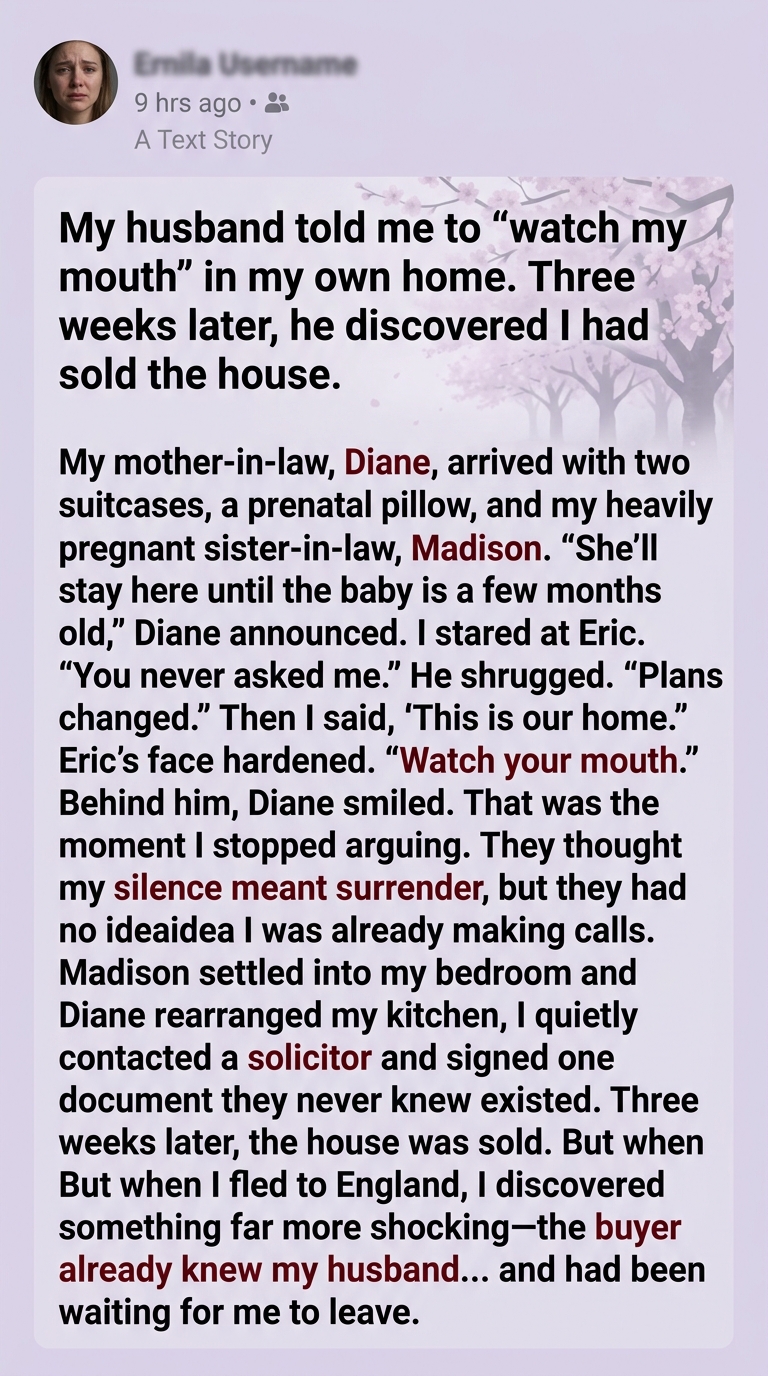
My husband told me to “watch my mouth” in my own home.
Three weeks later, he discovered I had sold the house.
But that wasn’t the part that shocked him.
The part that changed everything was who bought it.
My name is Claire, and until that winter, I had spent eight years believing my marriage was built on partnership.
I was wrong.
It started with my mother-in-law, Diane.
She had always been difficult.
Not openly cruel.
Just entitled.
She had a way of walking into a room and behaving as though everyone else had been invited into her house.
When Eric and I bought our home, she immediately began making suggestions.
The kitchen should be changed.
The curtains were ugly.
The spare room should be painted.
The garden needed work.
I tried to laugh it off.
“She means well,” Eric always said.
Then came the Thursday afternoon when Diane arrived with two suitcases.
Behind her was my heavily pregnant sister-in-law, Madison.
Madison was carrying a prenatal pillow under one arm.
Diane was carrying another suitcase.
I stared at them.
“What are you doing?”
Diane smiled.
“Madison will be staying here until the baby is a few months old.”
I thought I’d misheard her.
“Staying here?”
“Yes.”
She walked inside.
“Eric told us it was fine.”
I looked at my husband.
“Eric?”
He shrugged.
“Plans changed.”
“You never asked me.”
He looked annoyed.
“It’s family.”
Madison smiled awkwardly.
“I’m sorry, Claire. I didn’t know this would be a problem.”
That was the problem.
They had already decided.
My opinion wasn’t part of the decision.
I looked at Eric.
“This is our home.”
His face hardened.
“Watch your mouth.”
The room went silent.
Diane smiled.
Just slightly.
It was the smile of someone who had just won.
I didn’t argue.
I didn’t raise my voice.
I simply said:
“Okay.”
Eric looked surprised.
“What?”
“Nothing.”
I walked upstairs.
Behind me, I heard Diane telling Madison which bedroom would be hers.
My bedroom.
Within an hour, my closet had been emptied.
Madison’s bags were on my bed.
Diane was rearranging my kitchen.
She moved my dishes.
My coffee machine.
Even the photographs on the counter.
I stood in the hallway and watched.
Eric came upstairs.
“You need to be more understanding.”
I looked at him.
“Where am I supposed to sleep?”
“You can use the guest room.”
I almost laughed.
The guest room.
In my own house.
But I didn’t argue.
Instead, I went into the bathroom, closed the door, and made a phone call.
A solicitor answered.
“Good afternoon.”
“I need to ask about something.”
“What?”
“I own a house with my husband.”
“Yes?”
“I want to know whether I can sell my share.”
There was a pause.
“Are you both registered owners?”
“Yes.”
“Are there any restrictions?”
“I don’t know.”
“Then I’ll need to see the title documents.”
I sent them.
Twenty minutes later, the solicitor called back.
“Mrs. Bennett, this is unusual.”
“What?”
“You are the sole registered owner.”
I froze.
“What?”
“The property is in your name only.”
I sat on the bathroom floor.
“That can’t be right.”
“I’m looking at the title now.”
He explained.
Years earlier, when we’d bought the property, my father had helped with the deposit.
Because the deposit came from money left to me by my grandmother, my father had insisted that the property remain in my name.
Eric had always referred to it as “our house.”
I had assumed he was legally an owner.
He wasn’t.
Not at all.
The solicitor continued.
“You can sell the property without your husband’s consent, subject to the usual legal requirements.”
I stared at the floor.
Then I asked:
“What happens if my husband has been living there?”
“He may have occupancy rights depending on the circumstances, but that doesn’t make him an owner.”
I thanked him.
Then I sat there for a long time.
I didn’t want revenge.
I wanted clarity.
So I asked the solicitor one more question.
“If I decide to sell, how quickly can it happen?”
“Potentially very quickly.”
I hung up.
Then I opened my laptop.
And I made a decision.
I put the house on the market.
Quietly.
I didn’t tell Eric.
I didn’t tell Diane.
I didn’t tell Madison.
I simply started the process.
Within days, a buyer made an offer.
Cash.
No chain.
Fast completion.
The buyer’s solicitor moved quickly.
Three weeks after Diane arrived with those suitcases, the sale was finalized.
I signed the papers.
The money went into my account.
And that afternoon, I booked a one-way flight to England.
I packed one suitcase.
Not two.
Not three.
One.
Before leaving, I walked through the house.
Madison was asleep upstairs.
Diane was watching television.
Eric was in the kitchen.
I looked at him.
“I’m leaving.”
He didn’t even look up.
“Fine.”
“You’ll need to find somewhere else to live.”
He laughed.
“What are you talking about?”
“The house has been sold.”
He stopped.
Slowly, he turned around.
“What?”
I handed him the solicitor’s letter.
He read it.
Then read it again.
His face went pale.
“You sold the house?”
“Yes.”
“You can’t do that.”
“I already did.”
“This is our home.”
“No.”
I looked at him.
“It was my house.”
Diane came rushing into the kitchen.
“What is happening?”
Eric handed her the letter.
Her expression changed.
“You can’t sell this.”
“I already have.”
She looked at me as if I had committed some terrible crime.
“Where will Madison go?”
I looked at my pregnant sister-in-law.
“That isn’t my responsibility.”
Eric stepped toward me.
“You’ve lost your mind.”
I shook my head.
“No.”
I picked up my suitcase.
“I finally found it.”
Then I left.
At the airport, I turned off my phone.
I thought that was the end.
I was wrong.
When I landed in England, I turned my phone back on.
There were 127 missed calls.
Messages.
Threats.
Apologies.
Angry voicemails.
I ignored all of them.
My solicitor had arranged temporary accommodation for me while I settled in.
I was exhausted.
I ordered tea.
Then there was a knock on my hotel room door.
I assumed it was room service.
It wasn’t.
A man stood outside.
Early sixties.
Grey hair.
Dark coat.
He looked at me.
“Claire?”
“Yes?”
“My name is Robert.”
I stared at him.
“Do I know you?”
“No.”
Then he said:
“I bought your house.”
My stomach tightened.
“What?”
He smiled sadly.
“I thought you knew.”
“Knew what?”
He looked past me.
Then back at me.
“I’ve been waiting for you to leave.”
I felt cold.
“Why?”
He hesitated.
“Because I knew your husband.”
My heart began pounding.
“You know Eric?”
“I did.”
“What do you mean, did?”
Robert looked down.
“Eric worked for me.”
I stared at him.
“When?”
“Years ago.”
“Doing what?”
“Managing property accounts.”
I didn’t understand.
Then he handed me a folder.
Inside were documents.
Bank transfers.
Property records.
Emails.
And photographs.
I looked at one.
It showed Eric standing beside a group of men outside a property development.
Robert pointed to a name on the page.
“Your husband wasn’t just working for me.”
He paused.
“He was involved in something that nearly destroyed my company.”
I looked at him.
“What does that have to do with my house?”
Robert’s answer made my stomach drop.
“Your house was never supposed to be yours.”
I frowned.
“What?”
“Eric thought he had convinced you to refinance it.”
“I never refinanced.”
“I know.”
He pulled out another document.
A mortgage application.
My name was forged on it.
I stared at the signature.
It looked almost like mine.
Almost.
But it wasn’t.
Robert continued.
“Eric was planning to use the property as collateral.”
“For what?”
“To cover debts.”
“How much?”
“Enough to ruin you.”
I sat down.
The room suddenly felt too small.
“Why didn’t you tell me before?”
“I tried.”
“What?”
“I contacted your solicitor months ago.”
I stared at him.
“Why?”
“Because I knew Eric was hiding things.”
Robert leaned forward.
“I was watching him.”
I swallowed.
“Why?”
“Because he owed me money.”
Then he said something that changed the entire story.
“He wasn’t angry when you sold the house.”
I frowned.
“What?”
“He was terrified.”
“Why?”
“Because the sale meant he couldn’t use your property to cover what he owed.”
I sat completely still.
The house hadn’t simply been a place where Eric and his family felt entitled to live.
It had been their financial escape plan.
And my signature was supposed to make it possible.
Robert opened another file.
“This is the reason I bought your house.”
I looked at him.
“You bought it because you wanted the property?”
“No.”
“Then why?”
He pushed a document toward me.
The sale contract.
I recognized the price.
It was higher than the market valuation.
Much higher.
“Why would you pay this?”
Robert smiled.
“Because I knew what the house was worth to you.”
I didn’t understand.
Then he said:
“Your father contacted me.”
I stopped breathing.
“My father?”
“Before he died.”
I stared at him.
“He told me that if you ever discovered what Eric was doing, you would need a way out.”
My eyes filled with tears.
“He knew?”
“He suspected.”
Robert’s voice softened.
“He asked me to keep an eye on the property.”
I couldn’t speak.
My father had been gone for six years.
He had apparently worried about me until the very end.
Robert continued.
“When your house went on the market, I knew immediately.”
“You were the buyer.”
“Yes.”
“You were waiting for me?”
“Yes.”
“Why?”
“Because I wanted to make sure you got the money safely.”
I looked down at the sale papers.
The money was already in my account.
For the first time since leaving home, I felt safe.
But there was one final question.
“What happens to Eric?”
Robert sighed.
“That depends on what the investigators find.”
I looked at him.
“Investigators?”
He nodded.
“I didn’t come to England alone.”
My solicitor walked into the room.
Behind him was another man.
A financial investigator.
They explained that the documents Robert had collected were already being reviewed.
The forged mortgage application.
The unexplained transfers.
The debts.
The property records.
The evidence suggested Eric had been using other people’s identities and assets to cover his financial problems.
And now the house was no longer available to him.
Neither was I.
The investigation continued for months.
Eric eventually admitted that he had known the property was solely mine.
He had also admitted that he intended to pressure me into refinancing it.
Diane and Madison had known less than he had.
They had assumed the house belonged to both of us.
But Eric had known the truth.
He had simply never told them.
And that changed how I saw everything.
The command to “watch my mouth.”
The decision to move Madison into my bedroom without asking.
Diane rearranging my kitchen.
The assumption that I would simply accept whatever they decided.
It wasn’t just disrespect.
It was entitlement built on a lie.
Months later, I returned to England permanently.
I bought a small cottage near the coast.
No giant house.
No family staying without permission.
No one rearranging my kitchen.
No one telling me where I belonged.
I eventually learned what happened to the old house.
Robert renovated it.
He kept one thing exactly as it was.
The front garden.
My father had planted roses there.
Robert never touched them.
One spring morning, I received a photograph.
The roses were blooming.
Underneath the photograph was a message.
“Some things are worth preserving.”
I smiled.
Because for years, I had thought selling my house meant losing something.
Instead, it gave me something I hadn’t realized I’d lost.
My freedom.
My father had once helped me buy that house.
Years later, without me knowing, he helped make sure I could leave it.
And Eric?
He eventually sent me one final message.
“You destroyed our family.”
I stared at it for a long time.
Then I deleted it.
Because I hadn’t destroyed anything.
I had simply stopped allowing people who didn’t respect my boundaries to live inside them.
Three weeks after my husband told me to watch my mouth, I sold the house.
But the real thing I sold wasn’t the building.
It was the version of my life where everyone else made decisions for me.
And the strangest part?
The man who bought my house wasn’t waiting for me to fail.
He was waiting for me to finally walk away.
Sometimes the quietest person in the room isn’t surrendering. They’re making the one decision that everyone else will regret underestimating.