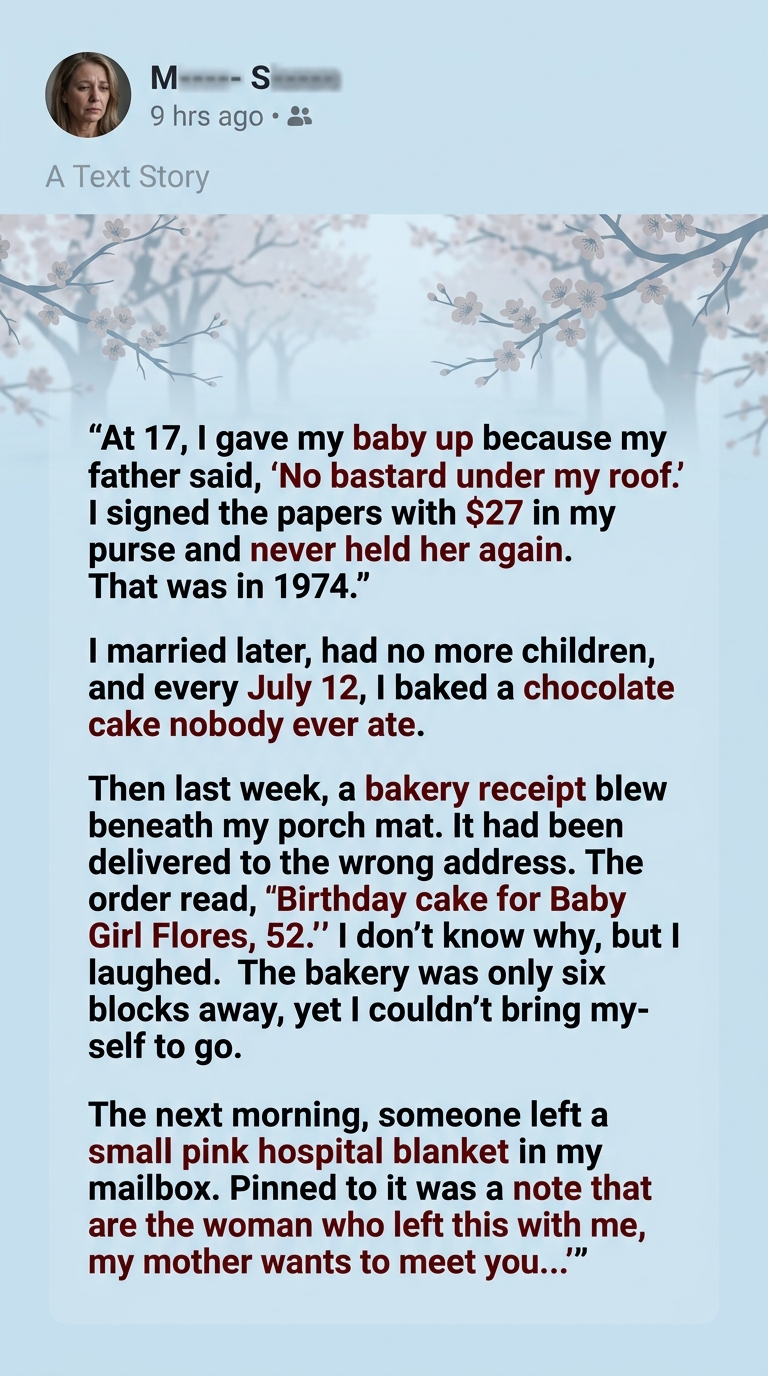
At seventeen, I gave my baby away because my father said:
“No bastard under my roof.”
I was seventeen years old.
It was 1974.
And I remember every detail.
The gray hospital walls.
The smell of disinfectant.
The tiny plastic bracelet around my daughter’s wrist.
And the way my hands shook when I signed the adoption papers.
I had $27 in my purse.
That was all I had.
I didn’t have a car.
I didn’t have a job.
I didn’t have anywhere to go.
And my father had made his decision very clear.
“If you bring that baby home,” he told me, “you won’t have a home.”
So I signed.
They took my baby from my arms.
I never held her again.
I never saw her face after that day.
I didn’t even get to choose her name.
The adoption papers called her:
Baby Girl Flores.
That was the last thing I had.
A name on a piece of paper.
For years, I tried to pretend I had moved on.
I married at twenty-four.
My husband, Thomas, was a good man.
He knew about the baby.
I told him before we married.
He never judged me.
We tried to have children.
It never happened.
Eventually, doctors told us it was unlikely.
Thomas held my hand.
“We’ll be okay,” he said.
And we were.
Mostly.
But every July 12, I baked a chocolate cake.
July 12 was her birthday.
I didn’t know what she looked like.
I didn’t know her favorite color.
I didn’t know whether she liked chocolate.
But I baked the cake anyway.
Every year.
Sometimes Thomas would ask:
“Do you want me to eat it?”
I’d shake my head.
“No.”
“Why?”
“Because it’s hers.”
He never asked again.
The cake would sit on the kitchen table until the next morning.
Then I’d throw it away.
I did that for fifty-two years.
Until last week.
I was sweeping my porch when something fluttered beneath the mat.
I bent down.
It was a bakery receipt.
The wind must have blown it from someone’s hand.
I almost threw it away.
Then I saw the delivery address.
Six blocks from my house.
And the order description.
I froze.
Birthday cake for Baby Girl Flores, 52.
I stared at the words.
Then, unbelievably, I laughed.
It was such a strange laugh.
Half shock.
Half sadness.
Half something I couldn’t name.
I carried the receipt inside.
I put it on the kitchen table.
Thomas had been gone for eight years by then.
I lived alone.
The house was quiet.
I stared at that receipt for hours.
The bakery was six blocks away.
I could have walked there.
I could have asked who ordered the cake.
But I couldn’t.
Because some part of me was terrified.
What if it was just a coincidence?
What if someone else had the same name?
What if the bakery had made a mistake?
Or worse…
What if it was really her?
I went to bed without doing anything.
The next morning, I checked my mailbox.
There was a small pink hospital blanket inside.
I recognized it immediately.
Not because I remembered every detail.
Because I remembered one tiny embroidered flower in the corner.
I had seen that flower the day my daughter was born.
My hands began shaking.
Pinned to the blanket was a note.
Only one sentence.
“If you are the woman who left this with me, my mother wants to meet you.”
I sat down on the front steps.
I couldn’t breathe.
My daughter was alive.
She had found me.
Somehow.
After fifty-two years.
I called the bakery.
A young woman answered.
“Hello?”
I almost hung up.
Instead I said:
“Someone ordered a birthday cake yesterday.”
“Which order?”
I read the receipt.
There was silence.
Then she said:
“Oh.”
“What?”
“That cake was picked up yesterday morning.”
“Who ordered it?”
“I can’t give out customer information.”
“Please.”
My voice cracked.
“My name is Maria Flores.”
Another silence.
Then the woman whispered:
“Are you the Maria Flores?”
My heart stopped.
“What do you mean?”
She said:
“Someone specifically asked us to call you if you came in.”
I closed my eyes.
“Who?”
“I think you should meet her yourself.”
That afternoon, I walked to the bakery.
My legs felt weak.
When I opened the door, a woman stood near the counter.
She was in her early fifties.
Dark hair.
Brown eyes.
A small scar above her left eyebrow.
She turned around.
We looked at each other.
Neither of us spoke.
Then she said:
“Are you Maria?”
I nodded.
She took one step toward me.
“My name is Elena.”
I couldn’t breathe.
“Elena…”
She smiled through tears.
“That’s the name my adoptive parents gave me.”
I covered my mouth.
She pulled a photograph from her purse.
It was a picture of a baby.
Wrapped in a pink hospital blanket.
The same blanket I had found in my mailbox.
“I’ve had this since I was a baby,” she said.
“Why?”
“My adoptive mother gave it to me when I turned eighteen.”
I touched the blanket.
“She told me my birth mother left it with me.”
I started crying.
“I remember that blanket.”
Elena nodded.
“I hoped you would.”
We sat at a small table in the corner.
For the next three hours, we talked.
She told me about her childhood.
Her adoptive parents had loved her deeply.
She had grown up in a warm home.
She had gone to college.
Married.
Had two children.
And eventually became a grandmother herself.
I showed her the only photograph I had of myself at seventeen.
She stared at it.
Then laughed.
“You look terrified.”
“I was.”
She smiled.
“I think I look like you.”
I looked at her.
“You do.”
Then she asked the question I’d feared for fifty-two years.
“Why did you give me away?”
I looked down.
“Because I was seventeen.”
She waited.
“My father told me there was no place for a child like you in our house.”
My voice broke.
“He told me if I kept you, I’d be on the street.”
Elena’s eyes filled with tears.
“So you didn’t want me?”
I reached across the table.
“I wanted you more than anything.”
“Then why didn’t you come for me?”
“I tried.”
She looked surprised.
“I wrote letters.”
“To where?”
“The adoption agency.”
“I never saw them.”
“I know.”
She looked confused.
“What do you mean?”
I told her about the letters.
About the birthday cards.
About the small amounts of money I had saved.
About every July 12.
The cake.
Every single year.
Her face crumpled.
“You baked me a cake?”
“Every year.”
She started crying.
“So why did I get the bakery cake?”
I looked at her.
She smiled through her tears.
“Because I started baking my own birthday cake every year too.”
I laughed.
“Chocolate?”
She nodded.
“Chocolate.”
We both cried.
Then she reached into her purse.
“I brought something else.”
She placed an envelope on the table.
Inside was a copy of her original adoption records.
There was something I had never seen.
A handwritten note.
I recognized the handwriting immediately.
My father’s.
I stared at it.
“What is this?”
Elena looked confused.
“I found it among some papers.”
I read the note.
The baby will be placed for adoption immediately. Maria is not to contact her.
My stomach dropped.
There was more.
Any letters or correspondence from Maria are to be withheld. She is too young and unstable to make decisions regarding the child.
I looked up.
“I never knew this existed.”
Elena stared at me.
“What?”
“I wrote to you.”
“How many times?”
“Every birthday.”
She shook her head.
“I never received anything.”
Suddenly, fifty-two years of pain took on a different shape.
My father hadn’t simply forced me to surrender my daughter.
He had made sure I couldn’t find her.
He had kept us apart.
For decades, I had blamed myself.
I thought my daughter had never wanted to know me.
I thought she had grown up and forgotten me.
But the truth was different.
We had both been looking for each other.
We just didn’t know it.
Elena reached across the table.
“Can I ask you something?”
“Yes.”
“Do you hate him?”
I thought about my father.
He had died twenty-six years earlier.
For most of my life, I had been angry at him.
But sitting across from my daughter, I realized something.
I didn’t want to give him another day of my life.
“No,” I said.
“I used to.”
“And now?”
I smiled sadly.
“Now I just wish he had known what he was taking from both of us.”
Elena squeezed my hand.
“He can’t change what happened.”
“No.”
“But we can change what happens next.”
I nodded.
She smiled.
“So…”
“Yes?”
“Is it true?”
“What?”
“You really baked a cake every July 12?”
I laughed.
“Yes.”
She leaned closer.
“Can I have this year’s?”
I smiled.
“You’ll have to wait until July.”
She shook her head.
“No.”
She stood.
“I’m ordering one now.”
We walked back to the bakery together.
The same bakery whose receipt had blown beneath my porch mat.
The same bakery that had unknowingly brought us together.
Elena ordered a chocolate cake.
Then she looked at me.
“What should we write on it?”
I thought for a moment.
Then I smiled.
“Happy birthday, Baby Girl.”
She laughed.
“No.”
She took the pen.
And wrote:
“Welcome Home, Mom.”
I couldn’t stop crying.
Neither could she.
The cake came out twenty minutes later.
We sat together at that little bakery table.
Two strangers who weren’t strangers anymore.
Fifty-two years late.
But together.
And for the first time in my life, I finally understood something.
Giving my baby up at seventeen had not meant I didn’t love her.
It meant I was a frightened child trapped in a situation created by adults who gave me no safe choice.
I had spent fifty-two years believing I had lost my daughter.
But she had been searching too.
And that little receipt beneath my porch mat had somehow carried a message across half a century:
She never forgot you.
That night, I brought the leftover cake home.
I put one slice on the kitchen table.
I looked at the empty chair across from me.
And for the first time, I didn’t throw the cake away.
I ate it.
Because my daughter was finally home.
I thought I had been punished for giving my baby away. I never knew she had spent fifty-two years trying to find the mother who had never stopped loving her.