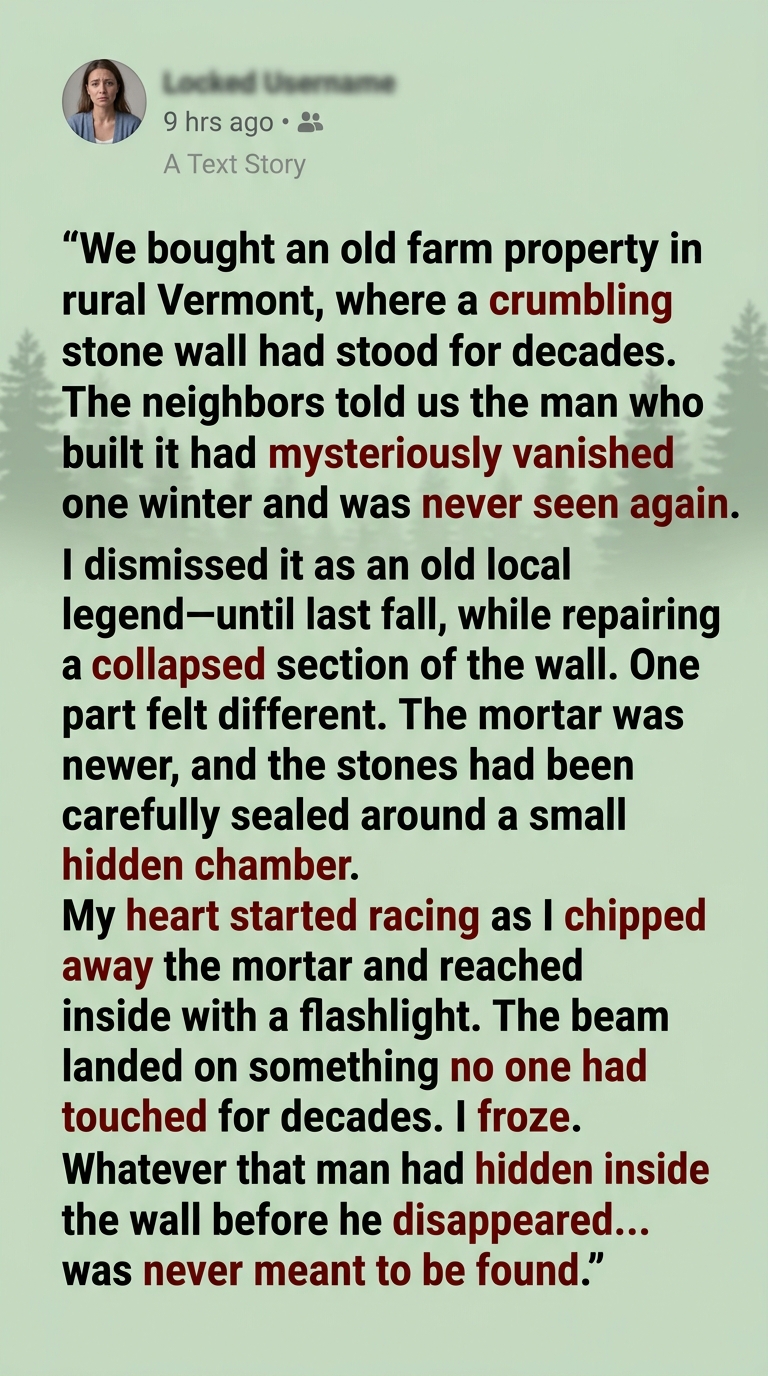
We bought an old farm property in rural Vermont, where a crumbling stone wall had stood for decades.
The neighbors told us the man who built it had mysteriously vanished one winter and was never seen again.
I dismissed it as an old local legend—until last fall, while repairing a collapsed section of the wall.
One part felt different.
The mortar was newer, and the stones had been carefully sealed around a small hidden chamber.
My heart started racing as I chipped away the mortar and reached inside with a flashlight.
The beam landed on something no one had touched for decades.
I froze.
Whatever that man had hidden inside the wall before he disappeared… was never meant to be found.
At first, I thought I was looking at an old wooden box.
It was wrapped in oilcloth and wedged tightly between two stones.
I pulled it free.
The box was surprisingly heavy.
My wife, Emma, came outside when she heard me calling her.
“What is it?”
“I don’t know.”
We carried it into the farmhouse.
The lock had already rusted away, so I carefully lifted the lid.
Inside were dozens of photographs.
Black-and-white photographs.
Most showed the farm.
The barn.
The farmhouse.
The stone wall.
But then I noticed something strange.
Every photograph had been taken from somewhere outside the property.
As if someone had been watching the farm.
Some photographs showed my house in winter.
Others showed the previous owners standing in the yard.
One showed a family eating dinner through the kitchen window.
Emma stared at it.
“They were being watched.”
I nodded.
Then I found an envelope underneath the photographs.
On the front, written in faded ink, were four words:
IF YOU FIND THIS, RUN.
Emma immediately wanted to call the police.
I agreed.
But before we did, I noticed something else inside the box.
A small metal key.
And beneath it, a handwritten notebook.
The first pages were nothing but dates.
Then names.
Dozens of them.
Some were names of people who had owned the property over the years.
Others were completely unfamiliar.
Near the back of the notebook, I found the name of the man who supposedly disappeared.
Elias Mercer.
According to the neighbors, Elias had vanished in 1968.
But the final entry in his notebook was dated December 14, 1968.
It read:
They know I found it.
The next page said:
The wall isn’t keeping something out.
The page after that contained only one sentence.
It’s keeping something in.
That was when we heard a noise outside.
Three knocks.
Not on the front door.
On the stone wall.
Emma looked at me.
“Did you hear that?”
Three more knocks.
We called the police.
While we waited, I went outside with a flashlight.
The sound had stopped.
But when I reached the wall, I noticed something I hadn’t seen earlier.
Behind the collapsed section was another layer of stones.
And underneath them was a narrow wooden door.
The key from the box fit the lock.
I stood there staring at it.
Emma grabbed my arm.
“Don’t open it.”
For once, I listened.
The police arrived twenty minutes later.
An officer named Harris examined the wall and immediately called for another unit.
When they carefully removed the remaining stones, they discovered a narrow underground passage.
It led beneath the property.
Inside were rusted tools, empty food cans, old clothing, and several wooden crates.
But there was something else.
A second box.
This one contained government documents from the 1960s.
And one photograph.
The photograph showed Elias Mercer standing beside three men.
One of them was wearing a military uniform.
Another was holding a rifle.
The third man was someone I recognized.
I stared at the picture.
It was the man who had sold us the farm.
I called him immediately.
He answered on the fourth ring.
“Hello?”
“Did you know Elias Mercer?”
Silence.
Then he hung up.
The police found him the next morning.
And what he eventually told us changed everything.
Elias had not simply disappeared.
He had discovered that the property had been used decades earlier to secretly store stolen government equipment and documents.
Several men involved had planned to retrieve everything before authorities could discover it.
Elias found the hidden chamber and threatened to expose them.
So they frightened him into silence.
Then, one winter night, he disappeared.
But Elias had anticipated what might happen.
Before leaving, he hid evidence inside the stone wall.
The photographs.
The notebook.
The documents.
Everything.
He had hoped someone would eventually find it.
But nobody did.
For more than fifty years.
The man who sold us the farm had inherited the property from his grandfather—one of the men connected to Elias.
He claimed he never knew the full story.
The investigation continued for months.
Then, one afternoon, I received a call from Officer Harris.
“We found something else.”
“What?”
“Human remains.”
They had discovered a shallow grave several hundred yards beyond the property line.
The remains were identified as Elias Mercer.
He had been missing for fifty-six years.
The case was reopened.
Several names from the notebook were traced to descendants of the men involved.
Most were elderly.
Some had already died.
But the evidence finally gave Elias’s family something they had been denied for generations.
The truth.
Months later, we repaired the stone wall.
But we didn’t rebuild it exactly as it had been.
We left one small section open and placed a bronze plaque nearby.
It read:
ELIAS MERCER — HE WAS NOT FORGOTTEN.
We never learned exactly why Elias chose the wall.
Maybe he knew someone would eventually repair it.
Maybe he knew the stones would survive longer than people.
Or maybe he simply believed that secrets could only stay buried for so long.
But there’s one thing I still think about.
The final photograph in the box.
I had assumed it was just another picture of the farm.
It wasn’t.
It showed Elias standing beside the stone wall.
The photograph had been taken shortly before he disappeared.
And written on the back were the words:
“If they find me, the wall will remember.”
Now, whenever I walk past that wall, I can’t help wondering how many people walked beside it over the decades without ever realizing what was hidden inside.
A missing man.
A buried crime.
And a secret that waited more than half a century for someone to finally uncover it.
We thought we had bought an old farmhouse.
We didn’t realize we had bought the place where a forgotten man had hidden the last evidence of his life.
And somehow, after all those years…
we were the ones who finally found it.