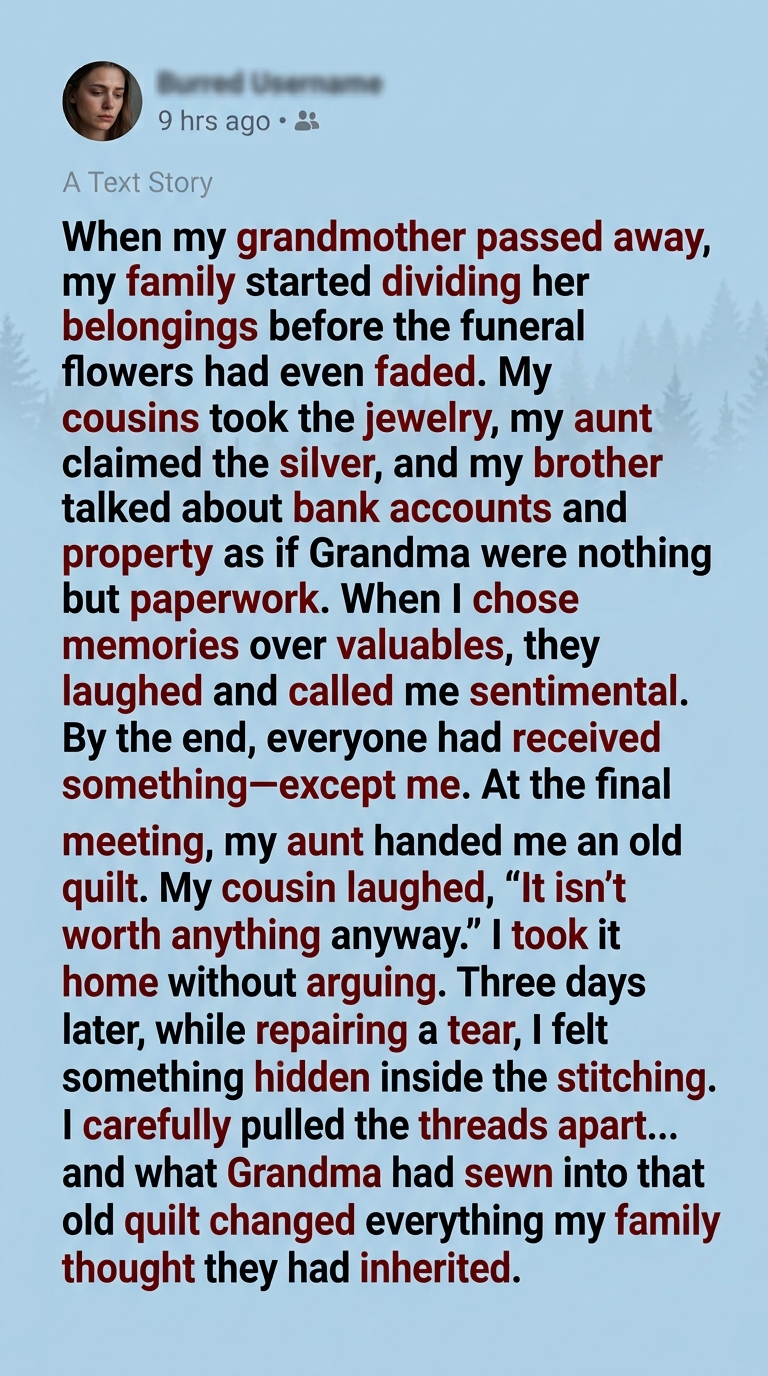
“When my grandmother passed away, my family started dividing her belongings before the funeral flowers had even faded.
My cousins took the jewelry, my aunt claimed the silver, and my brother talked about bank accounts and property as if Grandma were nothing but paperwork.
When I chose memories over valuables, they laughed and called me sentimental.
By the end, everyone had received something—except me.
At the final meeting, my aunt handed me an old quilt.
My cousin laughed.
“It isn’t worth anything anyway.”
I took it home without arguing.
Three days later, while repairing a tear, I felt something hidden inside the stitching.
I carefully pulled the threads apart…
And what Grandma had sewn into that old quilt changed everything my family thought they had inherited.
It was an envelope.
Small.
Yellowed.
And my name was written across the front in my grandmother’s handwriting.
I sat at the kitchen table for several minutes before opening it.
Inside was a single letter.
“My dear Emma,
If you are reading this, then everyone has already taken what they believe matters.”
I stopped.
My heart began beating faster.
“Don’t be angry with them. They have always measured wealth by what they can hold in their hands.”
I looked at the quilt.
Then continued reading.
“But you always measured wealth differently.”
There was something else inside the envelope.
A key.
And a handwritten address.
I recognized the address immediately.
It was the little cottage Grandma had owned on the edge of town.
My aunt had told everyone it was being sold because it wasn’t worth keeping.
Apparently, that wasn’t true.
The letter continued.
“The cottage isn’t empty.”
“What is inside belongs to you.”
I drove there the next morning.
The house looked exactly as I remembered it.
The faded blue door.
The crooked mailbox.
The garden where Grandma used to grow roses.
I unlocked the door.
Everything was still there.
Her books.
Her sewing machine.
Her photographs.
Her old wooden desk.
Then I noticed something strange.
The key from the envelope didn’t fit any door.
I searched the house.
Nothing.
Then I remembered something Grandma used to say whenever I asked why she kept the quilt.
“Some things are warmer than they look.”
I returned home and examined the quilt again.
This time, I noticed tiny embroidered flowers running along one edge.
There were twelve of them.
One for every year I had spent summers with Grandma.
I looked at the pattern.
The flowers weren’t random.
They formed letters.
A.
B.
I stared at them.
It was a combination.
I drove back to the cottage and found an old wooden cabinet beneath the stairs.
Inside was a small metal safe.
The key fit.
My hands shook as I opened it.
There were documents inside.
Property records.
Bank statements.
Investment certificates.
And a folder marked:
EMMA — FINAL INSTRUCTIONS.
I sat on the floor.
Grandma had apparently spent decades quietly investing money from the small sewing business she ran after my grandfather died.
The account had grown substantially.
But that wasn’t the biggest surprise.
The cottage wasn’t the only property she owned.
There were two additional properties.
And a substantial investment account.
My family had assumed Grandma’s estate consisted of her house, jewelry, and bank accounts.
They had never known about the private trust.
And according to the documents, I was the sole beneficiary.
I kept reading.
Grandma had deliberately excluded the properties and investments from the family discussions.
Not because she wanted to punish anyone.
Because she knew exactly what would happen.
Her letter explained why.
“I have watched people become different when they believe money is involved.”
“I wanted to see who would remember me and who would remember my possessions.”
My eyes filled with tears.
She had known.
She had known exactly what my family would do.
The jewelry.
The silver.
The furniture.
The arguments.
The rushing.
She had expected all of it.
But then I found the final page.
“Emma, you were the only one who never asked me what you would inherit.”
“You asked me to tell you stories.”
“You asked about Grandpa.”
“You helped me plant roses.”
“You sat beside me when my hands became too weak to sew.”
“That is why I am leaving you the things that cannot be divided.”
I cried.
Not because I had inherited money.
Because Grandma had noticed.
She had noticed every little thing I thought nobody remembered.
There was one final document.
A letter addressed to the entire family.
I wasn’t required to deliver it.
But I did.
Two weeks later, I invited everyone to my house.
My aunt arrived first.
My cousins followed.
My brother sat down with the same serious expression he’d worn during the estate meeting.
I placed the letter on the table.
“Grandma left this for all of you.”
My aunt opened it.
Her face changed as she read.
Then she handed it to my cousin.
Nobody spoke for several minutes.
Grandma’s letter didn’t criticize them.
It didn’t insult them.
It simply said:
“I hope you enjoy the things you chose.”
Then:
“I hope they remind you of me.”
And finally:
“But please remember that I was more than the things I owned.”
My brother looked down.
My cousin started crying.
My aunt was the first to speak.
“She knew.”
I nodded.
“She knew everything.”
My aunt looked at the quilt.
“Why did she give you this?”
I smiled.
“Because she knew you’d think it was worthless.”
Nobody laughed this time.
Months later, I sold one of the properties Grandma had left me.
I used part of the money to restore the cottage.
Then I turned it into something Grandma would have loved.
A small community sewing and craft center.
Anyone could come.
Children.
Retirees.
People who couldn’t afford supplies.
There was a long wooden table where Grandma’s sewing machine sat beneath a photograph of her.
And hanging on the wall was the old quilt.
I never repaired the tear completely.
I left the stitching where I had opened it.
Because that small tear was what led me to the truth.
One afternoon, my aunt visited.
She stood in front of the quilt for a long time.
“I used to think this was worthless,” she said.
“So did everyone.”
She smiled sadly.
“She knew exactly what she was doing.”
I nodded.
Then my aunt touched the quilt gently.
“Can I ask you something?”
“Sure.”
“Why didn’t she give you the jewelry too?”
I smiled.
“She knew I didn’t want it.”
My aunt laughed quietly.
“She really did know you.”
“Yes.”
And that was the greatest inheritance of all.
My family had fought over everything they could see.
But Grandma had left me something they couldn’t divide.
Her stories.
Her trust.
Her memories.
And a quilt that everyone thought was worthless.
Years later, people still ask why I never sold it.
I always give them the same answer.
Because some things are valuable precisely because you can’t put a price on them.
Grandma didn’t hide a fortune inside that quilt.
She hid a message.
She wanted to remind me that when everyone else was measuring her life by what she left behind…
I was the one person who remembered the woman who had lived it.
And in the end, that was the inheritance she cared about most.