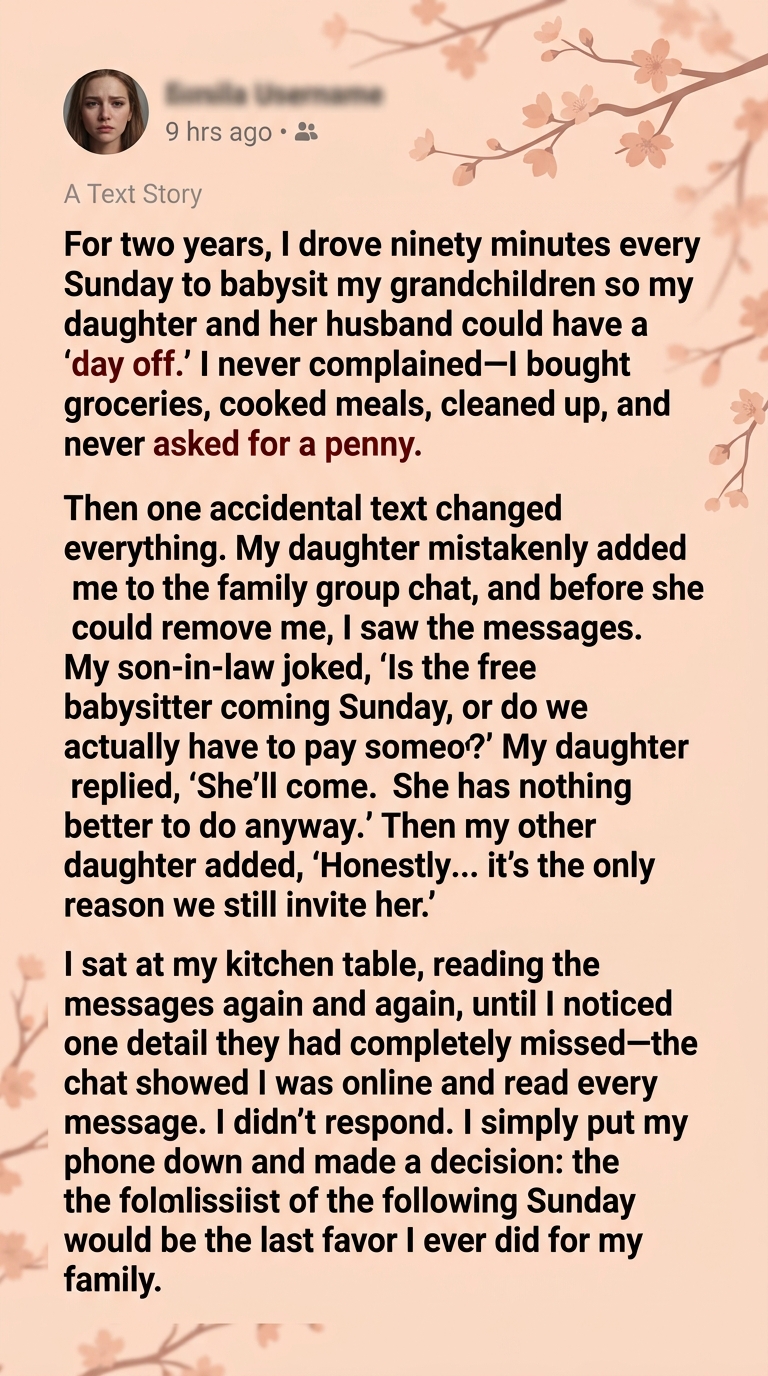
For two years, I drove ninety minutes every Sunday to babysit my grandchildren so my daughter and her husband could have a “day off.”
I never complained.
I bought groceries on the way.
I cooked meals.
I cleaned their kitchen.
I folded laundry.
I helped the children with homework.
Sometimes I even stayed late because they were “running behind.”
And I never asked for a penny.
I did it because they were my grandchildren.
Because I loved them.
Because I remembered what it was like to be overwhelmed as a young parent, and I wanted my daughter to have the support I never had.
Every Sunday morning, I woke up before sunrise, packed a small bag, grabbed my keys, and made the ninety-minute drive.
For two years.
Rain.
Heat.
Traffic.
It didn’t matter.
Then one Sunday, everything changed.
My daughter, Emily, had created a family group chat for planning her son’s birthday party.
Apparently, she accidentally added me.
My phone buzzed while I was sitting at my kitchen table drinking coffee.
I opened the message.
Emily added Mom.
A few seconds later, another message appeared.
Jason:
“Is the free babysitter coming Sunday, or do we actually have to pay someone?”
I stared at the screen.
My son-in-law.
Jason.
I waited for Emily to defend me.
Instead, she replied:
Emily:
“She’ll come. She has nothing better to do anyway.”
My stomach tightened.
Then my younger daughter, Rachel, joined the conversation.
Rachel:
“Honestly… it’s the only reason we still invite her.”
I read the messages once.
Then again.
Then a third time.
My hands went cold.
I looked at the little indicator beneath the messages.
Seen by Mom.
They had missed one detail.
The chat showed I was online.
And they knew I’d read everything.
For almost five minutes, nobody typed.
Then Jason sent:
Jason:
“Uh…”
Emily immediately replied:
Emily:
“Mom, I think you were added by accident.”
I didn’t respond.
Another message appeared.
Emily:
“Mom?”
Then:
Rachel:
“Maybe don’t say anything.”
I turned my phone face down.
I sat there in silence.
The coffee beside me went cold.
I thought about the thousands of dollars I’d spent on groceries.
The gas.
The birthday presents.
The clothes.
The school supplies.
The countless Sundays I’d given away.
But what hurt wasn’t the money.
It was realizing that every time I’d thought I was being invited because they wanted me there, they had apparently been calculating what I could do for them.
I didn’t sleep much that night.
The next morning, Emily called.
I watched her name appear on my screen.
I didn’t answer.
She called again.
Then again.
Finally, I picked up.
“Mom…”
“Good morning.”
“Are you mad?”
I almost laughed.
“No.”
There was silence.
“You saw the messages.”
“Yes.”
“Mom, I swear, it wasn’t—”
“Don’t explain.”
“But Jason was joking.”
“I know.”
“And Rachel didn’t mean—”
“I know.”
“You know how families joke.”
“Yes.”
She went quiet.
Then she said:
“Are you still coming Sunday?”
That question hurt more than anything else.
Not Are you okay?
Not I’m sorry.
Not Did we hurt you?
Just:
Are you still coming Sunday?
“No,” I said.
“What?”
“I won’t be coming Sunday.”
“Mom, we already made plans.”
“You’ll need to make different ones.”
She started crying.
I didn’t.
“Mom, please.”
“I drove ninety minutes every week because I loved you. Not because I had nothing better to do.”
Then I hung up.
Sunday came.
For the first time in two years, I stayed home.
At 10:15 that morning, Emily texted:
Are you coming?
I didn’t answer.
At 10:32:
Mom, the kids are asking where you are.
At 10:47:
Jason says you’re being ridiculous.
At 11:03:
Please call me.
I put the phone away.
Then I did something I’d forgotten how to do.
I spent Sunday doing exactly what I wanted.
I slept late.
Made pancakes.
Read a book.
Went for a walk.
And for the first time in years, I realized I wasn’t exhausted.
But the story didn’t end there.
The following Wednesday, there was a knock on my door.
It was my grandson, Noah.
Emily stood behind him.
Noah was holding a small backpack.
“Grandma,” he said.
I hugged him.
“I missed you.”
“I missed you too.”
Emily looked embarrassed.
“Can we talk?”
I let them inside.
She sat at my kitchen table—the same table where I’d read those messages.
She looked around.
Then she started crying.
“I didn’t realize how bad it sounded.”
I said nothing.
“I thought… I thought you didn’t mind.”
“I didn’t mind helping.”
“What’s the difference?”
“The difference is that you stopped seeing me as your mother.”
She looked down.
“You started seeing me as childcare.”
She covered her face.
“I was overwhelmed.”
“I know.”
“I was tired.”
“I know.”
“I needed help.”
“I know.”
“Then why couldn’t you just tell me?”
I looked at her.
“Because I shouldn’t have needed to explain that I was a person.”
She cried harder.
Then she said something I wasn’t expecting.
“Rachel told me she didn’t want you around.”
I frowned.
“What?”
“She said you were always criticizing her.”
I shook my head.
“I haven’t spoken to Rachel in weeks.”
Emily looked confused.
Then she pulled out her phone.
“Wait.”
She showed me a message.
It was from Rachel.
I don’t know why Mom keeps trying to insert herself into everything.
I stared at it.
There were more.
Apparently, Rachel had been telling Emily for months that I was “controlling,” “needy,” and “desperate to be included.”
None of it was true.
But then I noticed something.
Emily had sent messages too.
Messages I hadn’t seen.
Things about me being “convenient.”
About how I would always come because I “needed the family more than they needed her.”
That hurt.
But instead of fighting, I told Emily something she didn’t expect.
“I don’t want an apology today.”
She looked up.
“What do you want?”
“I want distance.”
“For how long?”
“I don’t know.”
She nodded slowly.
“And the kids?”
“You can bring them to me when you want. But I won’t be your weekly babysitter.”
She agreed.
Then she stood.
Before leaving, she turned around.
“Mom?”
“Yes?”
“Were you really happy doing all that?”
I thought about it.
“Yes.”
She looked surprised.
“Even though we treated you like that?”
“I was happy when I believed I was helping my family.”
She lowered her eyes.
“And now?”
“Now I want to help myself.”
Three months passed.
I didn’t babysit.
I didn’t chase anyone.
I didn’t send angry messages.
I simply stopped volunteering for people who treated my time like it was worthless.
Something unexpected happened.
My grandchildren started calling me.
Not because their parents needed childcare.
Because they missed me.
Noah called one afternoon just to tell me about a science project.
My granddaughter Lily called to show me a drawing.
They didn’t ask me for anything.
They just wanted to talk.
Eventually, Emily began changing too.
She started taking responsibility for her own schedule.
Jason hired a babysitter.
Rachel apologized.
Not immediately.
But eventually.
One evening, Rachel showed up at my house.
She stood on the porch holding a grocery bag.
“I brought you something.”
I opened it.
Inside were groceries.
I looked at her.
“What is this?”
She shrugged.
“You always used to bring groceries to us.”
She swallowed.
“I thought maybe it was my turn.”
I let her in.
We sat together for almost two hours.
She admitted she’d been jealous.
She’d convinced herself that Emily’s children loved me more.
So instead of dealing with her feelings, she’d turned me into the problem.
“I was awful,” she said.
“Yes.”
She nodded.
“I know.”
That honesty mattered.
A year after the group chat incident, Emily invited everyone to dinner.
This time, there was one important difference.
She didn’t ask me to babysit.
She asked me to come because she wanted me there.
When I arrived, Emily hugged me.
“I’m glad you’re here.”
I smiled.
“Me too.”
Dinner was different.
Nobody assumed I’d clean.
Nobody handed me a list of things to do.
Jason actually stood up and cleared my plate.
“Let me get that.”
I laughed.
“You don’t have to.”
“I know.”
He paused.
“I want to.”
After dinner, Noah sat beside me.
“Grandma?”
“Yes?”
“Are you coming next Sunday?”
I looked at Emily.
She smiled.
Then I looked back at him.
“Maybe.”
He frowned.
“Why maybe?”
“Because Grandma has plans now.”
“What plans?”
I smiled.
“Whatever I decide to do.”
He thought about it.
Then nodded seriously.
“Okay.”
And somehow, that little conversation meant more to me than any apology.
Because I had finally learned something I should have understood years earlier.
Being needed is not the same as being loved.
Being useful is not the same as being valued.
And family should never make you feel like your place at the table depends on what you can do for them.
That Sunday had been the last favor I ever did for my family.
But it wasn’t the end of my family.
It was the beginning of a healthier one.
I still drive to see my grandchildren.
Sometimes.
But now, when I arrive, nobody expects me to work.
They expect me to visit.
And there’s a difference.
A very important difference.
Because the last thing I learned from that accidental text wasn’t that my family didn’t love me.
It was that I’d spent years teaching them that my love came without limits.
That Sunday, I finally taught them something else.
My love is unconditional.
My time isn’t.