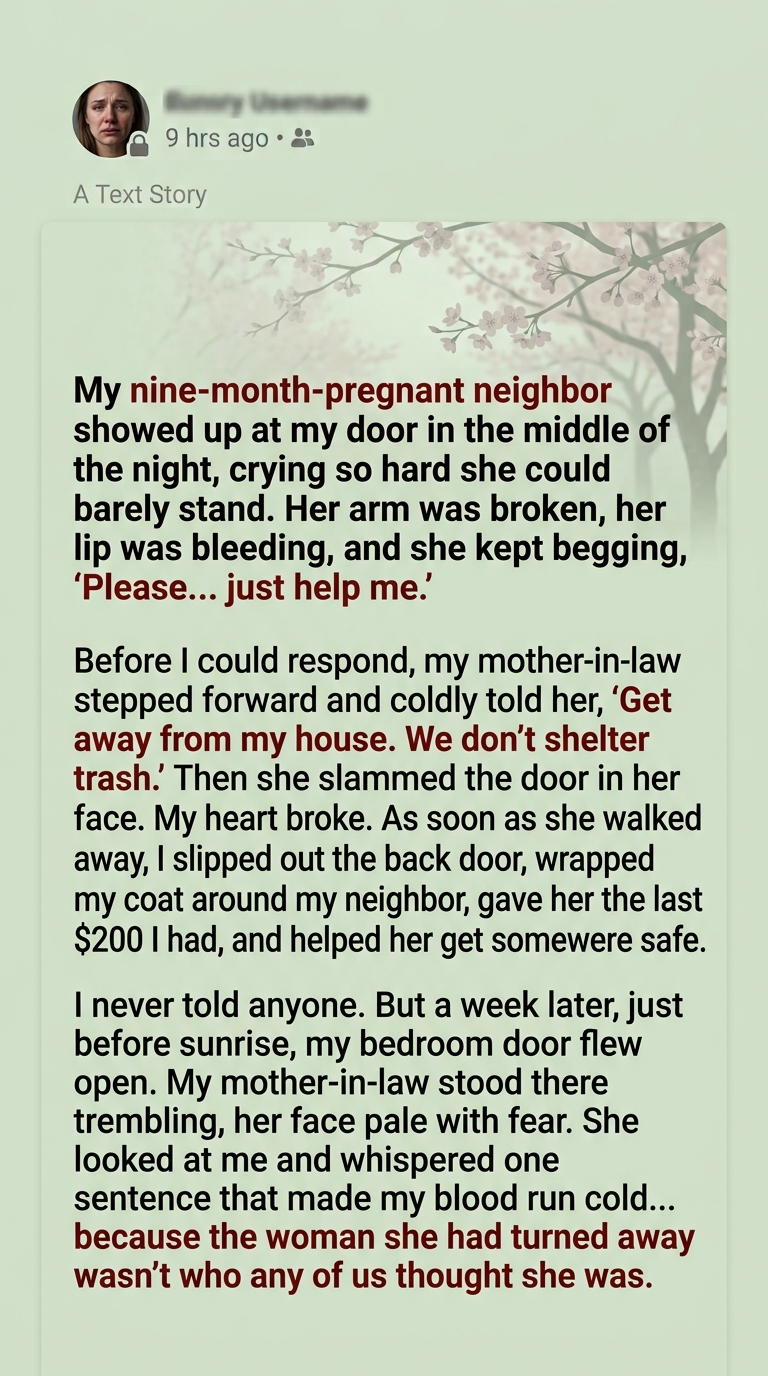
My nine-month-pregnant neighbor showed up at my door in the middle of the night, crying so hard she could barely stand.
Her arm was broken.
Her lip was bleeding.
One side of her face was swollen.
She was barefoot.
And she kept repeating the same words.
“Please… just help me.”
I opened the door wider.
“Sarah?”
She collapsed against the frame.
“Please.”
Before I could reach for her, my mother-in-law appeared behind me.
She looked at Sarah.
Then at the blood on her face.
Then at her swollen belly.
Instead of helping, she crossed her arms.
“Get away from my house.”
Sarah stared at her.
“I just need somewhere safe.”
My mother-in-law’s expression hardened.
“We don’t shelter trash.”
Sarah flinched.
I couldn’t believe what I’d heard.
“Mom…”
“Don’t get involved.”
Sarah’s eyes filled with tears.
“Please.”
My mother-in-law slammed the door.
I stood there frozen.
For several seconds, neither of us moved.
Then I heard Sarah crying outside.
I couldn’t leave her there.
I waited until my mother-in-law went upstairs.
Then I slipped out the back door.
Sarah was sitting against the fence, holding her stomach.
“Come with me.”
“Where?”
“Somewhere safe.”
I wrapped my coat around her.
I had only $200 in my wallet.
I gave her all of it.
“Take this.”
She stared at the money.
“I can’t.”
“Yes, you can.”
I helped her into my car.
We drove to a women’s shelter across town.
I didn’t tell my husband.
I didn’t tell my mother-in-law.
I didn’t tell anyone.
The shelter took Sarah in.
Before she went inside, she grabbed my hand.
“I’ll never forget you.”
I nodded.
“Just stay safe.”
Then she disappeared through the doors.
I thought that was the end of it.
I was wrong.
Exactly one week later, just before sunrise, my bedroom door flew open.
I woke up terrified.
My mother-in-law stood there.
She was trembling.
Her face was pale.
She closed the door behind her.
Then she whispered:
“That woman you helped… she isn’t who we thought she was.”
I sat up.
“What are you talking about?”
My mother-in-law looked toward the hallway.
“She’s alive.”
I frowned.
“Who?”
“My daughter.”
I stared at her.
“You don’t have a daughter.”
She sat on the edge of the bed.
“I did.”
Her voice broke.
“She died twenty-seven years ago.”
I didn’t understand.
“What does Sarah have to do with her?”
My mother-in-law looked at me.
“Everything.”
She told me a story I’d never heard.
Twenty-seven years earlier, she had given birth to a baby girl.
The baby had been diagnosed with a serious heart condition.
Doctors said she might not survive.
My mother-in-law was young and terrified.
Her husband convinced her that the baby should be placed for adoption because they couldn’t afford the treatment.
She signed the papers.
The baby survived.
But my mother-in-law never saw her again.
For years, she searched.
Then, eventually, she stopped.
“Why didn’t you tell anyone?”
“Because I was ashamed.”
I stared at her.
“And Sarah?”
My mother-in-law began crying.
“Sarah is my daughter.”
I couldn’t speak.
“But how do you know?”
She pulled a photograph from her robe.
It was old.
Faded.
A baby wrapped in a white blanket.
On the back was a handwritten note.
Sarah Marie — born May 14.
My mother-in-law had kept it for twenty-seven years.
“She had the same birthmark,” she whispered.
“What birthmark?”
“On her shoulder.”
I remembered.
When I had wrapped my coat around Sarah, I’d seen a small crescent-shaped birthmark near her collarbone.
My mother-in-law had recognized it when she saw Sarah at the door.
But instead of helping her, she’d rejected her.
Because she didn’t know.
Or maybe because she was too afraid to know.
I asked:
“Why are you telling me now?”
She looked terrified.
“Because Sarah called me.”
My heart stopped.
“What did she say?”
“She told me who she was.”
I stared at her.
“What else?”
My mother-in-law reached into her pocket.
She pulled out a hospital bracelet.
The name printed on it was:
Sarah Marie Carter.
Underneath it was a second line.
Emergency Contact: Evelyn Carter.
My mother-in-law’s name.
I couldn’t breathe.
“Where is she?”
“She had the baby.”
My heart jumped.
“When?”
“Last night.”
“Is she okay?”
“Yes.”
“And the baby?”
“She has a little girl.”
I started crying.
My mother-in-law looked at me.
“She asked for you.”
“Why?”
“She said you’re the only person who helped her.”
I couldn’t believe it.
We drove to the hospital together.
The entire ride was silent.
When we arrived, Sarah was sitting in a hospital bed.
Her arm was in a cast.
Her face was bruised.
But she was smiling.
And in her arms was a tiny baby.
She looked at me.
“You came.”
I walked toward her.
“Of course.”
Then she looked at my mother-in-law.
Neither woman spoke.
Finally, Sarah whispered:
“Mom?”
My mother-in-law broke down.
“Yes.”
Sarah started crying.
For a moment, I stepped away.
This was something they needed to face themselves.
My mother-in-law knelt beside the bed.
“I didn’t know it was you.”
Sarah looked at her.
“You called me trash.”
My mother-in-law closed her eyes.
“I know.”
“You didn’t even ask my name.”
“I know.”
“You looked at me like I wasn’t worth helping.”
Tears ran down my mother-in-law’s face.
“I was wrong.”
Sarah looked down at her baby.
“I spent my whole life wondering why my mother gave me away.”
My mother-in-law whispered:
“I was afraid.”
Sarah looked at her.
“Of what?”
“Of being poor.”
She shook her head.
“Of being a bad mother.”
Sarah’s voice was quiet.
“You were.”
My mother-in-law flinched.
“But…”
Sarah continued.
“You don’t get to pretend you weren’t.”
My mother-in-law nodded.
“I know.”
Then Sarah did something none of us expected.
She reached out her hand.
My mother-in-law took it.
Not because everything was forgiven.
It wasn’t.
But because the first step toward forgiveness sometimes begins with the truth.
The next few weeks were complicated.
Sarah’s husband was arrested.
The hospital helped her obtain a protective order.
The shelter helped her find permanent housing.
And my mother-in-law started going to therapy.
She wanted to rebuild the relationship she’d lost twenty-seven years earlier.
Sarah wasn’t ready to call her Mom all the time.
Sometimes she called her Evelyn.
Sometimes she didn’t call her anything.
My mother-in-law accepted that.
As for me, I continued visiting Sarah.
I brought groceries.
Baby clothes.
Diapers.
But one afternoon, Sarah stopped me.
“You already gave me enough.”
“What do you mean?”
She smiled.
“You gave me the thing I needed most.”
“What?”
“Someone believed me.”
I hugged her.
“You never deserved what happened to you.”
She nodded.
“I know that now.”
Months passed.
Sarah’s daughter grew healthy.
My mother-in-law became part of their lives slowly.
She attended doctor’s appointments.
Bought baby clothes.
Learned how to hold her granddaughter.
And every once in a while, she’d look at Sarah with tears in her eyes.
Not because she expected forgiveness.
Because she knew what she’d almost lost.
One evening, my mother-in-law came to my house.
She sat beside me.
“I owe you something.”
“What?”
“An apology.”
I smiled sadly.
“You already apologized.”
“No.”
She shook her head.
“I apologized to Sarah.”
She looked at me.
“I owe you one too.”
“For what?”
“For the person I was when she came to that door.”
I didn’t answer.
She continued.
“I thought I was protecting my family.”
“You weren’t.”
“I know.”
“You were protecting yourself.”
She nodded.
Then she said:
“If you hadn’t opened the back door…”
She couldn’t finish.
I understood.
Sarah might not have survived that night.
The baby might not have survived.
And my mother-in-law might never have discovered the daughter she had spent twenty-seven years mourning.
Sometimes I think about that night.
About the blood on Sarah’s face.
The fear in her eyes.
The $200 I gave her.
The door that slammed shut.
And the door I opened.
I used to think the most important decision I’d ever made was leaving that house through the back door.
But I was wrong.
The most important decision was refusing to believe that someone was worthless simply because another person said she was.
Sarah eventually rebuilt her life.
Her daughter grew up surrounded by people who loved her.
And my mother-in-law never again called anyone “trash.”
Years later, at Sarah’s daughter’s fifth birthday party, I watched my mother-in-law kneel beside her granddaughter.
Sarah stood nearby.
They were laughing.
My mother-in-law looked at me.
She smiled.
Then she whispered:
“Thank you.”
I shook my head.
“You found each other.”
She looked at Sarah.
“No.”
She looked back at me.
“You opened the door.”
And maybe that’s all any of us can do sometimes.
Open a door.
Offer a coat.
Give away the last $200.
Help someone reach safety.
Because we never know who is standing on the other side.
And sometimes, the person everyone tells us to turn away…
is the person whose life will change ours forever.