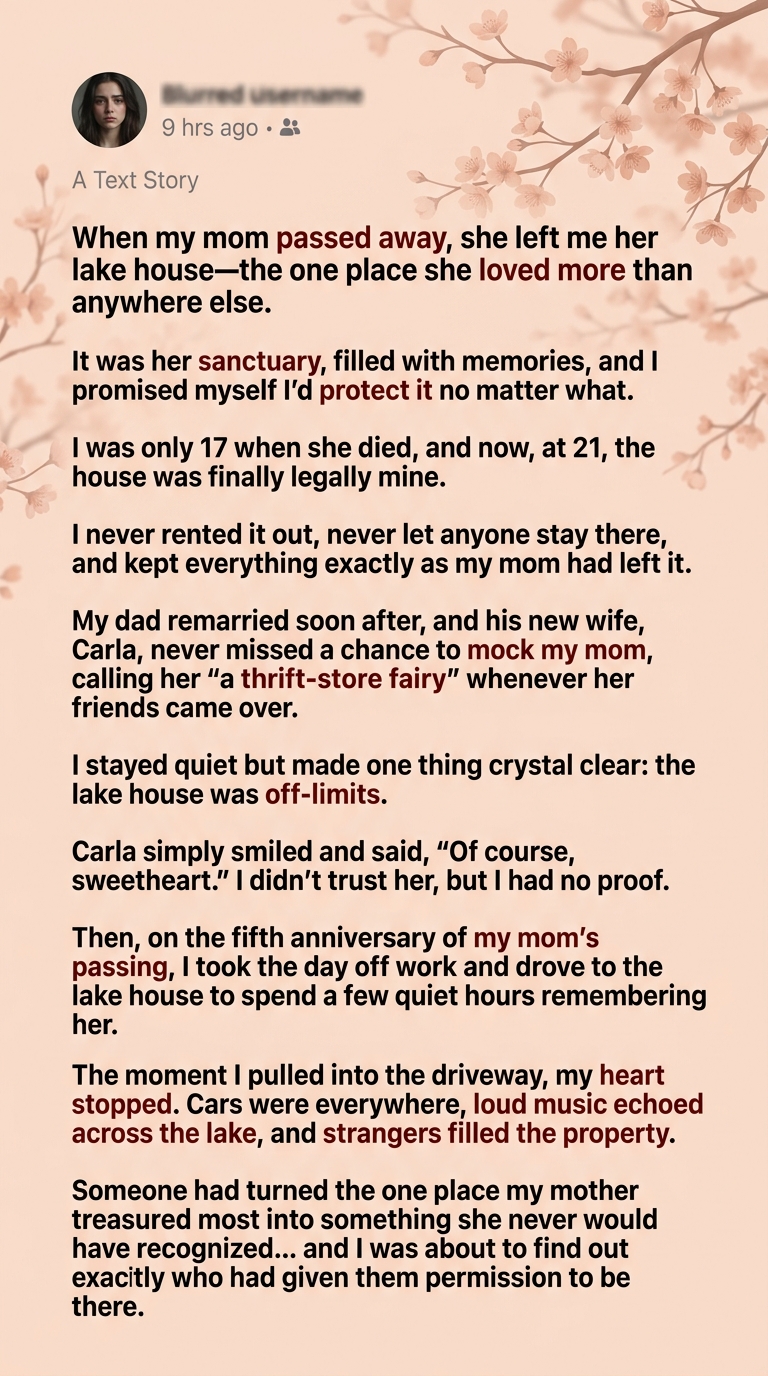
When my mom passed away, she left me her lake house—the one place she loved more than anywhere else.
It wasn’t a mansion.
It wasn’t particularly modern.
The kitchen cabinets were old.
The wooden floors creaked.
The roof needed repairs every few years.
But to my mom, it was perfect.
She used to say the lake house was the only place where she could hear herself think.
She and I spent every summer there.
We’d swim in the mornings, sit on the dock in the evenings, and stay up late talking about everything.
When I was seventeen, she died.
I wasn’t ready.
I don’t think anyone ever is.
After the funeral, my father told me something that changed everything.
“The lake house is yours.”
I stared at him.
“What?”
“Your mother left it to you.”
I didn’t understand why at first.
I was seventeen.
How could I own a house?
He explained that my mother had created a trust for me years earlier, and the property would legally transfer to me when I turned twenty-one.
Until then, my father would manage it.
I spent four years counting down to that birthday.
Not because I wanted to sell the house.
Not because I wanted to make money from it.
I simply wanted it to be mine.
When I turned twenty-one, the paperwork was completed.
The lake house officially belonged to me.
I never rented it.
I never listed it.
I barely let anyone stay there.
I kept my mother’s furniture exactly where she had left it.
Her books remained on the shelves.
Her favorite blue blanket stayed folded over the couch.
Her coffee mug sat in the kitchen cabinet.
Sometimes I would drive there alone and sit on the porch.
It felt like visiting her.
My father had remarried shortly after Mom died.
His new wife was named Carla.
At first, I tried to be polite.
But Carla made it difficult.
She constantly mocked my mother.
Whenever her friends came over, she’d tell stories about how “cheap” Mom had been.
Once, she held up one of Mom’s old sweaters and laughed.
“Your mother really was a thrift-store fairy, wasn’t she?”
Everyone laughed.
I didn’t.
I simply took the sweater from her hands.
“Don’t touch her things.”
Carla rolled her eyes.
“You’re so sensitive.”
Maybe I was.
But Mom was gone.
Her belongings were all I had left.
So I made one rule very clear.
“The lake house is off-limits.”
Carla smiled.
“Of course, sweetheart.”
I didn’t trust that smile.
But I had no proof she would ever go there.
For years, nothing happened.
Then came the fifth anniversary of Mom’s death.
I took the day off work.
I wanted to spend it at the lake house.
Alone.
I packed some food, flowers, and an old photograph of Mom.
Then I drove there.
I was thinking about her the entire way.
I imagined sitting on the dock.
Maybe I’d read one of her favorite books.
Maybe I’d cry.
Maybe I’d simply listen to the water.
But when I turned onto the road leading to the house, I saw something that made my hands tighten around the steering wheel.
Cars.
Everywhere.
Dozens of them.
Parked along the driveway.
On the grass.
Along the road.
I slowed down.
Music was blasting.
People were laughing.
Someone had set up a large tent beside the lake.
My heart stopped.
“What is this?”
I pulled into the driveway.
People were walking across my mother’s property carrying drinks.
A man was standing beside the dock grilling food.
Someone had put speakers on the porch.
I got out of my car.
“Excuse me!”
Nobody heard me.
I walked toward the house.
Then I saw a banner hanging across the porch.
CARLA’S SUMMER PARTY
I froze.
Carla.
My stepmother.
I walked inside.
The house looked completely different.
Furniture had been moved.
Mom’s photographs were stacked in a corner.
Her books had been shoved into boxes.
Someone had put a cooler on the dining table.
I felt sick.
Then I heard a familiar voice.
“There you are!”
I turned.
Carla walked toward me holding a glass.
She smiled.
“Oh, sweetheart. You came!”
I stared at her.
“What is this?”
She looked around.
“My party.”
“I can see that.”
“You should have told me you were coming.”
I laughed.
“You should have told me you were coming.”
She frowned.
“I live here now.”
My stomach dropped.
“No, you don’t.”
She smiled.
“Your father said it was fine.”
I pulled out my phone.
“I’ll call him.”
“You don’t need to.”
“Actually, I do.”
I called Dad.
He answered after several rings.
“Hey.”
“Dad, where are you?”
“At home.”
“Did you give Carla permission to use the lake house?”
Silence.
Then:
“What?”
“There’s a party here.”
Another silence.
“I’m sorry.”
I looked at Carla.
“She said you gave her permission.”
Dad’s voice became tense.
“I didn’t.”
I hung up.
Carla’s smile disappeared.
“Your father doesn’t understand.”
“What exactly doesn’t he understand?”
She crossed her arms.
“That you’re young. You don’t use the house. It makes no sense for it to sit empty.”
“It isn’t empty.”
She looked around.
“You haven’t been here in months.”
“That’s irrelevant.”
She lowered her voice.
“I thought family shared things.”
“This isn’t yours.”
She laughed.
“You’re acting like your mother.”
That sentence made me stop.
“What did you say?”
“You heard me.”
I stepped closer.
“You don’t get to use my mother’s name like that.”
She rolled her eyes.
“Your mother is gone.”
I stared at her.
“So are you.”
She blinked.
“What?”
“I want everyone out.”
She laughed.
“You can’t be serious.”
“I am.”
“There’s over fifty people here.”
“Then you should start telling them.”
She stared at me.
Then she walked away.
I pulled out my phone and called the property manager.
He confirmed what I already knew.
The house was legally mine.
Carla had no permission to use it.
Neither did my father.
Then I called the police.
I wasn’t trying to embarrass anyone.
I simply wanted my property back.
Within twenty minutes, officers arrived.
The party ended quickly.
People started leaving.
Carla was furious.
“This is ridiculous!”
One officer calmly explained that she had no right to remain on the property after being asked to leave by the legal owner.
She looked at me.
“You’re destroying this family.”
I shook my head.
“No, Carla.”
“You did that yourself.”
Once everyone left, I walked through the house.
It was a mess.
But then I noticed something strange.
The boxes containing my mother’s things weren’t random.
Someone had deliberately removed every photograph of her.
Every framed picture.
Every painting.
Even the small wooden plaque she kept beside the fireplace.
I opened one of the boxes.
Inside was a stack of my mother’s handwritten journals.
I had never seen them before.
I sat on the floor.
Then I opened the first one.
The first pages were ordinary.
Recipes.
Garden notes.
Little observations about the lake.
Then, several pages in, I found something that made my heart stop.
It was a letter addressed to me.
I recognized Mom’s handwriting immediately.
I couldn’t breathe.
The letter was dated six months before she died.
It began:
My darling, if you’re reading this, you’re old enough to understand why I made the choices I did.
I read slowly.
She explained that she had always worried my father would eventually try to sell the lake house.
She knew how much he disliked maintaining it.
She also knew that Carla had been pressuring him to sell it.
Mom had anticipated it.
That’s why she had placed the house into the trust.
But then I reached the last paragraph.
If someone ever tells you that the lake house is only a building, don’t believe them.
It’s the place where you learned to swim.
It’s where we watched the first snowfall from the porch.
It’s where you told me you wanted to become a doctor.
You don’t have to keep it forever.
But if you do keep it, make sure you keep it because it makes you happy—not because you are afraid to let me go.
I started crying.
I’d spent four years preserving every object because I was terrified that changing anything meant losing her.
But Mom had never asked me to freeze time.
She had only wanted the house to remain a place where I could be myself.
I called Dad.
He arrived an hour later.
He walked through the house and looked ashamed.
“I didn’t know she wrote that.”
“I didn’t either.”
He sat beside me.
“I’m sorry.”
“For what?”
“For letting Carla think she could do this.”
I looked at him.
“Why did you let her believe she could?”
He was quiet.
Then he admitted that Carla had been pressuring him for years.
She wanted to sell the lake house.
She believed the property could bring in a large amount of money.
When he refused, she started using it without telling him.
The party wasn’t the first time.
She had brought friends there before.
She had even started advertising it as a private vacation property to people she knew.
I stared at him.
“She was renting it out?”
“Not officially.”
“Dad.”
He lowered his head.
“She collected money from people.”
I felt sick.
My mother’s sanctuary had become a business.
And Carla had been profiting from it.
The legal situation took months to resolve.
Carla had to repay the money she had collected.
She was banned from the property.
My father and I eventually had a long conversation about boundaries.
Our relationship took time to repair.
But it did.
As for the lake house, I made one change.
I opened it.
Not as a rental.
Not as a party venue.
I started inviting families who needed a quiet place for a weekend.
Some were friends.
Some were people from the community.
I didn’t charge them.
I simply wanted the house to do what Mom had always wanted it to do.
Give people a place to breathe.
I kept her blue blanket.
Her coffee mug.
Her books.
But I moved the furniture around.
I painted the kitchen.
I replaced the old curtains.
And one summer evening, I sat on the dock with my father.
He looked at the house.
“Your mother would have liked what you did.”
I smiled.
“I think so too.”
He was quiet for a moment.
Then he said,
“She would have hated that party.”
I laughed.
“She definitely would have.”
We sat there watching the sun disappear behind the lake.
And for the first time in five years, I realized something.
Protecting my mother’s memory didn’t mean keeping her house untouched.
It meant making sure the love she put into that house survived.
Carla had tried to turn it into something she could profit from.
She had failed.
Because the lake house was never just a property.
It was my mother’s last gift to me.
And now, instead of being a museum to the woman I’d lost, it had become exactly what she had always wanted it to be.
A place where people felt safe.
A place where people could heal.
A place where love stayed long after the person who gave it was gone.
And every time I stand on that dock, I still feel like Mom is there.
Not because nothing changed.
But because I finally understood that she never wanted me to stop living.
She wanted me to keep going.