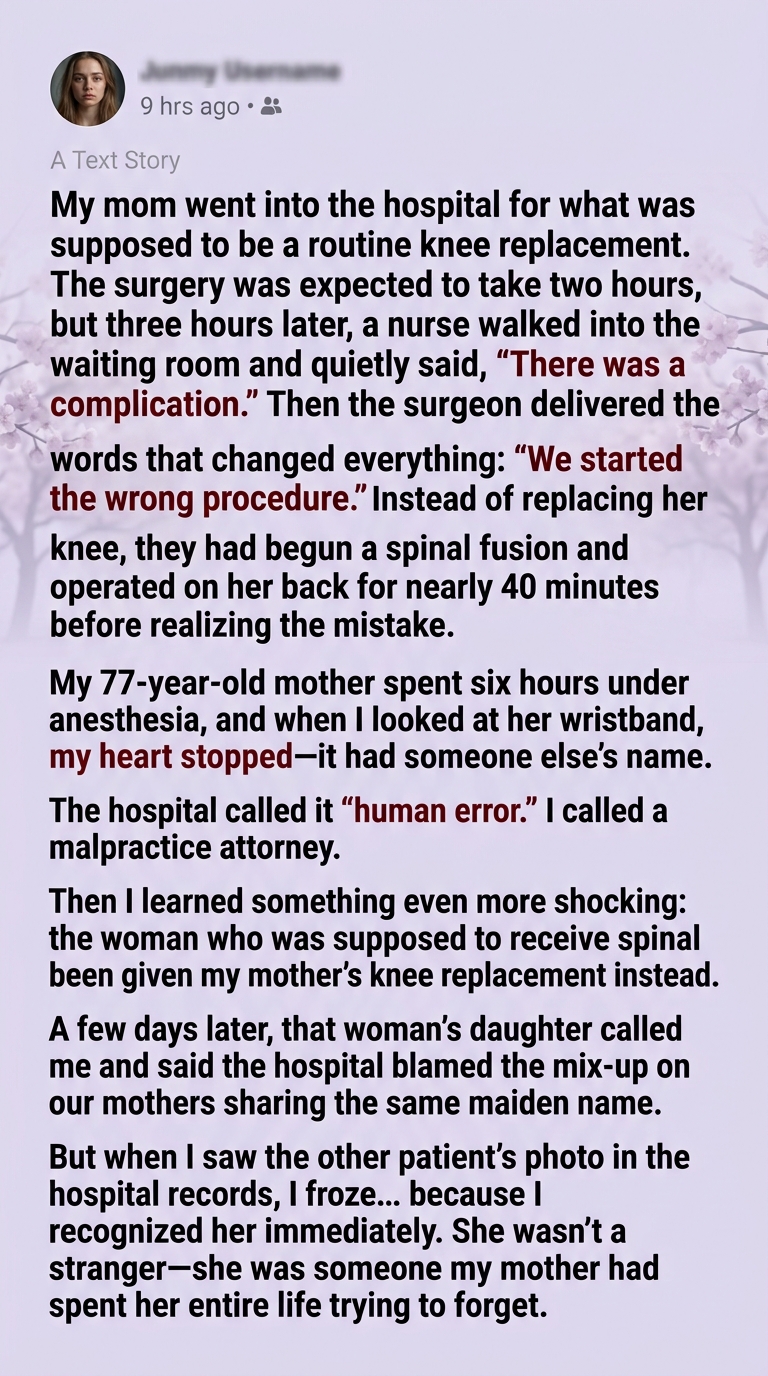
My mom went into the hospital for what was supposed to be a routine knee replacement.
She was seventy-seven.
She had been complaining about her knee for years, and finally, after months of physical therapy and consultations, her orthopedic surgeon recommended surgery.
“Two hours,” the surgeon told us.
Maybe a little longer if there were complications.
My mother laughed.
“Two hours? I can handle that.”
She was nervous, but she was also excited.
She had already picked out the shoes she wanted to wear once she could walk without pain.
The morning of the surgery, I drove her to the hospital.
She squeezed my hand before they wheeled her away.
“Don’t look so worried.”
“I can’t help it.”
“You’ll see me at lunch.”
I smiled.
“I’ll be here.”
She disappeared through the surgical doors.
I sat in the waiting room with a cup of coffee.
One hour passed.
Then two.
Then three.
I checked the clock.
Something felt wrong.
Finally, a nurse approached me.
She looked nervous.
“Are you Mrs. Carter’s daughter?”
“Yes.”
She sat beside me.
“There was a complication.”
My stomach tightened.
“What kind of complication?”
Before she could answer, the surgeon came into the waiting room.
His face was pale.
He closed the door behind him.
“I need to explain something.”
“Is my mother okay?”
“She is stable.”
“Then what happened?”
He hesitated.
“We started the wrong procedure.”
I stared at him.
“What?”
He swallowed.
“Your mother was scheduled for a knee replacement.”
“I know.”
“But the surgical team began a spinal fusion.”
For several seconds, I couldn’t process the words.
“You operated on her back?”
“Yes.”
“How?”
“We discovered the error approximately forty minutes into the procedure.”
My hands began shaking.
“You’re telling me my mother went into surgery for her knee and you operated on her spine?”
He nodded.
I stood.
“Why?”
He had no answer that made sense.
A patient mix-up.
A charting error.
A communication failure.
A series of mistakes.
They called it human error.
I called it impossible.
My mother had been under anesthesia for nearly six hours by the time the correct surgery was completed.
When I finally saw her, she was unconscious.
I stood beside her bed.
Then I noticed her wristband.
I stared at it.
The name was wrong.
The procedure code was wrong.
The patient identification number didn’t match her chart.
I immediately called the nurse.
“This isn’t my mother’s information.”
The nurse looked at the band.
Her face changed.
“I’ll get the supervisor.”
Within minutes, hospital administrators were everywhere.
They apologized.
They promised an investigation.
They told me my mother was being monitored.
But I couldn’t stop thinking about one thing.
If the wristband had someone else’s name…
Who had received my mother’s knee surgery?
I called a malpractice attorney that afternoon.
He told me not to sign anything.
“Document everything,” he said.
“Every name. Every time. Every conversation.”
So I did.
Three days later, I received a call from an unfamiliar number.
A woman introduced herself as Laura.
“My mother was in the same hospital.”
I immediately became cautious.
“Why are you calling me?”
“Because I think our mothers were part of the same mistake.”
My heart sank.
She explained that her mother had been scheduled for spinal surgery.
Instead, the hospital had performed a knee replacement.
I closed my eyes.
“So they gave my mother her surgery…”
“And gave my mother yours.”
Neither of us spoke.
Then Laura said,
“The hospital told us it happened because our mothers had the same maiden name.”
I frowned.
“What was your mother’s maiden name?”
She told me.
My stomach dropped.
It was the same as my mother’s.
But something about the explanation bothered me.
A shared surname could explain confusion.
It couldn’t explain why the identification bracelet was wrong.
It couldn’t explain why multiple verification steps had failed.
And it certainly couldn’t explain why the hospital had somehow switched two completely different procedures.
I asked Laura for her mother’s name.
She told me.
Then she sent me a photograph from the hospital records.
I opened it.
And froze.
I knew that woman.
Not personally.
But I’d seen her before.
In old photographs.
In my mother’s stories.
In one particular photograph hidden at the back of a drawer.
I called my mother.
She was still recovering in the hospital.
“Mom?”
Her voice was weak.
“What?”
“Do you know a woman named Eleanor?”
Silence.
A long silence.
Then my mother whispered,
“Where did you hear that name?”
I stared at the photograph.
“She was the other patient.”
Another silence.
“Mom, who is she?”
My mother began crying.
I’d never heard her cry like that.
“She’s the reason your father left.”
I sat down.
“What?”
My mother had never told me the entire story.
I knew my parents had separated briefly when I was young.
I knew there had been another woman.
But I had always believed it was simply an affair.
It wasn’t.
My mother finally told me the truth.
Forty-eight years earlier, she and Eleanor had worked at the same company.
They had been friends.
Very close friends.
Until my mother discovered that Eleanor had been stealing money from the company.
My mother reported it.
Eleanor was fired.
But before she left, she told my mother,
“You’ll regret this.”
A few months later, Eleanor began an affair with my father.
My mother divorced him.
He eventually married Eleanor.
The marriage lasted only a few years.
But the damage remained.
My mother never forgave either of them.
She refused to speak Eleanor’s name.
She refused to attend family events where Eleanor might appear.
She even moved to another town.
For nearly fifty years, she had avoided her.
And now they had ended up in the same operating room.
I couldn’t believe it.
“Mom, do you think this was intentional?”
She was silent.
“I don’t know.”
That answer stayed with me.
The hospital continued calling it an accident.
But my attorney requested the surgical records.
Then something strange appeared.
The two patients had not merely been assigned the wrong wristbands.
Their charts had been manually switched in the electronic system less than an hour before surgery.
Someone had accessed both records.
Someone had changed the procedure fields.
Someone had also changed the patient photographs.
The hospital’s internal investigation found that the changes had been made using the credentials of a surgical coordinator.
But the coordinator denied doing it.
Then security footage provided the missing piece.
A woman had entered the records office shortly before the changes were made.
She wasn’t hospital staff.
She was a visitor.
And when investigators identified her, we learned she was Eleanor’s adult daughter.
Laura.
I stared at the report.
My attorney looked at me.
“Did Laura know who your mother was?”
“I don’t know.”
I called her.
“Laura, I need to ask you something.”
“What?”
“Did you know our mothers knew each other?”
Silence.
Then she whispered,
“Yes.”
“How?”
“My mother told me.”
“When?”
“Years ago.”
My heart sank.
“Did you know my mother was the woman who reported your mother?”
“Yes.”
“Why didn’t you tell me?”
“Because I didn’t know what to think.”
I asked the question that mattered.
“Did you access the hospital records?”
She started crying.
“I did.”
“Why?”
“My mother was terrified of surgery.”
I listened.
“She had been telling me for months that the hospital couldn’t be trusted.”
“Why?”
“Because she thought your mother was somehow involved.”
I was stunned.
“She thought my mother was trying to hurt her?”
“Yes.”
“And you believed her?”
“I don’t know.”
Laura admitted she had entered the records office because she wanted to verify that her mother’s surgery was scheduled correctly.
She saw my mother’s name.
Then she saw the shared maiden name.
And she panicked.
She changed the records.
Not to hurt anyone, she claimed.
She thought she was correcting a mistake.
But she had made everything catastrophically worse.
She had switched the procedure information herself.
She never imagined the hospital staff would rely on the altered records without performing the required identity checks.
The hospital had failed.
Laura had interfered.
And two elderly women had undergone the wrong operations.
My attorney immediately notified investigators.
Laura eventually admitted what she had done.
The hospital’s own failures were also investigated.
Several employees were disciplined.
The hospital agreed to cover my mother’s additional medical treatment and rehabilitation.
My mother’s recovery took months.
The accidental spinal surgery caused complications that made her rehabilitation much harder.
But she eventually recovered enough to walk with a cane.
And surprisingly, she never asked about Eleanor again.
Until one afternoon.
I was sitting beside her in the rehabilitation center when she said,
“Did she survive?”
I knew exactly who she meant.
“Yes.”
My mother stared out the window.
“Good.”
I looked at her.
“That’s all?”
She nodded.
“I spent half my life hating that woman.”
She paused.
“I’m too old to carry that anymore.”
I took her hand.
“Do you want to see her?”
My mother thought about it.
“No.”
Then she smiled.
“But I’m glad she’s alive.”
A few weeks later, Laura contacted me.
She apologized.
Not just for what she had done.
For believing the worst about my mother without ever knowing the whole story.
I accepted the apology.
But I didn’t excuse what happened.
Two women had been harmed because too many people trusted assumptions instead of verifying facts.
My mother eventually had her knee replacement properly completed.
It worked.
She wore the shoes she’d bought months earlier.
The first time she walked without pain, she cried.
“So,” I joked, “was the surgery worth it?”
She laughed.
“Ask me again when I’m eighty.”
Then she looked at me.
“You know what I learned?”
“What?”
“Some people spend their whole lives trying to hurt each other.”
She squeezed my hand.
“And eventually, they discover they’ve wasted all that time.”
I thought about Eleanor.
About my mother.
About two women who had spent nearly fifty years carrying a wound that neither of them had been able to forget.
Then I thought about that hospital wristband.
A simple piece of plastic.
A wrong name.
A wrong procedure.
One mistake leading to another.
And I realized how easily a life can be changed when people stop paying attention to the truth.
My mother had gone into the hospital expecting to have her knee repaired.
Instead, she was forced to confront the one person she had spent half a century trying to forget.
And strangely enough, the worst mistake the hospital made became the thing that finally gave my mother a chance to let go.
Not because what happened was acceptable.
It wasn’t.
Not because forgiveness erased the past.
It didn’t.
But because after fifty years, my mother finally realized something.
She didn’t have to forget Eleanor.
She simply had to stop carrying her.