From the day she started, something about Emily felt off.
She was a new employee on my team.
Quiet.
Polite.
Always on time.
Always working.
And yet, something about her behavior made me uneasy.
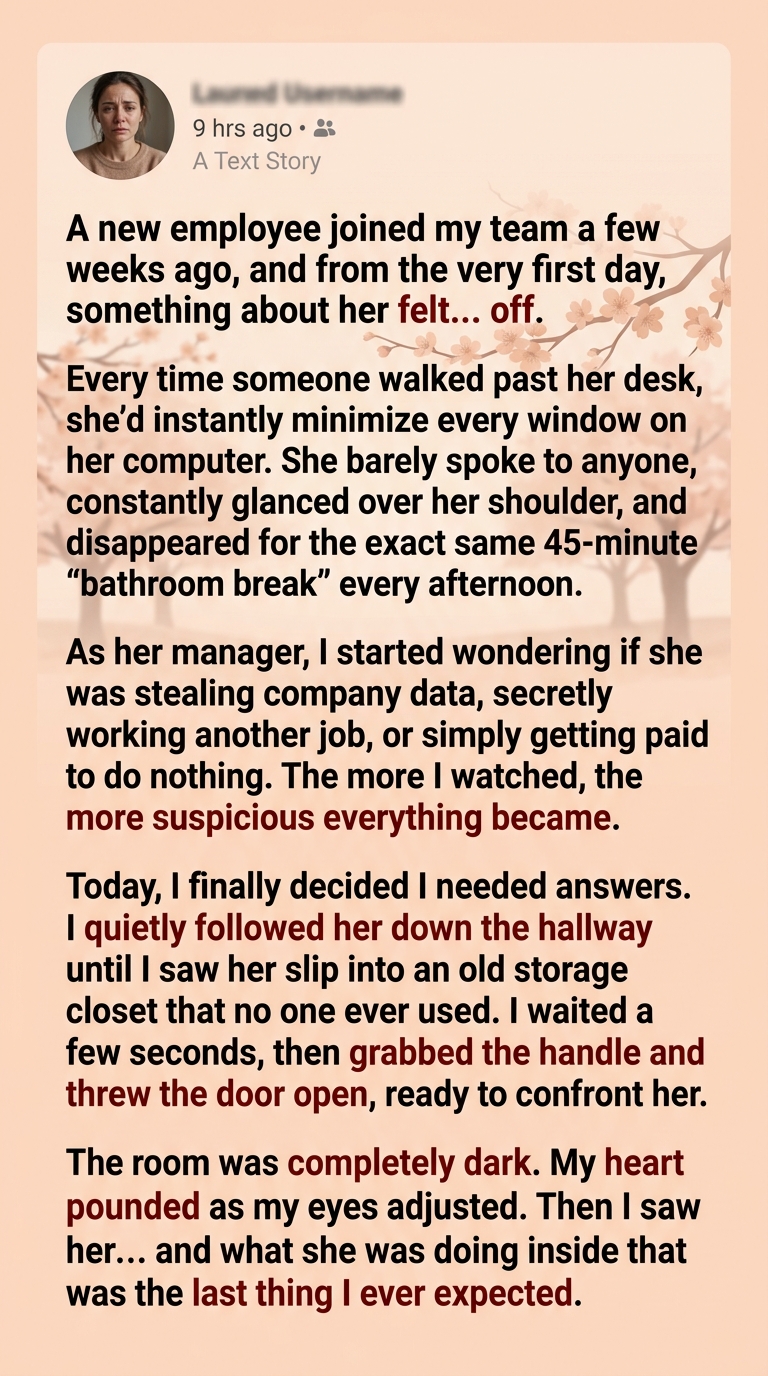
Whenever someone walked past her desk, she immediately minimized every window on her computer.
Every single time.
If I approached from behind, she would close whatever she was looking at.
If someone asked what she was doing, she’d smile and say,
“Just finishing up some work.”
But she never explained what kind.
She barely spoke during team meetings.
She ate lunch alone.
She never joined conversations.
And every afternoon at exactly 2:15, she’d stand up and say,
“I’ll be back.”
Then she’d disappear for exactly forty-five minutes.
Not forty-four.
Not forty-six.
Forty-five.
Every day.
At first, I didn’t care.
People have private lives.
Employees take breaks.
Not everyone wants to socialize at work.
But then I started noticing other things.
She constantly looked over her shoulder.
She checked the hallway before leaving her desk.
Sometimes she would stop typing the moment someone approached.
One afternoon, I walked behind her desk unexpectedly.
She slammed her laptop shut.
I stopped.
“What were you working on?”
She smiled nervously.
“Nothing important.”
That answer stayed in my mind.
As her manager, I had a responsibility to protect company information.
So I started wondering.
Was she stealing data?
Was she secretly working for a competitor?
Was she using company equipment for something she shouldn’t?
Or was she simply pretending to work?
The more I watched her, the more suspicious she seemed.
Then one Monday morning, our IT department sent me an unusual alert.
Someone had accessed an old internal folder from Emily’s workstation.
The folder contained archived employee records.
Nothing highly classified.
But it wasn’t something a new employee should have been opening.
I called IT.
“Can you tell me what was accessed?”
The technician frowned.
“The folder was opened for about thirty seconds.”
“Did she copy anything?”
“No.”
“Download anything?”
“No.”
“Then what happened?”
“She opened one file.”
“What file?”
He told me.
It was the personnel record of a former employee named Daniel Carter.
Daniel had left the company eight years earlier.
I barely remembered him.
“Why would Emily be looking at his file?”
The technician shrugged.
“I don’t know.”
I decided to ask her.
But before I could, she disappeared again at 2:15.
Forty-five minutes.
Every day.
I checked her work calendar.
Nothing.
I checked the employee directory.
Nothing.
I asked HR whether Emily had requested any special accommodation.
They said no.
My suspicion grew.
Finally, I decided I needed answers.
That afternoon, when Emily stood up at exactly 2:15, I waited thirty seconds.
Then I followed her.
She walked down a hallway most employees never used.
Past the old conference rooms.
Past the maintenance office.
Then she stopped in front of a storage closet.
She looked around.
Then unlocked the door.
She slipped inside.
I waited.
Five seconds.
Ten.
Fifteen.
I walked toward the door.
I grabbed the handle.
And pulled it open.
The room was completely dark.
“Emily?”
No answer.
I switched on the light.
Then froze.
Emily was sitting on the floor.
But she wasn’t using a laptop.
She wasn’t stealing files.
She wasn’t hiding company information.
She was sitting beside an old man.
He was lying on a folded blanket.
He looked exhausted.
And connected to his arm was a small medical device.
Emily jumped up.
“What are you doing here?”
I stared at her.
“Who is he?”
The old man looked at me.
Then Emily started crying.
“He’s my father.”
I didn’t know what to say.
“Your father?”
She nodded.
“He worked here.”
I looked at the old man again.
Then at the file name I had seen earlier.
“Daniel Carter?”
The old man closed his eyes.
“Yes.”
Everything suddenly made sense.
Daniel had been a longtime employee at the company.
Eight years earlier, he had been diagnosed with a serious illness.
He had lost his health insurance after leaving the company.
His medical expenses had destroyed his savings.
Emily had taken a job with our company partly because she needed the income to care for him.
But there was more.
Daniel had nowhere else to go.
He was too weak to live alone.
Emily couldn’t afford professional care.
So every afternoon, she brought him to the building.
She had found the unused storage room because it was the only quiet place where she could give him his medication and check on him.
“Why didn’t you tell HR?” I asked.
She looked down.
“Because I thought they’d fire me.”
“Why?”
“Because I knew bringing him here wasn’t allowed.”
I looked at the room.
There was a small cooler.
A bag of medication.
A bottle of water.
A blanket.
And a photograph.
Emily and her father.
She had been taking care of him alone.
I felt ashamed.
All the things I had interpreted as suspicious suddenly had innocent explanations.
The minimized windows?
She had been researching her father’s medication.
The glances over her shoulder?
She was making sure nobody saw him.
The forty-five-minute break?
His medication schedule.
The archived employee file?
She had been trying to find information about his old benefits.
And the constant secrecy?
She was terrified of losing the only job keeping them afloat.
I sat down.
“How long has this been going on?”
“Three weeks.”
“Since you started here?”
She nodded.
“I applied because I heard my father talk about this company for years.”
She smiled sadly.
“He always said it was the best place he ever worked.”
I looked at Daniel.
“Why didn’t he tell us he was sick?”
Daniel opened his eyes.
“Because I was embarrassed.”
I shook my head.
“You don’t have anything to be embarrassed about.”
He looked away.
Emily wiped her tears.
“I know this is against the rules.”
I sighed.
“It is.”
She nodded.
“I’ll leave.”
“No.”
She looked at me.
“I’m not going to fire you.”
She stared.
“What?”
“You should have told me.”
“I was scared.”
“I know.”
I looked at Daniel.
“Does he have somewhere safe to stay?”
She shook her head.
“No.”
I pulled out my phone.
I called HR.
Then our employee assistance program.
Then the company’s benefits coordinator.
Within a few hours, we had found a temporary medical housing program for Daniel.
The company also discovered that because Daniel had been a longtime employee, he qualified for a retirement benefit he had never claimed.
Emily had never known.
The next morning, HR helped her file the paperwork.
Two weeks later, Daniel moved into a small assisted-living facility near Emily’s apartment.
His medical care improved.
Emily stopped disappearing every afternoon.
She started eating lunch with the team.
She started talking during meetings.
And she stopped minimizing her screen whenever someone walked by.
One afternoon, she came into my office.
“I wanted to thank you.”
I smiled.
“You don’t have to.”
“Yes, I do.”
She paused.
“I thought you were going to fire me.”
“I almost believed the worst about you.”
She smiled.
“I know.”
I looked at her.
“Why didn’t you ever ask for help?”
She looked down.
“Because I’ve spent my whole life believing that asking for help means you’ve failed.”
I shook my head.
“No.”
She looked up.
“Asking for help means you’re human.”
She smiled.
Months later, Daniel came to the office for the first time.
He wanted to see the place where he had worked.
When he walked into the lobby, several older employees recognized him.
One of them shouted,
“Daniel Carter?”
Daniel smiled.
Within minutes, people were shaking his hand and telling stories about him.
He had apparently been one of the most respected employees in the department.
I watched Emily standing beside him.
She looked proud.
Before they left, Daniel came to me.
“Thank you.”
“For what?”
“For giving my daughter a chance.”
I smiled.
“She earned it.”
He shook his head.
“You didn’t know that when you opened the closet door.”
He was right.
I didn’t.
I thought I was about to uncover theft.
Instead, I discovered sacrifice.
I thought Emily was hiding something because she was guilty.
She was hiding something because she was afraid.
I thought the forty-five-minute break meant she didn’t care about her job.
It meant she was trying to keep her father alive.
And the most important lesson I learned wasn’t about employees.
It was about assumptions.
We see someone’s behavior.
We create a story.
Then we start treating our story as if it were the truth.
Emily taught me to pause before judging.
Because sometimes the person who looks suspicious isn’t hiding something terrible.
Sometimes they’re carrying something painful that they’re not ready to share.
And sometimes the door you open expecting to find wrongdoing…
opens onto someone quietly doing everything they can to take care of the person they love.