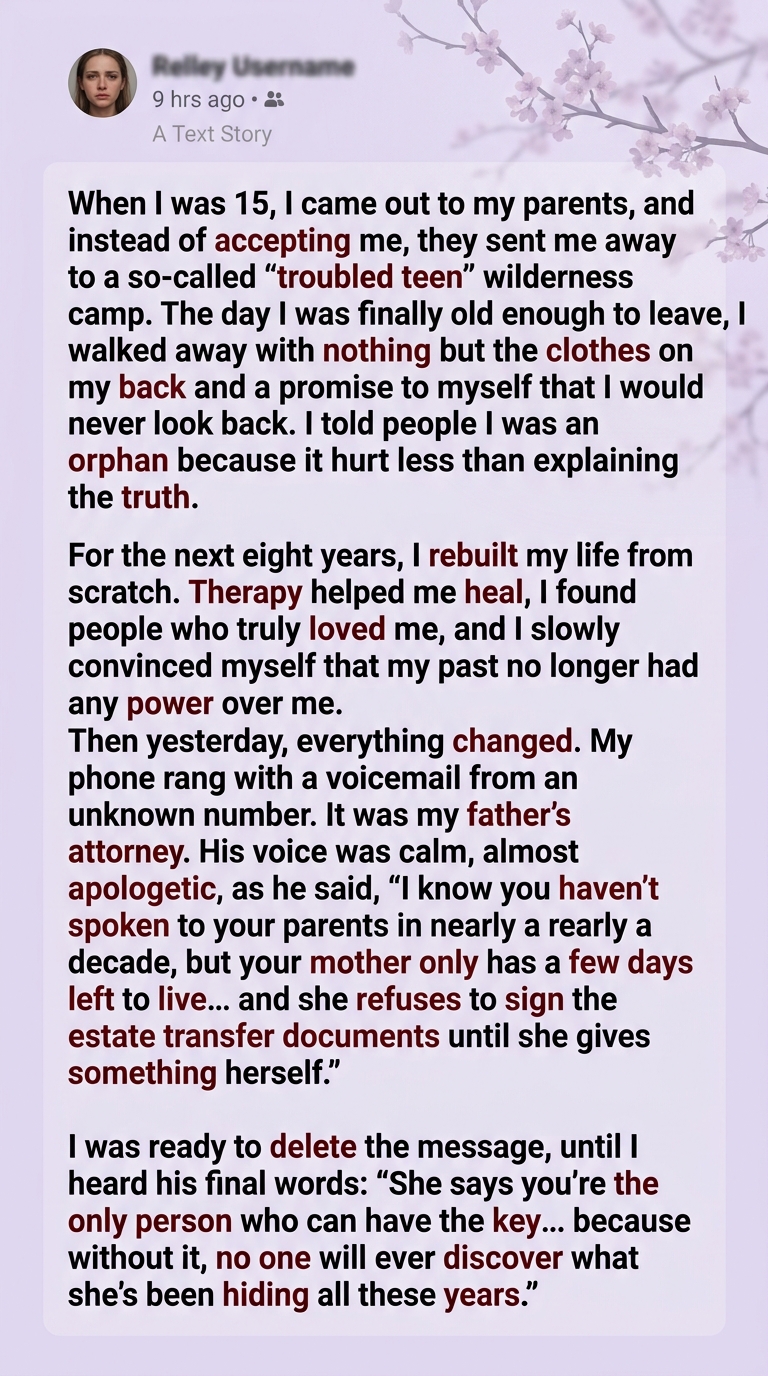
When I was fifteen, I told my parents the truth about who I was.
I expected fear.
Maybe confusion.
Maybe a hundred questions.
What I never expected was for my father to look at me as if I’d become a stranger.
My mother didn’t say anything.
She just cried.
Three days later, they sent me away.
They called it a “troubled teen wilderness program.”
They told relatives I needed structure.
They told their friends I needed discipline.
The truth was much simpler.
They didn’t want a gay child in their house.
The camp was supposed to last six weeks.
It lasted nearly a year.
There were long hikes, isolation, forced group sessions, and endless lectures about changing who I was.
I learned quickly not to talk about my family.
I learned not to expect rescue.
And most importantly, I learned that sometimes the people who are supposed to love you most can be the people you have to survive.
When I was finally old enough to leave, I walked away with nothing but the clothes I was wearing.
My parents never came.
Nobody picked me up.
I slept in a youth shelter for several weeks, worked wherever I could, and eventually finished high school through night classes.
When people asked about my family, I started saying I was an orphan.
It was easier.
“I’m sorry,” they’d say.
I would nod.
It hurt less than saying:
“They’re alive. They just don’t want me.”
For the next eight years, I rebuilt my life.
Therapy helped.
Friends helped.
People who loved me exactly as I was helped most of all.
I eventually moved to a different city.
I got a job in graphic design.
I rented a small apartment with terrible plumbing and a beautiful view of nothing but another brick building.
It was perfect.
I had a chosen family.
I had people who knew my story and didn’t treat it like something shameful.
And slowly, I stopped thinking about my parents.
Or at least, I convinced myself I had.
Then yesterday, my phone rang.
Unknown number.
I almost ignored it.
Instead, I answered.
A man’s voice said, “Is this Daniel?”
“Yes.”
“My name is Robert Hayes. I’m an attorney representing your parents.”
My entire body went still.
I hadn’t heard my father’s name spoken aloud in years.
“I don’t have anything to discuss with them.”
“I understand.”
“Then why are you calling?”
There was a pause.
“Your mother is very ill.”
I closed my eyes.
“How ill?”
“She has only a few days left.”
I didn’t say anything.
Then he added:
“She refuses to sign the estate transfer documents until she gives you something herself.”
I almost laughed.
“I don’t want anything from her.”
“I suspected you’d say that.”
“Then we’re finished.”
I was about to hang up when he said:
“There’s one more thing.”
I waited.
“She says you’re the only person who can have the key.”
My stomach tightened.
“What key?”
“I don’t know.”
“Then why are you telling me?”
“Because she said that without it, no one will ever discover what she’s been hiding all these years.”
I didn’t sleep that night.
The next morning, I drove back to the town I’d spent eight years trying to forget.
The house looked smaller than I remembered.
The same white siding.
The same oak tree.
The same front porch where I’d once sat at thirteen and dreamed about leaving.
Robert met me outside.
“You don’t have to go inside,” he said.
“I know.”
But I went in.
My father was sitting in the living room.
He looked older.
Much older.
For a moment, I saw the man who had packed my clothes into a duffel bag.
Then I saw a tired old man staring at the floor.
“Where is Mom?”
“Upstairs.”
“Does she really want to see me?”
He nodded.
“She has been asking for you.”
I looked at him.
“For eight years?”
He didn’t answer.
That was answer enough.
I went upstairs.
My mother was lying in a hospital bed beside the window.
She looked nothing like the woman I remembered.
Her hair was thin.
Her hands trembled.
But her eyes were the same.
When she saw me, she started crying.
“Daniel.”
I stood in the doorway.
She reached toward me.
I didn’t move.
“I thought you’d never come.”
“I almost didn’t.”
“I know.”
She looked at the chair beside her.
I sat.
For several seconds, neither of us spoke.
Then she whispered:
“I owe you the truth.”
“You owed me that eight years ago.”
She closed her eyes.
“Yes.”
I expected an apology.
Instead, she said:
“Your father thought sending you away would protect our family.”
I laughed bitterly.
“Protect it from me?”
“No.”
She looked directly at me.
“From what he was afraid would happen if the truth came out.”
I frowned.
“What truth?”
My mother looked toward the bedroom door.
Then she whispered:
“Your father wasn’t the one who sent you away.”
I stared at her.
“He signed the papers.”
“Yes.”
“Then what are you talking about?”
“I forced him to.”
That stunned me.
She started crying.
“I was afraid.”
“Of me?”
“No.”
“Then what?”
She reached beneath her pillow and pulled out a small brass key.
She placed it in my hand.
It was old.
Heavy.
And engraved with a single number.
17.
“What’s this?”
“The only thing I managed to save for you.”
I stared at it.
“Save from what?”
She took a breath.
“From your father.”
My mother told me that shortly after I came out, my father had decided to cut me out of everything.
He wanted to remove my name from the family trust.
But there was a problem.
My grandfather had created the trust years earlier.
And he had included one condition.
If either of his children tried to disinherit a child solely because of that child’s sexual orientation, the offending parent would lose control of the trust.
My father couldn’t risk that.
So he created another story.
He claimed I was unstable.
Troubled.
Difficult.
He convinced my mother that sending me away would give him time to “fix the situation.”
She had signed the papers.
Then something happened.
My grandfather died.
And my mother discovered what was actually inside the trust.
It wasn’t just money.
There was a property.
A small building downtown.
A collection of investments.
And a private safety fund specifically established for any grandchild who needed a fresh start.
My grandfather had created it because he had once watched his own brother lose everything after being rejected by the family.
He wanted his grandchildren to have somewhere to go.
My father discovered the fund.
And he wanted control of it.
So he hid it from me.
My mother had found out.
She had tried to confront him.
That’s when my father threatened her.
He told her that if she ever told me about the trust, he’d make sure I received nothing.
She stayed silent.
For years.
I stared at her.
“You knew?”
She nodded.
“You knew I was sleeping in shelters?”
Tears ran down her face.
“Yes.”
“You knew I was telling people I was an orphan?”
She covered her mouth.
“Yes.”
I stood up.
“I don’t understand.”
“I was afraid.”
“You were my mother.”
“I know.”
“No. You don’t.”
I walked toward the door.
Then she said something that stopped me.
“The key isn’t for the trust.”
I turned.
“Then what is it for?”
She pointed toward the hallway.
“Your grandfather’s house.”
I remembered it.
He had died when I was twelve.
My father had told me the property was sold years ago.
My mother shook her head.
“He left it to you.”
My heart stopped.
“Me?”
She nodded.
“Your father hid the deed.”
“Why?”
“Because your grandfather knew what kind of man your father could become.”
She told me the key opened a storage room beneath my grandfather’s old house.
Inside was a safe.
And inside the safe were letters.
Letters my grandfather had written to me.
One for every birthday after his death.
He had known I might someday need them.
Robert drove me there.
The house had been empty for years.
The key opened the front door.
We walked inside.
Everything smelled like dust and old wood.
I found the hidden staircase behind a bookshelf.
At the bottom was a steel door.
The brass key fit perfectly.
Inside was a small room.
There was a safe.
A wooden box.
And a stack of envelopes.
My name was written on every one.
I opened the first.
It was dated my thirteenth birthday.
My grandfather wrote:
Daniel,
If you’re reading this, I’m probably not around to give you this letter myself. But I want you to know something. Whatever you become, whoever you love, and whatever path you choose, you will always have a home here.
I couldn’t breathe.
I opened another.
Then another.
He had written about school.
My dreams.
My fears.
Things I’d told him when I was little.
He had somehow known me better than my parents ever had.
At the bottom of the box was a legal document.
The house belonged to me.
So did the trust.
And there was one final letter.
It said:
If your father ever tries to convince you that you’re difficult to love, remember this: the problem was never that you were too much. The problem was that he was too small to understand how much you were worth.
I sat on the floor and cried.
Not because of the money.
Not because of the house.
Because for the first time, I had proof that someone in my family had loved me exactly as I was.
My mother died three days later.
I went to the funeral.
My father approached me afterward.
“I know I can’t fix it,” he said.
“No.”
“I made terrible decisions.”
“You did.”
He looked down.
“Your mother loved you.”
I looked at him.
“Then she should have told me.”
He nodded.
“I know.”
I never moved back home.
I didn’t suddenly forgive my father.
And I didn’t pretend eight years of silence could disappear because my mother had finally told me the truth.
But I kept the key.
I kept my grandfather’s letters.
And eventually, I renovated the old house.
I turned it into a small community center for young people who had been rejected by their families.
The first room became a counseling space.
The second became a free computer lab.
And upstairs, I created a small bedroom where anyone who needed somewhere safe could stay for a few nights.
I put the brass key in a glass box near the entrance.
Underneath it, I placed a simple sign.
YOU DON’T HAVE TO EARN THE RIGHT TO BE LOVED.
Years ago, my parents sent me away because they believed they could erase the person I was.
They failed.
I didn’t become who they wanted.
I became who I was supposed to be.
And the strangest part is that the key my mother thought would unlock a family secret ended up unlocking something much more important.
A home.
Not the home I was born into.
The home I chose to build.
Sometimes the family that rejects you teaches you the hardest lesson of all:
You can lose the people who were supposed to love you…
and still find people who do.