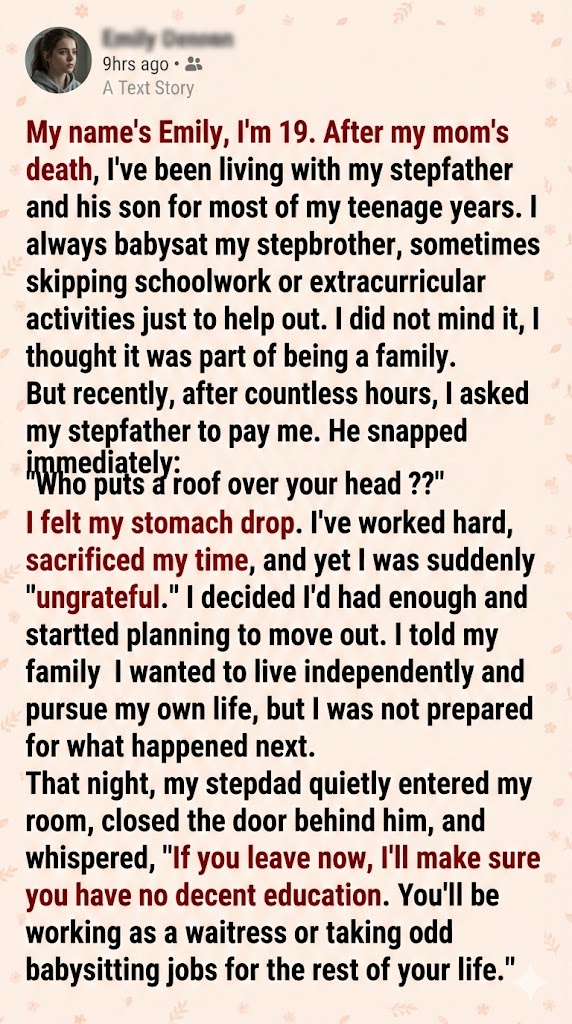
His words hung in the air like toxic smoke. My heart hammered against my ribs—not just from fear, but from a sudden, cold clarity. For years, I had confused his control for protection, but in that moment, the mask slipped completely. He wasn’t a guardian; he was a jailer. And he had just tried to weaponize my future to keep his free housekeeper.
I didn’t scream. I didn’t cry. I stared at him in the dim light of my room until he finally smirked, thinking his threat had worked, and turned to leave. That silence was my first real act of rebellion.
As soon as I heard the heavy click of his bedroom door down the hall, I moved. I didn’t wait for morning. I grabbed the duffel bag I had started packing earlier and shoved in the essentials: my laptop, my documents, a few changes of clothes, and the only framed photo I had of my mother. I climbed out my ground-floor window, the same way I used to sneak out to the library to study in peace.
The first six months were exactly as hard as he predicted, but not for the reasons he thought. I couch-surfed with friends from high school, sleeping in living rooms and surviving on instant noodles. He was right about one thing: I did end up working as a waitress. I took the graveyard shift at a 24-hour diner, smelling like grease and old coffee, my feet throbbing until they felt numb.
Every time I wiped a table or counted my tips, his voice echoed in my head: “You’ll be working odd jobs for the rest of your life.”
But there was a massive difference between his prediction and my reality. When I babysat for extra cash or poured coffee at 3 AM, the money in my pocket was mine. The roof over my head—eventually a tiny, drafty studio apartment I shared with two other girls—was ours. I wasn’t doing it to serve him; I was doing it to build a foundation he couldn’t take credit for.
He tried to sabotage me, of course. When tax season came, he refused to provide his information for my financial aid applications, hoping to block me from college. He thought that would break me. Instead, it forced me to fight. I walked into the university’s financial aid office and laid it all out. I worked with counselors, filed for a “dependency override” due to the abusive environment, and wrote letters explaining my estrangement. It was humiliating and exhausting, but I refused to let his signature be the gatekeeper to my education.
The university granted the override. I got the loans. I got the grants. I got in.
It took me five years instead of four because I had to work full-time while studying. I missed parties, I missed sleep, and there were days I wanted to give up. But every time I felt weak, I remembered that night in my bedroom. I remembered him threatening to clip my wings, and I used that anger as fuel.
I graduated last spring with a degree in Social Work, focusing on family law and advocacy.
On graduation day, I didn’t look for his face in the crowd. I looked out and saw the friends who had let me sleep on their couches, the diner owner who gave me free meals when I was broke, and the professors who believed in me. That was my family.
A few weeks ago, my phone buzzed with a number I didn’t recognize. It was my stepbrother. He sounded tired. He told me that our stepfather had lost his job and was struggling with health issues. He said the house was a mess, the bills were piling up, and they “really needed a woman’s touch” to get things back in order. He asked if I could come by, maybe help out financially or just “help dad out” for old times’ sake.
I sat in my office—my own office—and looked at my diploma on the wall. I thought about the scared 19-year-old girl who climbed out a window to save her own life.
“I’m sorry,” I said, my voice steady and calm. “But I can’t help you. I have a career to manage, and I’ve worked too hard to get here. You’ll have to figure out how to put a roof over your own heads.”
I hung up, blocked the number, and went back to work. He swore I’d be nothing without him, but in the end, I became everything I am in spite of him.