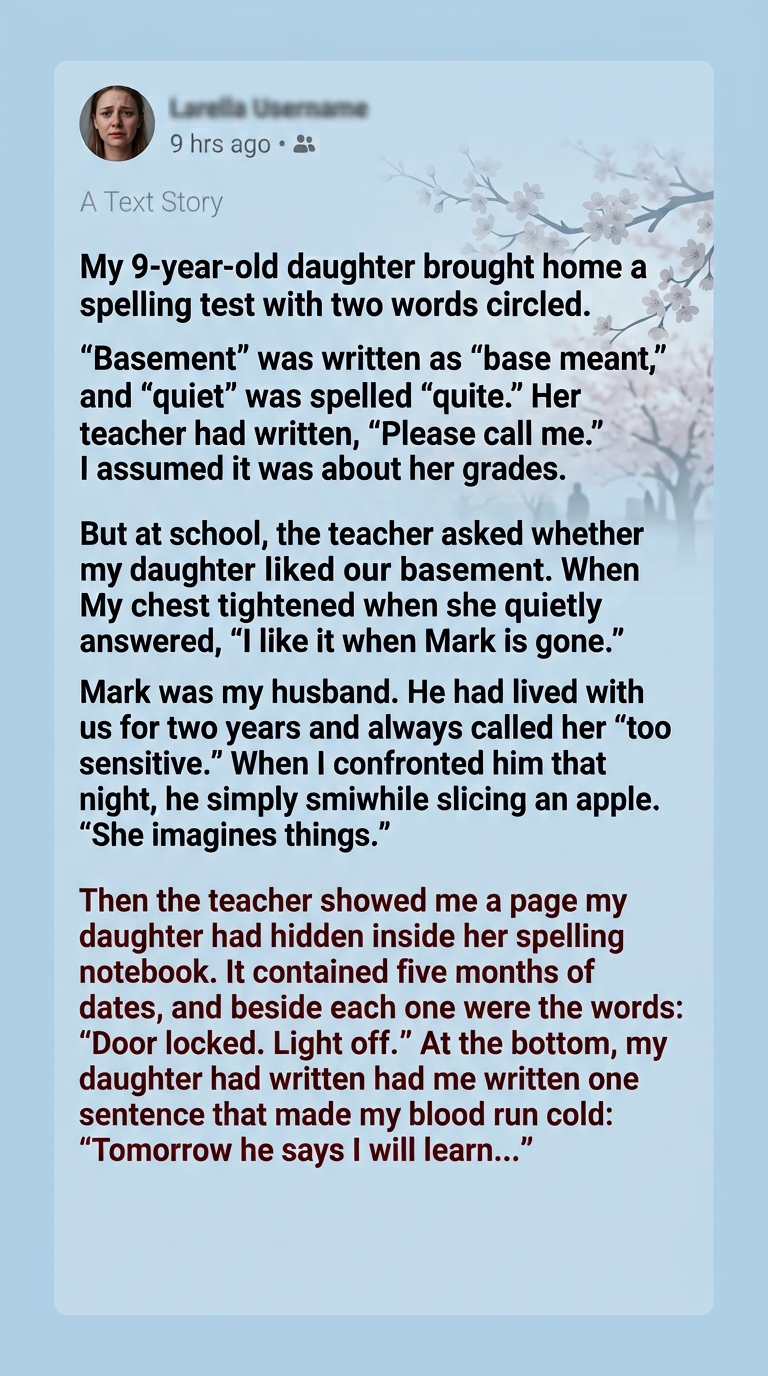
My 9-year-old daughter brought home a spelling test with two words circled.
“Basement” was written as “base meant.”
And “quiet” was spelled “quite.”
Her teacher had written underneath:
Please call me.
I assumed it was about her grades.
I was wrong.
The next morning, I went to the school expecting to hear that my daughter needed extra help with spelling.
Instead, her teacher closed the classroom door behind me.
“Thank you for coming,” she said.
I smiled nervously.
“Is something wrong with Emma?”
The teacher didn’t answer immediately.
She sat across from me and folded her hands.
“Does Emma like your basement?”
My smile disappeared.
“Our basement?”
“Yes.”
I frowned.
“I mean… she doesn’t really spend much time down there.”
The teacher looked at me carefully.
“Does she ever go down there alone?”
Before I could answer, Emma walked into the room.
She looked at me.
Then at her teacher.
Her teacher gently asked, “Emma, can you tell your mom what you told me yesterday?”
Emma stared at the floor.
I crouched beside her.
“Sweetheart?”
Her lips trembled.
Then she whispered,
“I like it when Mark is gone.”
My chest tightened.
Mark.
My husband.
Emma’s stepfather.
He had lived with us for two years.
He was always telling me Emma was “too sensitive.”
Too emotional.
Too imaginative.
Too dramatic.
Whenever she complained about something, he had an explanation.
“She misunderstood.”
“She was probably dreaming.”
“She makes things bigger than they are.”
And I had believed him.
At least, I had wanted to.
I looked at my daughter.
“What do you mean, honey?”
Emma wouldn’t look at me.
“I don’t like when he takes me downstairs.”
Mark.
The basement.
Suddenly, those two misspelled words didn’t look like mistakes anymore.
The teacher slid another piece of paper across the desk.
It was a page from Emma’s spelling notebook.
I recognized her handwriting immediately.
There were dates written down the left side.
Five months’ worth.
And beside each date were the same four words:
Door locked. Light off.
My hands began to shake.
“What is this?”
The teacher’s voice softened.
“Emma gave it to me yesterday.”
I looked at my daughter.
“Why didn’t you tell me?”
She finally looked up.
Her eyes were full of tears.
“Because Mark said you wouldn’t believe me.”
I felt something inside me break.
“What did he say?”
Emma whispered,
“He said you would think I was making things up.”
I stared at the page.
Five months.
Five months of dates.
Five months of something happening in my own house.
And I hadn’t noticed.
That night, I waited until Mark came home.
He walked into the kitchen like nothing was wrong.
He kissed my cheek.
“Hey.”
I stepped away.
“Did you take Emma into the basement last night?”
He paused.
Then smiled.
“Where is this coming from?”
“Answer me.”
He picked up an apple.
“You know she’s imaginative.”
He pulled a knife from the drawer and began slicing the apple.
“She imagines things.”
The sound of the knife hitting the cutting board suddenly made my stomach turn.
“What happened in the basement?”
“Nothing.”
“Then why does she keep writing ‘Door locked. Light off’?”
He stopped cutting.
For the first time, the smile disappeared.
“She shouldn’t be snooping around my things.”
My heart dropped.
“Your things?”
He looked at me.
Then he laughed softly.
“You’re seriously taking the word of a nine-year-old over your husband?”
That was when I realized something.
He hadn’t asked what she told me.
He hadn’t asked why she was scared.
He hadn’t asked what she had written.
He already knew.
He knew exactly what she had told her teacher.
I quietly picked up my phone from the counter.
“I think we need to talk about this somewhere else.”
His expression changed.
“You’re overreacting.”
“No.”
I looked toward the hallway.
Emma was standing there.
Watching us.
I walked toward her.
“Go to your room and get your favorite things.”
Mark stood up.
“Where are you going?”
“Somewhere you aren’t.”
He laughed.
“You’re leaving because of a spelling test?”
“No.”
I looked directly at him.
“I’m leaving because my daughter has been keeping a record of what happens in our basement for five months.”
He didn’t answer.
That silence told me more than anything else could have.
I took Emma to my sister’s house.
The next morning, I contacted the school counselor and the police.
Investigators came to our house.
They searched the basement.
At first, they found nothing unusual.
Then one officer noticed that one section of the basement wall looked newer than the rest.
Behind it was a narrow storage area.
Inside were boxes.
Old clothes.
A folding chair.
A small table.
And a notebook.
My daughter recognized it immediately.
“That was his.”
The officer opened it.
There were dates.
Times.
Notes about the basement.
Notes about Emma.
And one sentence repeated over and over:
She must learn to keep secrets.
I felt sick.
But the investigator wasn’t finished.
There was also a small camera hidden near the basement doorway.
It wasn’t pointed toward anything innocent.
It had been positioned to record who entered and left the basement.
The investigators took everything.
Mark was questioned.
He insisted Emma was confused.
He said he had never hurt her.
And that part mattered.
Because eventually, investigators discovered something different.
Mark had been using the basement as a place to secretly store documents and stolen property connected to his former employer.
He had lost his job months earlier.
He had been taking company records, equipment, and confidential materials home.
The basement wasn’t a hidden punishment room.
It was his hiding place.
And Emma had accidentally discovered it.
She had seen boxes being brought downstairs.
She had heard him talking to someone on the phone.
She had noticed him locking the basement door whenever he was working with the documents.
He had frightened her into silence.
He told her that if she told anyone, he would blame her for “breaking into his private room.”
He told her nobody would believe a little girl.
And because Emma was only nine, he knew exactly which words would scare her most.
“You’re too sensitive.”
“You’re imagining things.”
“Your mother will be disappointed in you.”
But Emma found a way to fight back.
She couldn’t tell me directly.
So she wrote.
Every time something happened, she wrote down the date.
Door locked. Light off.
She had been building a record.
Quietly.
Carefully.
Waiting for someone to notice.
Then I remembered the sentence at the bottom of her notebook.
The one that had made my blood run cold.
Tomorrow he says I will learn…
I asked her about it.
She sat beside me on my sister’s couch, holding a stuffed rabbit against her chest.
“What did he say you would learn?”
She looked at me.
Then whispered,
“How to keep a secret forever.”
I closed my eyes.
I pulled her into my arms.
“You never have to keep a secret from me.”
She cried against my shoulder.
“I tried to tell you.”
“I know.”
“I told you he was scary.”
I could barely speak.
“I know, sweetheart.”
“No, Mom.”
She pulled away.
“You didn’t know.”
That hurt more than anything.
Because she was right.
I had been so busy trying to keep our family together that I had ignored the little things that didn’t fit.
The way Emma stopped going downstairs.
The way she became quiet whenever Mark entered a room.
The way she started sleeping with her bedroom door open.
The way she stopped asking him for help with homework.
I had explained every warning away.
Until my daughter finally found a way to write the truth where someone else could see it.
Mark was arrested on charges related to the stolen property and confidential records.
The investigation into everything he had done continued for months.
But for us, the most important thing happened much sooner.
Emma came home.
Not to the house.
Not yet.
We moved temporarily into my sister’s guest room while the investigation continued.
For the first few weeks, Emma slept beside me.
She woke up from nightmares.
Sometimes she checked the locks.
Sometimes she asked me whether Mark knew where we were.
And every time, I answered the same way.
“He doesn’t get to decide what happens to us anymore.”
Slowly, she began to heal.
She started spelling again.
One afternoon, she brought me a new test.
The word basement was spelled correctly.
So was quiet.
Both were circled in red.
But this time, her teacher had written something different.
Excellent work!
Emma looked at me.
“Mom?”
“Yeah?”
“I spelled them right.”
I smiled.
“You did.”
She thought for a moment.
Then she said,
“I don’t think I like the word basement anymore.”
I hugged her.
“You don’t have to.”
She smiled.
“And quiet?”
“What about it?”
“I think quiet is okay sometimes.”
I nodded.
“It is.”
She leaned against me.
“As long as nobody makes you be quiet.”
I held her tighter.
Because that was the lesson I wished I’d understood five months earlier.
Silence isn’t always peace.
Sometimes silence is fear.
Sometimes a child doesn’t have the words to explain what is happening.
And sometimes the only way they know how to ask for help is by leaving tiny clues where they hope someone will find them.
Emma didn’t need me to be a perfect mother.
She needed me to listen.
And now, whenever she says something—even something that seems small—I stop what I’m doing.
I look at her.
And I listen.
Because sometimes the quietest child in the room is the one trying hardest to tell you something.