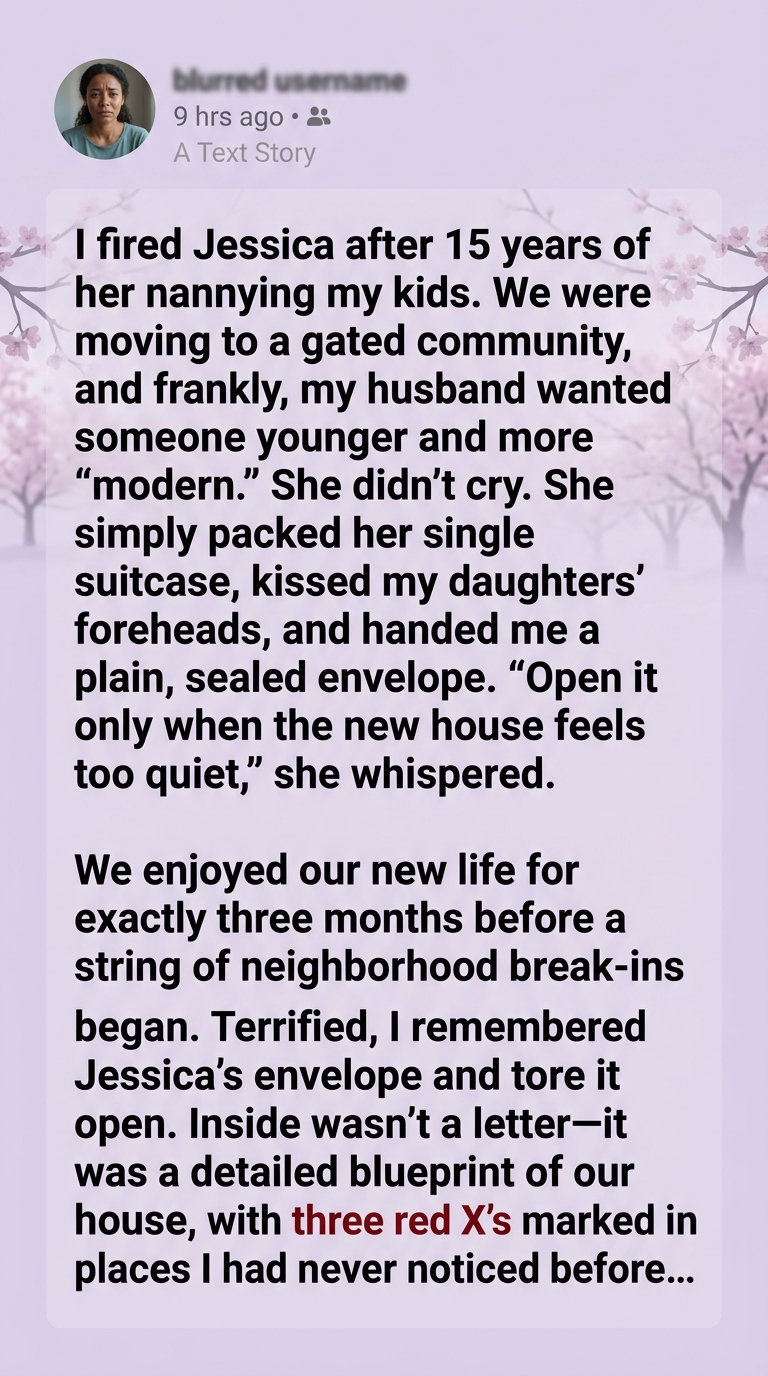
I fired Jessica after fifteen years of her nannying my kids.
Even writing that sentence now makes me feel ashamed.
She had started working for us when my oldest daughter, Emma, was only two.
Back then, I was exhausted, working long hours, and trying to keep a marriage together while raising two little girls.
Jessica had been twenty-six.
Quiet.
Patient.
Reliable.
She became the person who knew where everything was.
She knew which daughter hated peas.
Which one needed the hallway light on to sleep.
Which stuffed animal couldn’t go into the washing machine.
She knew their allergies, their fears, their favorite songs, and the exact tone of voice that meant one of them was about to cry.
For fifteen years, she was there.
Birthdays.
Christmas mornings.
First days of school.
Fevers at three in the morning.
Broken hearts.
School plays.
Everything.
My daughters called her Jess.
Sometimes, they called her Mom by accident.
And every time they did, I felt a tiny stab of jealousy.
I should have been grateful.
Instead, I listened to my husband.
“We’re moving into a completely different lifestyle,” he told me.
“We can’t bring the past with us.”
He said Jessica was too old-fashioned.
Too cautious.
Too involved.
Then one night he finally said the part he had been avoiding.
“We need someone younger. Someone more modern.”
I knew exactly what he meant.
Jessica was forty-one.
The new neighborhood was filled with people who had assistants, personal trainers, smart-home systems, and live-in staff.
My husband wanted someone who looked like she belonged there.
Jessica didn’t argue when I told her.
She didn’t cry.
She didn’t ask for more money.
She didn’t remind me that she had practically raised my children.
She simply nodded.
“Of course.”
The next morning, she packed her things into one small suitcase.
That’s all she had after fifteen years.
One suitcase.
Before she left, she went upstairs.
She kissed both of my daughters on the forehead.
My youngest started crying.
“Are you coming with us to the new house?”
Jessica smiled.
“I’ll always be somewhere close.”
My daughter didn’t understand.
Neither did I.
Jessica came downstairs carrying a plain white envelope.
She handed it to me.
“What’s this?”
“Something important.”
I laughed nervously.
“Jessica, if this is a resignation letter, I already fired you.”
She shook her head.
“Open it only when the new house feels too quiet.”
I stared at her.
“What does that mean?”
She looked toward the front door.
Then back at me.
“You’ll know.”
And she left.
Three months later, I knew exactly what she meant.
The new house was beautiful.
It had a security gate.
Cameras.
Motion sensors.
A smart doorbell.
Two garages.
A backyard large enough for a pool.
We had everything my husband said we needed.
But Jessica had been right about one thing.
It was quiet.
Too quiet.
There were no little footsteps running down the hallway.
No laughter from the kitchen.
No one knocking on my bedroom door because they couldn’t sleep.
My daughters had grown older.
They spent more time at school and with friends.
My husband traveled constantly.
And I began realizing that the house wasn’t just quiet.
It felt empty.
Then the break-ins started.
The first one happened three streets away.
A family’s back door had been forced open.
Nothing major was taken.
A laptop.
Some jewelry.
Cash.
Then another house was hit.
Then another.
Our neighborhood association sent out an alert.
PLEASE REMAIN VIGILANT.
Security patrols were increased.
People started checking their cameras every night.
My husband told me not to worry.
“We’re behind a gate.”
“We have cameras.”
“We’re fine.”
I wanted to believe him.
Then one morning, I woke up to police cars outside.
The house across the street had been robbed.
The strange part was that the family had been home.
They had been asleep upstairs.
Whoever entered had moved through the downstairs rooms without waking them.
I started checking our locks every night.
Then, one evening, I saw something that made my stomach tighten.
Our back gate was open.
I knew I had locked it.
My husband said I must have forgotten.
But I hadn’t.
That night, I barely slept.
At 2:17 in the morning, I heard something downstairs.
A soft sound.
Like a door closing.
I sat up.
My husband was asleep beside me.
I grabbed my phone.
Then I heard another sound.
A faint click.
I turned on the hallway light.
Nothing.
I checked the security app.
All cameras were working.
No motion detected.
I went downstairs anyway.
The house was empty.
But the back door was unlocked.
I called the police.
They searched the property and found no one.
One officer told me something that stayed with me.
“If someone is getting into these houses without triggering the alarms, they may know something about the neighborhood’s security setup.”
That night, I remembered Jessica.
Her envelope.
I went into my closet.
It was still there.
Three months unopened.
I sat on the floor and tore it open.
Inside wasn’t a letter.
It was a blueprint.
My house.
Detailed.
Every room.
Every hallway.
Every door.
Even the garage.
And there were three red X’s.
I stared at them.
The first was in the basement.
The second was behind the master bedroom closet.
The third was near the garage.
I immediately called my husband.
He came upstairs.
“What is that?”
“I don’t know.”
“Where did you get it?”
“Jessica.”
He stared at the blueprint.
Then laughed.
“Your nanny left you a treasure map?”
“Stop.”
I pointed at the first X.
“That’s the basement wall.”
“So?”
“There’s no reason for that marking.”
He shrugged.
“Maybe she marked something from when the house was being built.”
We called a contractor the next morning.
He looked at the blueprint.
Then looked at the basement.
“That’s interesting.”
“What?”
He pointed at the wall.
“The foundation plans don’t match what you’re showing me.”
My stomach dropped.
“What does that mean?”
“There should be a maintenance corridor here.”
He knocked on the wall.
It sounded hollow.
We removed a section of drywall.
Behind it was a narrow passage.
And inside that passage was an old electrical panel.
But that wasn’t the strangest thing.
There was a second door.
A small steel door.
Locked.
My husband stared at it.
“Where did that come from?”
The contractor shook his head.
“I have no idea.”
We called the police.
They opened it.
Inside was a cramped utility space.
Nothing valuable.
Nothing obviously suspicious.
Just wires, pipes, and an old access ladder leading upward.
The officer followed it.
Then stopped.
“Where does this go?”
We checked the blueprint.
The ladder ended behind the master bedroom closet.
Exactly where Jessica had marked the second X.
The closet wall was opened.
Behind it was another access panel.
And suddenly everything made sense.
Our house had been built with hidden service corridors.
They were old.
They weren’t part of the current floor plan.
And the security system didn’t monitor them.
The third X was in the garage.
Behind a cabinet was another access door.
The police found a narrow tunnel leading toward the rear boundary wall.
Someone could enter through that route without using our doors.
I felt sick.
“But why would Jessica know about this?”
The police officer looked at me.
“That is what you need to ask her.”
We found Jessica the next day.
She lived in a small apartment about twenty minutes away.
When she opened the door and saw the blueprint in my hand, she didn’t look surprised.
She looked sad.
“I wondered how long it would take.”
I stared at her.
“You knew?”
She stepped aside.
“Come in.”
We sat at her kitchen table.
I put the blueprint down.
“Why didn’t you tell me?”
“Because your husband wouldn’t have listened.”
“What does that mean?”
She took a breath.
“When the house was being renovated before you moved in, I was here almost every day.”
She explained that she had noticed workers using strange access points.
She had asked questions.
They told her the corridors were part of the original property design.
But one contractor had quietly warned her that the passages had been used before by maintenance workers—and that the current security company hadn’t included them in the system.
Jessica had kept notes.
Then, shortly before we moved, she noticed something else.
One of the contractors had returned after hours.
She saw him near the garage.
When she confronted him, he claimed he had forgotten a tool.
But Jessica didn’t believe him.
She took photographs of his vehicle.
She wrote down the license plate.
And she told my husband.
I remembered.
He had dismissed her.
He told me she was becoming paranoid.
He told me she was trying to make herself seem indispensable.
Jessica looked at me.
“I knew you were moving into that house.”
“I thought the envelope might make you understand someday.”
I couldn’t speak.
Then she added something that made my blood run cold.
“The break-ins aren’t random.”
“What?”
“They’re testing the houses.”
She explained that the intruders weren’t simply looking for valuables.
They were learning security patterns.
Which cameras worked.
Which gates opened.
Which houses had blind spots.
And someone had discovered the old service corridors.
The police connected Jessica’s notes to the recent break-ins.
Her photographs became evidence.
The license plate she had written down belonged to a subcontractor who had worked on several homes in the neighborhood.
He wasn’t working alone.
Within weeks, the investigation led to multiple arrests.
The break-ins stopped.
Our neighborhood became quiet again.
But this time, the quiet felt different.
I went back to Jessica’s apartment after everything was over.
I stood at her door with my daughters beside me.
My oldest hugged her first.
Then my youngest.
They cried.
Jessica cried too.
I waited until they were finished.
Then I said the words I should have said three months earlier.
“I’m sorry.”
Jessica looked at me.
“For what?”
“For firing you.”
She smiled sadly.
“You didn’t fire me because I wasn’t good enough.”
I looked down.
“You fired me because someone convinced you I wasn’t valuable anymore.”
That sentence hurt because it was true.
My husband eventually admitted that he had wanted to replace Jessica because he thought she didn’t fit our new lifestyle.
He apologized.
But some things don’t disappear with an apology.
I started visiting Jessica every week.
Sometimes with my daughters.
Sometimes alone.
One afternoon, I brought her a framed photograph.
It was from my oldest daughter’s first birthday.
Jessica was holding her.
I handed it to her.
“You should have this.”
She looked at the picture.
Then at me.
“I have hundreds of memories.”
“I know.”
“But you don’t have to keep working for us to be part of the family.”
She smiled.
“I know that now.”
We eventually invited Jessica to our family holidays.
She came to birthdays.
She attended graduations.
She became exactly what she had always been.
Family.
And every once in a while, when I’m walking through that enormous house and hear nothing but the hum of the refrigerator, I think about the envelope.
The blueprint.
The three red X’s.
But I don’t think about the break-ins anymore.
I think about the woman who had spent fifteen years protecting my children.
A woman I let go because someone else convinced me she was outdated.
She wasn’t outdated.
She was observant.
Loyal.
Careful.
And when everyone else thought she was no longer useful, she quietly left behind the one thing that could protect us.
A warning.
Sometimes the people who know your home best aren’t the ones who own it.
They’re the ones who spent years making sure everyone inside it was safe.