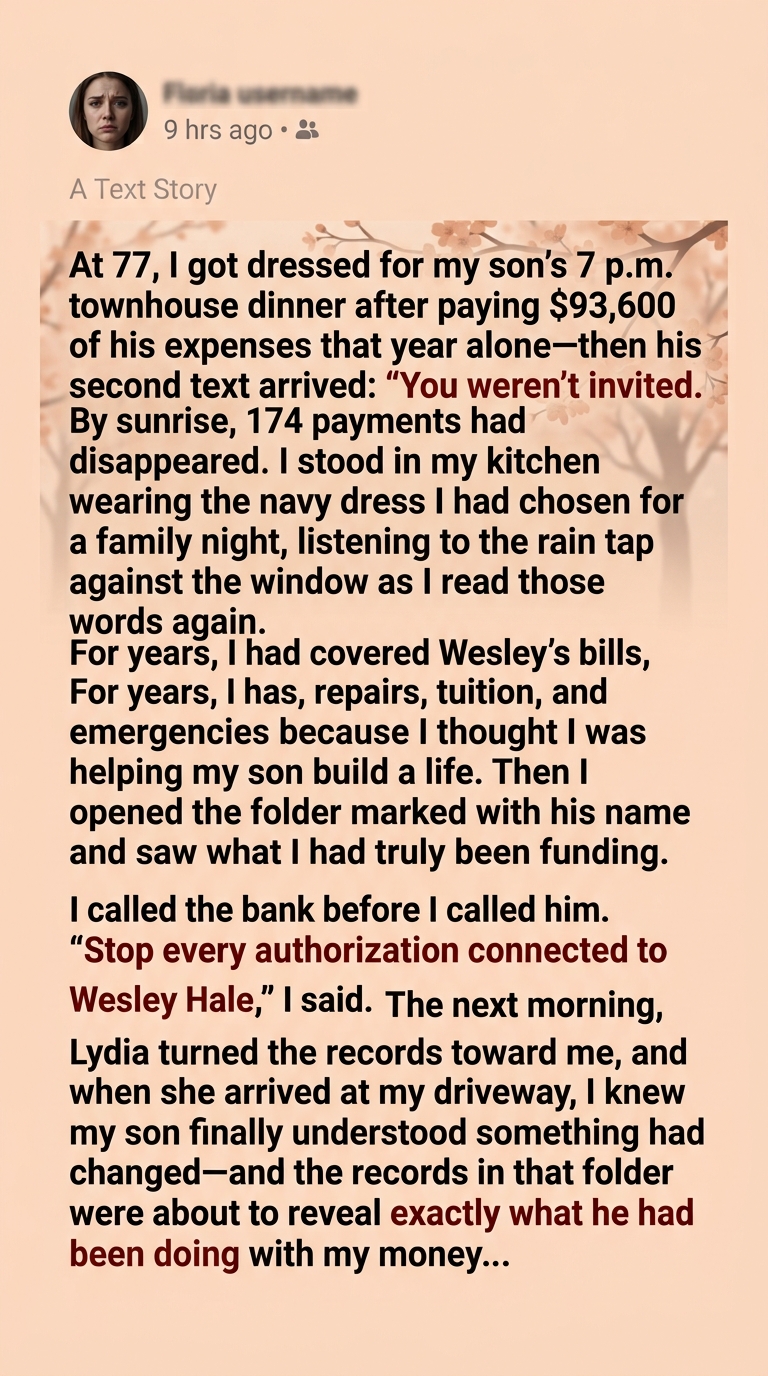
At seventy-seven, I still believed helping your children was one of the last privileges of being a mother.
Even when they were grown.
Even when they didn’t ask.
Even when they stopped saying thank you.
That belief cost me more than I want to admit.
The night everything changed, I was standing in my kitchen wearing the navy dress I’d bought specifically for my son’s 7 p.m. townhouse dinner.
I had done my hair.
I had put on lipstick.
I’d even worn the pearl earrings Wesley gave me for my seventieth birthday.
Then my phone buzzed.
His first text said:
Running a little late. See you at seven.
I smiled.
A few seconds later, another message appeared.
Actually, don’t come.
I stared at it.
Then another one arrived.
You weren’t invited. Lydia doesn’t want you there.
I read it twice.
Then a third time.
My hands went cold.
I sat down at the kitchen table.
For years, I had paid Wesley’s bills.
Not because he was irresponsible.
At least, that was what I told myself.
I paid his college tuition after his father died.
I paid for repairs when their townhouse flooded.
I helped with Lydia’s medical bills.
I covered their car payment during a difficult year.
I paid daycare when their children were small.
Then there were emergencies.
A broken furnace.
A leaking roof.
A tax bill.
A business expense.
A credit card balance.
A “temporary” cash-flow problem.
One thing became another.
By the time I turned seventy-seven, I had convinced myself that supporting my son wasn’t a financial burden.
It was love.
That year alone, I had paid $93,600 toward expenses connected to Wesley and his family.
I had never added it all up.
Until that night.
I walked to my office.
Opened the bottom drawer.
Pulled out the folder marked:
WESLEY HALE — FAMILY EXPENSES
I’d started keeping records after my accountant suggested it.
I opened the folder.
Receipts.
Bank transfers.
Checks.
Credit card statements.
Electronic payments.
I began counting.
Twenty-three payments for utilities.
Fourteen for car expenses.
Nine for insurance.
Thirty-one for home repairs.
Twenty-seven for credit cards.
Sixteen for restaurant charges I’d reimbursed because Wesley claimed they were “client dinners.”
Eight tuition payments.
And dozens of smaller transfers.
I kept counting.
When I finished, the number was sitting in front of me.
174 payments.
One hundred seventy-four.
I leaned back.
Then I noticed something.
Several payments weren’t what I remembered.
There were transfers to a company called Hale Strategic Solutions.
I didn’t recognize the name.
I turned the page.
There were payments to a storage facility.
A luxury car service.
A private club.
A jewelry store.
And something called L&H Properties.
I knew immediately that the “L” was probably Lydia.
My stomach tightened.
I called my bank.
The woman who answered knew me.
Her name was Lydia.
Not my daughter-in-law.
My banker.
“Mrs. Hale?”
“Yes.”
“Is everything okay?”
“No.”
I looked at the folder.
“Stop every authorization connected to Wesley Hale.”
There was silence.
“Do you want me to freeze the recurring payments?”
“All of them.”
“Are you sure?”
I looked at the message on my phone.
You weren’t invited. My wife doesn’t want you there.
“Yes.”
“Effective immediately.”
I hung up.
Then I sat in the dark.
For the first time in years, nobody needed anything from me.
And somehow, that felt terrifying.
The next morning, my banker came to my house.
Lydia placed a thick packet on my kitchen table.
“I reviewed the transactions you authorized over the last three years.”
She pushed the first page toward me.
“You’ve transferred $287,400 to accounts connected to your son.”
I stared at the number.
“I thought it was closer to one hundred thousand.”
“That was just this year.”
My mouth went dry.
She turned another page.
“These payments were categorized as household expenses.”
I looked at them.
“Some were.”
“Yes.”
“But not all.”
“No.”
She slid another document across the table.
“These transfers went to Hale Strategic Solutions.”
“What’s that?”
“It’s a company registered eighteen months ago.”
“Who owns it?”
She looked at me.
“Wesley Hale.”
I felt my chest tighten.
“What does the company do?”
“That is where things become interesting.”
She handed me another page.
The company had almost no public activity.
No employees.
No office.
No visible clients.
Yet I had sent it more than $140,000.
“Why would I pay his company?”
“You didn’t.”
I looked at her.
“He moved money from the household account after you transferred funds.”
My hands started shaking.
“He moved my money?”
“Some of it.”
“How?”
She pointed to a stack of documents.
“Your son had access to your online banking.”
I felt something inside me go very still.
“No.”
“He was listed as an authorized user on one of the accounts.”
“I gave him access years ago.”
“For emergencies?”
“Yes.”
“He apparently used that authorization more broadly.”
I couldn’t speak.
Lydia continued.
“There are transfers from the account you thought was paying household expenses into several accounts controlled by your son.”
“How much?”
She hesitated.
“$174,000.”
I stared at her.
“That’s almost exactly the number of payments.”
“The payment count is coincidental.”
I looked down at the documents.
Then I saw something.
A transfer labeled:
HOME REPAIR — $8,400
But the recipient was a company in Nevada.
Another:
TUITION — $12,000
But it went to a luxury vehicle financing company.
Another:
MEDICAL — $4,800
But it went to L&H Properties.
I looked at Lydia.
“What’s L&H?”
She pulled another document from the packet.
“It’s a property company owned by Lydia Hale.”
My son’s wife.
The woman who didn’t want me at dinner.
Suddenly, the expensive townhouse made sense.
The new cars.
The vacations.
The renovations.
The jewelry.
The private club.
I had been told they were struggling.
They weren’t.
They were building a life with money they had convinced me was being used to survive.
Then Lydia turned one final page toward me.
“This is the document I think you need to see most.”
It was a loan application.
My name was listed as a guarantor.
I stared at it.
“I never signed this.”
Lydia nodded.
“We thought you had.”
“Who submitted it?”
She pointed to the signature.
My name.
But it wasn’t my handwriting.
It was a digital signature.
I felt sick.
“How much?”
“$420,000.”
I pushed my chair back.
“They tried to borrow four hundred twenty thousand dollars using me as guarantor?”
“Yes.”
“Did they get it?”
“No.”
“Why not?”
“The bank requested verification.”
I closed my eyes.
That was the moment everything became clear.
The 174 payments weren’t the whole story.
They were evidence.
My son hadn’t simply accepted my help.
He had built a financial system around it.
And apparently, he believed I would never look closely enough to notice.
At 9:17 the next morning, a car pulled into my driveway.
Wesley got out.
Lydia was in the passenger seat.
They walked toward my front door.
I didn’t move.
The doorbell rang.
I opened it.
Wesley looked exhausted.
“Mom.”
I said nothing.
Lydia looked past me.
“Can we come in?”
“No.”
She flinched.
Wesley swallowed.
“Mom, please.”
“You weren’t inviting me to your house last night.”
“That’s not what happened.”
“Your text said exactly that.”
He looked at Lydia.
She looked away.
I stepped onto the porch.
“Tell me something.”
“What?”
“Did you know about the $420,000 loan application?”
Wesley’s face changed.
Lydia whispered:
“Wesley…”
He looked at me.
“I can explain.”
“That wasn’t my question.”
He rubbed his forehead.
“Yes.”
I nodded.
“Did you forge my signature?”
“No.”
“Did you use my account without telling me?”
Silence.
“Did you transfer my money into your company?”
More silence.
“Did you use money I gave you for repairs, tuition, medical bills, and emergencies to pay for things you never told me about?”
Wesley finally looked up.
“Some of it.”
“Some?”
“I was going to pay you back.”
“With what?”
He had no answer.
I looked at Lydia.
“Did you know?”
She started crying.
“Yes.”
I closed my eyes.
That hurt more than Wesley’s admission.
Because Lydia had called me Mom.
She had sat beside me in hospitals.
She had asked me for recipes.
She had hugged me on Christmas mornings.
And all the while, she knew.
Wesley stepped forward.
“Mom, we got in over our heads.”
“You didn’t get in over your heads.”
I shook my head.
“You built a life you couldn’t afford and convinced me to pay for it.”
“We needed help.”
“You needed honesty.”
He looked at the ground.
Then he said something that finally made me understand.
“I knew you’d say no.”
I stared at him.
“So you didn’t ask.”
“I thought you’d judge us.”
“No.”
My voice broke.
“I would have told you to stop.”
He looked at me.
“That isn’t better.”
“Yes, it is.”
I pointed toward the house.
“I can forgive a child who asks his mother for help.”
I paused.
“I don’t know how to forgive a grown man who makes his mother pay for a life he knows she would never approve of.”
Wesley started crying.
“I was scared.”
“Of what?”
“Of failing.”
I softened for half a second.
Then I remembered the forged loan application.
“You weren’t failing.”
I looked at Lydia.
“You were pretending.”
Neither of them argued.
That afternoon, I called my attorney.
The unauthorized accounts were closed.
The remaining authorizations were revoked.
The forged loan application was reported.
My attorney also discovered something else.
Wesley had been telling lenders that my financial support represented “family investment income.”
That phrase made me laugh bitterly.
I had never invested in his company.
I had invested in my son.
Those were not the same thing.
The investigation took months.
Wesley eventually admitted to several unauthorized transfers.
Some money was returned.
Some was gone.
Some had been spent.
Some assets were sold.
The loan application was withdrawn.
And Lydia filed for divorce.
Not because of the money.
Because she finally admitted that Wesley had lied to her too.
He had told her I willingly funded everything.
She hadn’t known how much he had taken without telling me.
For a long time, I didn’t speak to my son.
Then, one Sunday afternoon, he came to my house.
He stood on the porch.
No expensive car.
No new watch.
No polished shoes.
Just jeans and an old jacket.
“Can I come in?”
I looked at him.
“Yes.”
He sat at my kitchen table.
The same table where Lydia had shown me the records.
“I sold the car,” he said.
I nodded.
“I moved out of the townhouse.”
I nodded again.
“I got another job.”
“Good.”
He looked down.
“I’ve started paying back what I can.”
“Good.”
Then he looked at me.
“I know paying it back won’t fix it.”
“No.”
“I know saying sorry won’t fix it.”
“No.”
“I know I might never get you back.”
I finally looked at him.
“You’re my son.”
His eyes filled with tears.
“That doesn’t mean you get to hurt me without consequences.”
He nodded.
“I know.”
I reached across the table.
Not to hug him.
Not yet.
I simply placed my hand over his.
“Wesley, I don’t need you to repay every dollar tomorrow.”
He looked surprised.
“I need you to become someone who would never do this again.”
He nodded.
“I will.”
It took time.
A lot of time.
Trust didn’t return because he apologized.
It returned slowly.
One honest conversation at a time.
One payment at a time.
One decision at a time.
And I learned something too.
Helping your children is beautiful.
But helping someone doesn’t mean surrendering your boundaries.
Love doesn’t require you to ignore the numbers.
And generosity doesn’t mean allowing someone to turn your kindness into an entitlement.
The navy dress I wore that night stayed hanging in my closet.
I never wore it again.
Not because it reminded me of the dinner I missed.
It reminded me of the woman I had been before that night.
The woman who thought being a good mother meant saying yes whenever her son needed something.
Now I understood.
Sometimes being a good mother means saying no.
Sometimes it means closing the account.
Sometimes it means letting your grown child face the consequences of the life they’ve chosen.
And sometimes, the most loving thing you can do for someone you raised…
is stop rescuing them.
Because the 174 payments didn’t just show me where my money had gone.
They showed me what my son had become when he believed I’d never stop giving.
And the day I stopped was the day he finally had to start becoming responsible for his own life.