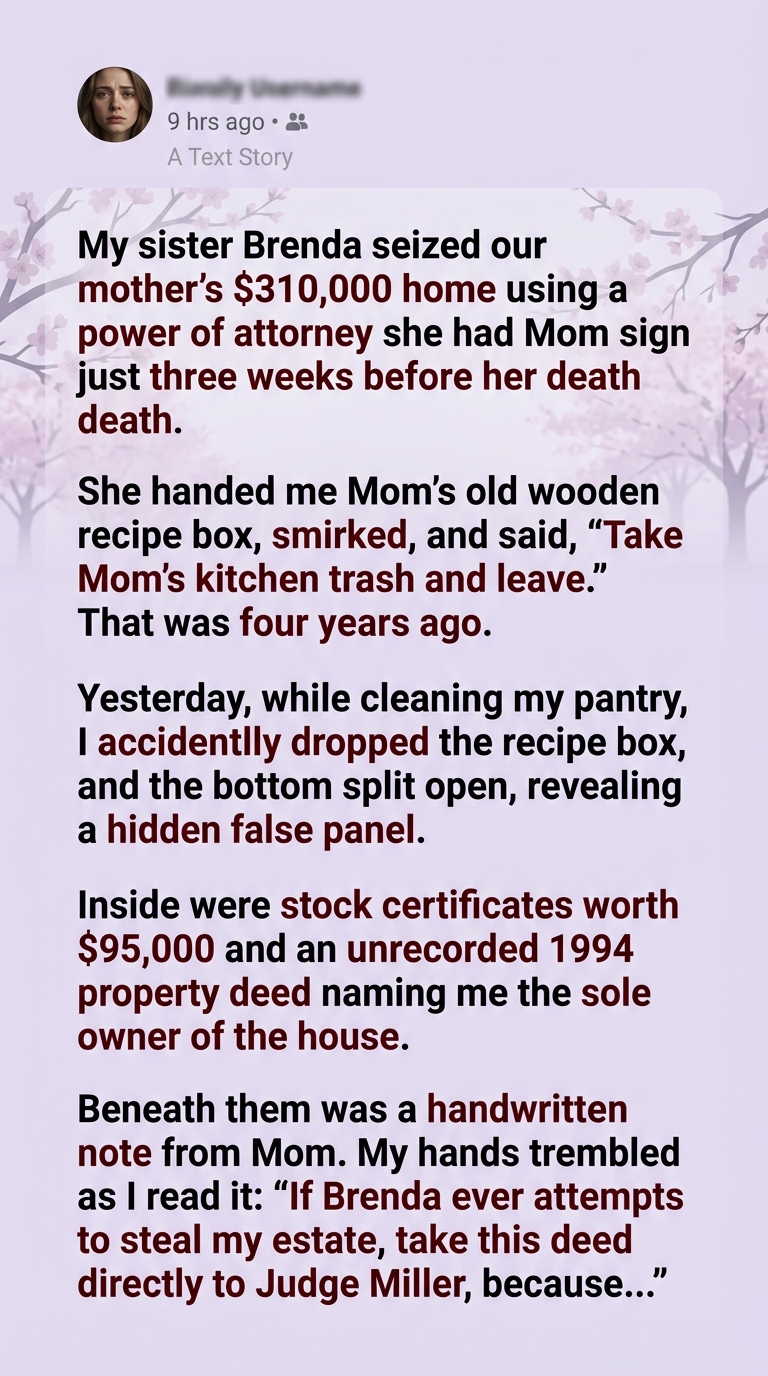
My sister Brenda seized our mother’s $310,000 home using a power of attorney she had Mom sign just three weeks before her death.
She handed me Mom’s old wooden recipe box, smirked, and said:
“Take Mom’s kitchen trash and leave.”
That was four years ago.
Yesterday, while cleaning my pantry, I accidentally dropped the recipe box.
The bottom split open.
At first, I thought I’d broken it.
Then I noticed something strange.
The bottom wasn’t supposed to open.
I ran my fingers along the wood.
There was a tiny seam.
I pressed it.
A false panel popped loose.
Inside were several documents wrapped in wax paper.
My hands started shaking before I even opened them.
The first thing I saw was a stack of stock certificates.
$95,000 worth.
I stared at the number.
Then I found an old property deed.
The paper was yellowed.
The ink had faded.
But the name on it was clear.
Sole grantee: Margaret Ellis.
My name.
I read the date.
June 14, 1994.
The property was the house my mother had owned for more than thirty years.
The same house Brenda had taken from her estate.
The same house Brenda had told me belonged to her.
I sat down on the pantry floor.
There was one more thing inside the false compartment.
A handwritten note.
Mom’s handwriting.
I recognized it immediately.
My hands trembled as I unfolded the paper.
It said:
“If Brenda ever attempts to steal my estate, take this deed directly to Judge Miller, because…”
The sentence stopped there.
I stared at the page.
“Because what?”
Then I noticed something.
The rest of the message wasn’t written on the front.
It was on the back.
I turned the paper over.
“…because he already knows the truth.”
I stopped breathing.
Judge Miller.
I knew that name.
He had been our family’s attorney for years.
He had handled Mom’s original will.
He had helped Dad with his business.
And four years earlier, when Brenda presented the power of attorney after Mom died, Judge Miller had been the one person I tried to contact.
He never returned my call.
At least, that’s what I thought.
I grabbed my phone and searched through my old messages.
There it was.
An email from four years ago.
From: Thomas Miller
I opened it.
The message contained only one sentence.
“Please don’t sign anything until we speak.”
I had never seen it.
I stared at the date.
The email had been sent two days after Mom’s funeral.
But I had never received it.
The message had been forwarded to an address I no longer used.
An address Brenda knew.
My stomach turned.
I immediately called Judge Miller’s office.
His assistant answered.
“Judge Miller’s office.”
“This is Claire Ellis.”
There was silence.
Then the woman said:
“Mrs. Ellis?”
“Yes.”
“Where have you been?”
I almost laughed.
“What do you mean?”
“Judge Miller has been trying to reach you for four years.”
My heart started pounding.
“Why?”
“He said he was concerned about your mother’s estate.”
I looked at the deed on my kitchen table.
“Can I see him?”
“Tomorrow morning.”
“I need to see him today.”
There was a pause.
Then she said:
“He’ll make time.”
The next morning, I walked into Judge Miller’s office carrying the recipe box.
He was eighty-one now.
He looked older than I remembered.
But the moment he saw the wooden box, his expression changed.
“You found it.”
I froze.
“You knew?”
He nodded slowly.
“Your mother told me about it.”
I sat down.
“Why didn’t you tell me?”
“I tried.”
“I never got your messages.”
“I know.”
He opened a drawer and pulled out a file.
Inside were copies of letters.
All addressed to me.
Four years’ worth.
Some had been returned.
Others had never reached me.
Judge Miller looked at me.
“Your sister intercepted them.”
I felt sick.
“Why?”
“Because she didn’t want you to know what your mother had done.”
He opened the file.
“Your mother transferred the house to you in 1994.”
I pointed at the deed.
“But why wasn’t it recorded?”
“She intentionally didn’t record it.”
“Why?”
“Because she was afraid.”
“Of Brenda?”
He nodded.
“Your mother knew Brenda had become obsessed with the house.”
I remembered the arguments.
The constant comments.
The way Brenda used to say:
“Mom’s house should stay in the family.”
She had always meant herself.
Judge Miller continued.
“Your mother came to me shortly after your father’s death. She told me she wanted the house to go to you.”
“Why?”
He smiled sadly.
“She said Brenda wanted the property.”
“She did.”
“She also said you were the only one who helped her without asking what you’d get in return.”
Tears filled my eyes.
“Then why didn’t she just tell me?”
“She wanted you to have it without fighting your sister for it.”
I looked at the deed.
“But Brenda got it anyway.”
“Temporarily.”
I looked up.
“What?”
Judge Miller opened another folder.
Inside was a copy of the power of attorney Brenda had used.
“Your mother signed this three weeks before her death.”
“Yes.”
“Do you know what condition she was in?”
I shook my head.
“She was very sick.”
“Was she mentally competent?”
“I don’t know.”
Judge Miller looked at me.
“She wasn’t.”
My stomach dropped.
“What?”
“Your mother had already been diagnosed with significant cognitive impairment.”
I stared at him.
“Then how could Brenda use the power of attorney?”
“She couldn’t legally use it to transfer the house the way she did.”
He pulled out another document.
“This is the medical evaluation from two weeks before the power of attorney was signed.”
Mom’s doctor had written:
Patient lacks capacity to understand complex financial transactions.
I covered my mouth.
“Brenda knew.”
“Yes.”
“How?”
“Because she was the one who took your mother to the appointment.”
I closed my eyes.
The room seemed to tilt.
Judge Miller continued.
“Your sister then used the power of attorney to transfer the house into her own name.”
“And nobody stopped her?”
“She didn’t notify me.”
“Why?”
“Because she knew I would challenge it.”
I stared at him.
“What about Mom’s will?”
He slid another document across the desk.
I read it.
Mom had divided her estate equally between Brenda and me.
Except for one thing.
The house was already mine.
It had never been part of the estate.
Brenda hadn’t inherited it.
She had taken it.
I felt something inside me shift.
For four years, I had believed my sister had beaten me.
She hadn’t.
She had simply gotten away with something.
Until now.
Then Judge Miller pointed toward the recipe box.
“There’s more.”
I opened it.
He took out the stock certificates.
“Your mother bought these for you in 1994.”
“For me?”
“Yes.”
“Why?”
“Because she knew the house might become a source of conflict.”
He smiled.
“She wanted to make sure you had something that was completely yours.”
I looked at the certificates.
$95,000.
Then he said something I wasn’t expecting.
“Those aren’t worth $95,000 anymore.”
I looked up.
“What are they worth?”
He smiled.
“Approximately $412,000.”
I nearly dropped them.
But Judge Miller wasn’t finished.
“Your mother left one more instruction.”
He opened a small envelope.
Inside was another handwritten note.
This one was dated five days before Mom died.
I read it aloud.
“Claire, if you are reading this, Brenda has probably convinced herself that everything belongs to her. Let her believe it for as long as necessary. Do not fight her without proof. Wait until you have the deed, the medical records, and the original power of attorney. Then take everything to Thomas.”
I looked at Judge Miller.
“Why did she call you Thomas?”
He smiled.
“Because she trusted me.”
I continued reading.
“Your sister thinks money makes her powerful. It doesn’t. Truth does.”
I started crying.
At the bottom was one final sentence.
“And Claire, don’t hate her. I don’t want my last gift to you to be another four years of anger.”
I folded the letter.
I couldn’t speak.
Judge Miller reached across the desk.
“Your mother knew this would happen.”
“How?”
“She told me Brenda had been pressuring her for months.”
“And you let me believe I had lost everything.”
“I was bound by confidentiality.”
“But you tried to reach me.”
“Yes.”
I nodded.
“I’m glad you did.”
Two days later, we filed the documents.
The legal process took months.
Brenda fought everything.
She claimed Mom had willingly given her the house.
She claimed the deed was invalid.
She claimed I had fabricated the documents.
Then the original deed was authenticated.
The medical records were verified.
The power of attorney was examined.
And finally, Judge Miller produced something Brenda didn’t know existed.
A recording.
Three weeks before Mom died, she had met with him privately.
She was weak.
Her voice was soft.
But her words were clear.
“I know Brenda wants my house.”
Judge Miller asked:
“Do you want her to have it?”
Mom answered:
“No.”
“Who do you want to have it?”
There was a long pause.
Then Mom said:
“Claire.”
The recording ended.
Brenda’s entire case collapsed.
The court invalidated the transfer.
The house was returned to my ownership.
The stock certificates were confirmed as mine.
And Brenda was ordered to account for the money she had taken from Mom’s estate while acting under the power of attorney.
But when everything was finally over, I didn’t feel victorious.
I felt tired.
Four years of anger had left a deeper mark than I realized.
I drove to the old house alone.
My house.
The house I had been thrown out of four years earlier.
The front door still had the same brass handle.
The kitchen still had the same yellow curtains Mom loved.
I walked into her old kitchen.
Then I saw something that made me stop.
A small wooden chair sat beside the window.
Mom used to sit there every morning and drink coffee.
I sat down.
For the first time in four years, I allowed myself to cry.
Not because I had won.
Because I finally understood why Mom had hidden everything.
She knew Brenda would fight me.
She knew Brenda would lie.
But she also knew something else.
She knew eventually, the truth would be stronger than both of us.
A week later, Brenda came to my door.
She looked different.
Older.
Smaller.
“Can I come in?”
I opened the door.
She stood there holding nothing.
“I don’t expect you to forgive me.”
“Good.”
She looked down.
“I was angry.”
“At me?”
“At Mom.”
“Why?”
“Because she trusted you.”
I said nothing.
Brenda’s eyes filled with tears.
“I thought if I got the house, I’d finally feel like she had chosen me.”
I looked at her.
“She did choose both of us.”
“What?”
“She left you half the estate.”
“But you got the house.”
“No.”
I shook my head.
“Mom gave me the house thirty years ago.”
Brenda started crying.
“I didn’t know.”
“You didn’t want to know.”
She looked at me.
For the first time, neither of us had anything left to fight about.
I stepped aside.
“Come in.”
She hesitated.
Then walked inside.
We sat at the kitchen table where Mom used to make Christmas cookies.
We didn’t solve twenty years of resentment that afternoon.
But we talked.
Really talked.
And when Brenda left, she hugged me.
It wasn’t a perfect ending.
It wasn’t a clean one.
But it was honest.
That night, I opened the old recipe box again.
Inside were Mom’s recipes.
Her handwriting.
Her stock certificates.
Her deed.
And the note that had changed everything.
I placed them carefully back inside.
Then I smiled.
Because my mother hadn’t left me a house.
Not really.
She had left me proof that she had known me.
Trusted me.
And believed that one day, when everything else was taken away, the truth would still find its way home.
Sometimes the greatest inheritance isn’t what someone leaves you.
It’s the truth they protected until you were finally strong enough to carry it.